Bklieger/infinite-bookshelf
Your instant book factory, with all the usual AI fine print
A Streamlit app that generates complete nonfiction books from one-line prompts using Groq's fast Llama inference.
Not currently ranked — collecting fresh signals.
star history
What it does
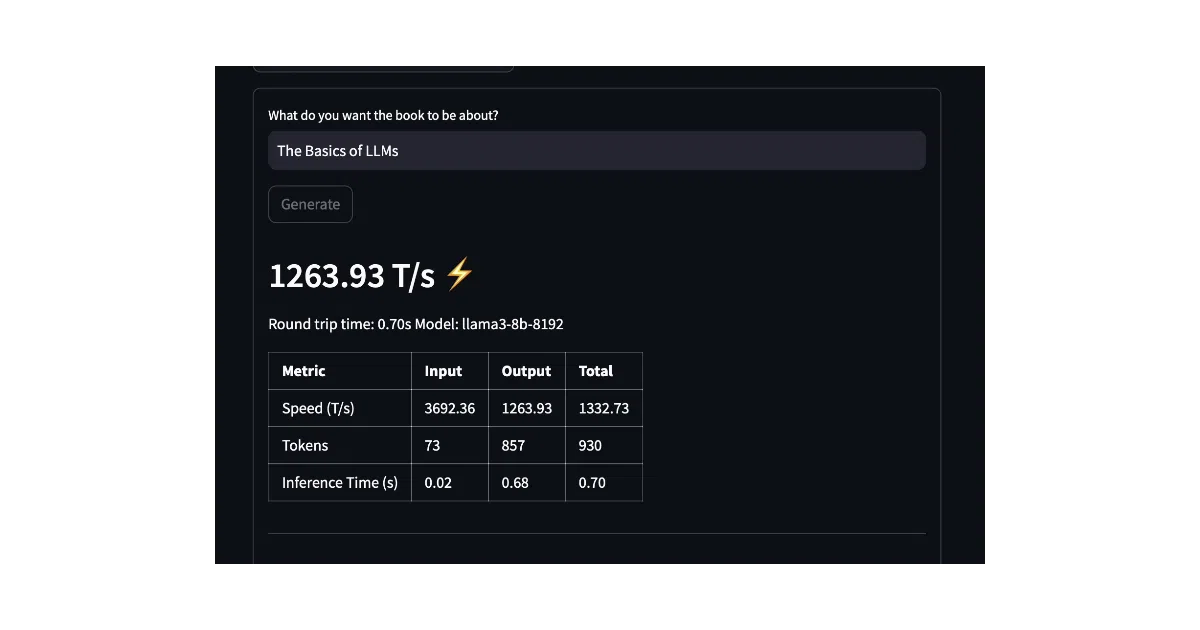
Infinite Bookshelf is a Streamlit app that takes a single prompt—“The Basics of Large Language Models,” say—and generates a structured, multi-chapter book in seconds. It outputs markdown-formatted text with tables and code blocks, viewable in-browser and downloadable as text or styled PDF. The hosted version runs at infinite.benjamin.sh; local setup requires a Groq API key and standard Python venv ritual.
The interesting bit
The app uses two Llama models in a tag-team: a larger one plans the book structure, a smaller one races through chapter content. This split is the actual engineering decision—trading coherence for speed, since each chapter currently sees only its own title as context, not the full book. The README is upfront that this is why fiction still flops.
Key highlights
- Scaffolded prompting switches between model sizes to balance generation speed against outline quality
- Markdown-native output with code examples and tables, rendered in Streamlit
- Download options: plain text or styled PDF (added in v0.3.0)
- Hosted version available; local install is standard Python venv +
pip install -r requirements.txt - Inference statistics surfaced in the UI since v0.2.0
Caveats
- The README explicitly warns: “may generate inaccurate information or placeholder content” and labels output “for entertainment purposes only”
- Windows local install may require GTK3 runtime, an extra dependency not mentioned for other platforms
- Fiction generation is acknowledged as weak due to limited cross-chapter context
Verdict
Worth a spin if you need quick scaffolding for tutorials, documentation drafts, or novelty content. Skip it if you need factual reliability or narrative coherence across long-form work—the project itself admits both are currently out of scope.
Frequently asked
- What is Bklieger/infinite-bookshelf?
- A Streamlit app that generates complete nonfiction books from one-line prompts using Groq's fast Llama inference.
- Is infinite-bookshelf open source?
- Yes — Bklieger/infinite-bookshelf is open source, released under the MIT license.
- What language is infinite-bookshelf written in?
- Bklieger/infinite-bookshelf is primarily written in Python.
- How popular is infinite-bookshelf?
- Bklieger/infinite-bookshelf has 1.4k stars on GitHub.
- Where can I find infinite-bookshelf?
- Bklieger/infinite-bookshelf is on GitHub at https://github.com/Bklieger/infinite-bookshelf.