Armur-Ai/Pentest-Swarm-AI
When your pentest agents stop taking orders and start taking initiative
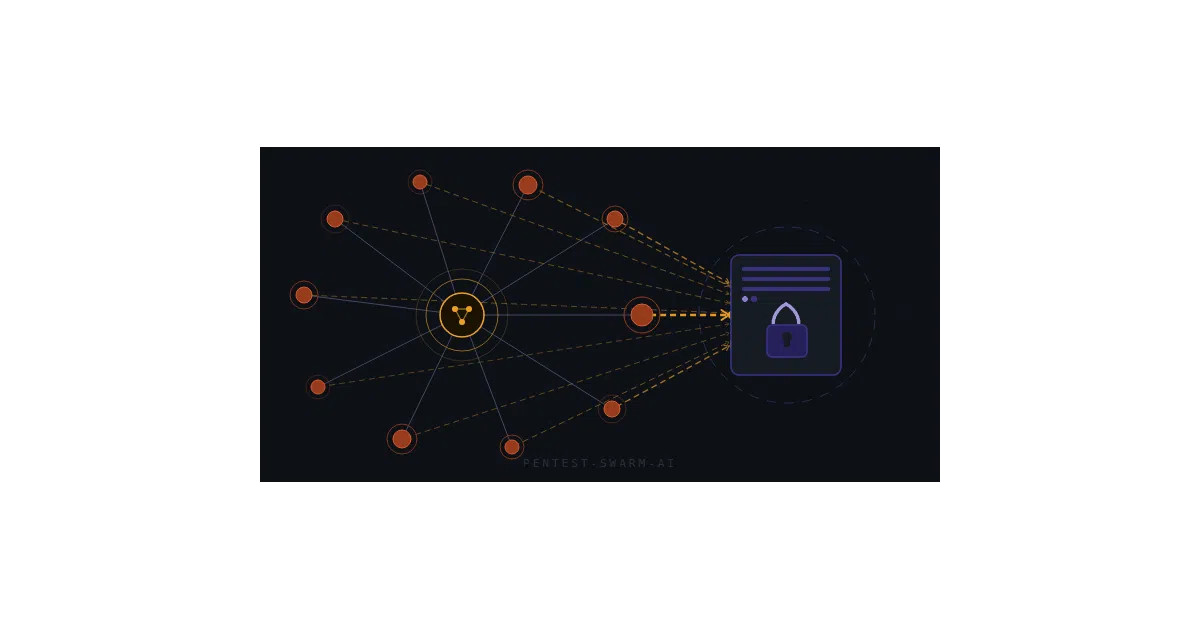
A Go-based offensive-security framework that swaps the usual LLM pipeline for a stigmergic blackboard where recon, classify, exploit, and report agents wake each other up like ants finding sugar.
Velocity · 7d
+4.9
★ / day
Trend
↘cooling
star history
What it does
Pentest Swarm AI runs autonomous penetration tests by coordinating specialist agents through a shared Postgres-backed blackboard. Recon agents feed findings with decaying “pheromone” weights; classification, exploitation, and reporting agents trigger themselves when the board state matches their predicates. It wraps eight ProjectDiscovery tools plus nmap, speaks Claude or any OpenAI-compatible model, and outputs markdown, HTML, JSON, or SARIF.
The interesting bit
The authors are almost more interested in taxonomy than exploits. Their core claim — backed by a detailed comparison table — is that every other “multi-agent” pentest tool is actually a pipeline with a central planner. They built stigmergy (indirect coordination via environment), emergence (unplanned attack chains), and decentralization (self-triggering agents) from scratch because, they argue, nobody else had. The pheromone decay is configurable per finding type: ports stay hot for hours, sessions for minutes.
Key highlights
- Real swarm architecture: no central orchestrator rewrites needed to add agents
- Scope enforcement at both tool and executor layers; cleanup registry runs on SIGINT, crash, or budget exhaustion
- Claude prompt caching enabled by default for recon and classifier to cut API costs
--strictmode promotes LLM errors to fatal crashes rather than silent hallucinations- AGPL 3.0; alpha status with a public implementation plan and honest feature-status labels
Caveats
- The stigmergic swarm scheduler itself is alpha; the stable default is still the sequential 5-phase runner
- Benchmark numbers are explicitly promised for a future release, not yet shipped
- Postgres blackboard backend is beta; the memory-backed version is what currently runs
Verdict
Security researchers and red-teamers who want to experiment with decentralized agent coordination should watch this closely. If you need a battle-tested autonomous pentest tool today, the sequential mode works but the swarm is still a research direction — albeit a well-documented one.
Frequently asked
- What is Armur-Ai/Pentest-Swarm-AI?
- A Go-based offensive-security framework that swaps the usual LLM pipeline for a stigmergic blackboard where recon, classify, exploit, and report agents wake each other up like ants finding sugar.
- Is Pentest-Swarm-AI open source?
- Yes — Armur-Ai/Pentest-Swarm-AI is open source, released under the AGPL-3.0 license.
- What language is Pentest-Swarm-AI written in?
- Armur-Ai/Pentest-Swarm-AI is primarily written in Go.
- How popular is Pentest-Swarm-AI?
- Armur-Ai/Pentest-Swarm-AI has 3k stars on GitHub and is currently cooling off.
- Where can I find Pentest-Swarm-AI?
- Armur-Ai/Pentest-Swarm-AI is on GitHub at https://github.com/Armur-Ai/Pentest-Swarm-AI.