Amm1rr/WebAI-to-API
Your browser's AI, now pretending to be an API
Wraps browser-based LLMs in an OpenAI-compatible server so your existing tools can talk to Gemini without knowing it's really just scraping the web UI.
Not currently ranked — collecting fresh signals.
star history
What it does
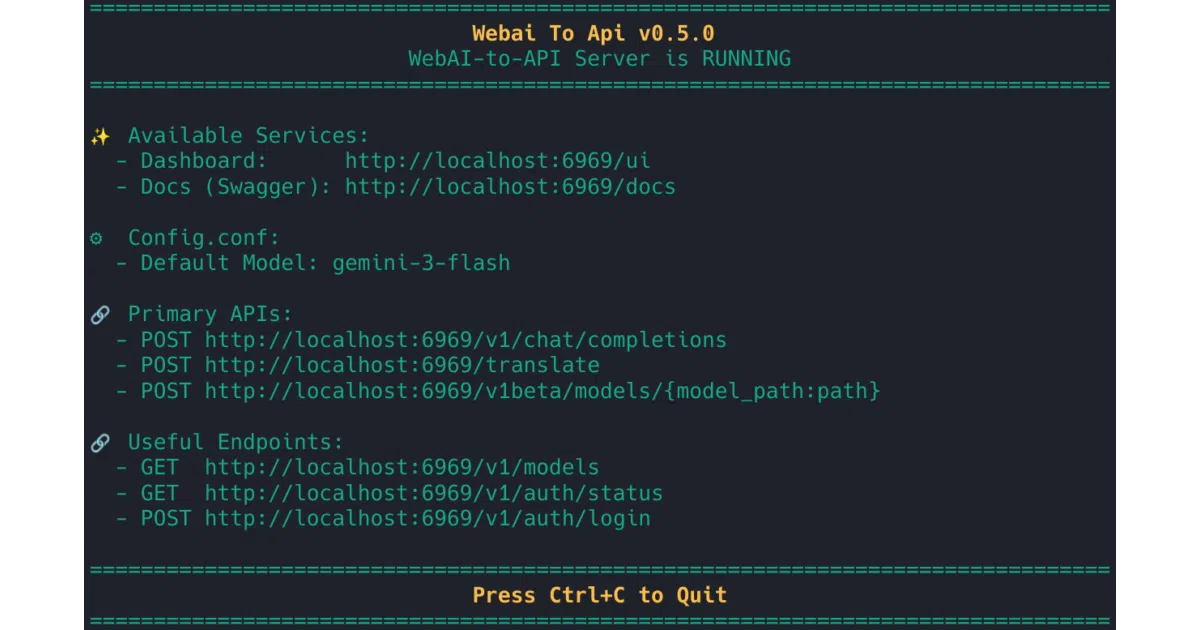
WebAI-to-API is a FastAPI server that sits between your code and browser-native AI services, primarily Google Gemini. It exposes an OpenAI-compatible /v1/chat/completions endpoint, plus a few native ones like /gemini-chat for persistent sessions. The project also bundles a secondary gpt4free-powered server as fallback, and offers a direct Atlas Cloud integration for when you want actual API reliability instead of browser puppetry.
The interesting bit
The architecture is deliberately thin: a single chat.py orchestrator delegates to provider-specific modules that each handle their own “transformation and streaming quirks.” For Gemini specifically, it can operate in two modes — a lightweight WebAPI backend using your browser cookies, or a full Playwright browser automation runtime. The cookie-based path is the clever hack: it piggybacks on your existing browser session to avoid API keys entirely, with automatic cookie retrieval via browser_cookies3 if you leave the config blank.
Key highlights
- OpenAI-compatible streaming and chat completions, including system prompts and conversation history
- Three operational modes: cookie-based Gemini WebAPI, Playwright browser runtime, Atlas Cloud direct API, plus gpt4free fallback
- Atomic, non-blocking config persistence for rotated cookies and runtime state changes
- SQLite-backed conversation snapshots for the WebAPI backend, with list/delete endpoints
- Dual licensing: AGPLv3 from v0.5.0 onward, MIT for earlier versions, with commercial licensing available
Caveats
- The README’s “research and educational purposes only” disclaimer and anti-commercial warning sits awkwardly next to the project’s own commercial licensing offer and Atlas Cloud sponsorship
- Conversation management endpoints (list, delete) only work for Gemini WebAPI SQLite snapshots; Playwright and Atlas conversations are explicitly unsupported
- Token counts in responses are hardcoded to zero, so any usage tracking or billing logic you layer on top will need its own accounting
Verdict
Worth a look if you need a quick, keyless way to pipe Gemini into OpenAI-shaped tools for personal prototyping. Skip it if you need production reliability, actual usage metrics, or a licensing story that doesn’t require reading two contradictory paragraphs.
Frequently asked
- What is Amm1rr/WebAI-to-API?
- Wraps browser-based LLMs in an OpenAI-compatible server so your existing tools can talk to Gemini without knowing it's really just scraping the web UI.
- Is WebAI-to-API open source?
- Yes — Amm1rr/WebAI-to-API is open source, released under the MIT license.
- What language is WebAI-to-API written in?
- Amm1rr/WebAI-to-API is primarily written in Python.
- How popular is WebAI-to-API?
- Amm1rr/WebAI-to-API has 1.4k stars on GitHub.
- Where can I find WebAI-to-API?
- Amm1rr/WebAI-to-API is on GitHub at https://github.com/Amm1rr/WebAI-to-API.