Akegarasu/lora-scripts
The honest glue layer between you and kohya-ss
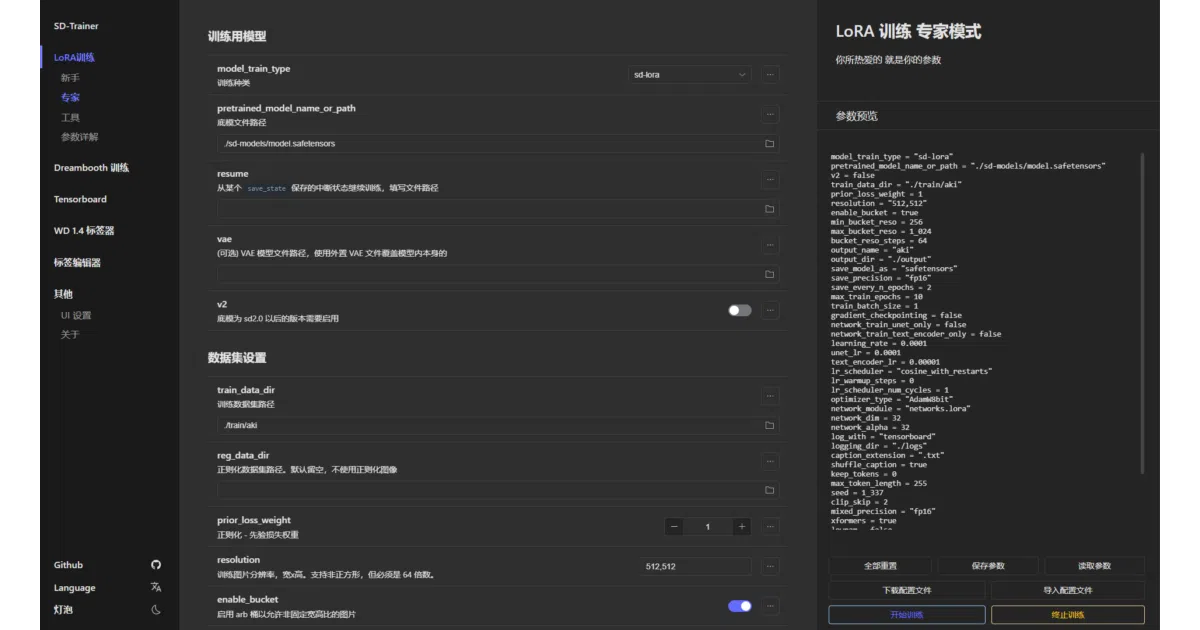
It wraps the finicky kohya-ss/sd-scripts trainer in a WebUI and preset environment so you can train LoRAs and Dreambooth models without editing shell scripts.
Not currently ranked — collecting fresh signals.
star history
What it does
SD-Trainer is a convenience wrapper around the well-known kohya-ss/sd-scripts training engine. It provides a local WebUI — plus bundled install scripts — for training LoRA and Dreambooth models on Stable Diffusion. The interface also folds in TensorBoard, a WD 1.4 tagger, and a tag editor so your dataset prep stays in the same browser tab.
The interesting bit
The README is remarkably upfront: this is a “preset & one key training environment,” not a reinvention of the wheel. The new WebUI bills itself as the “REAL Stable Diffusion Training Studio,” but the real value is simply stopping you from hand-editing train.sh and managing virtualenvs by hand.
Key highlights
- All-in-one WebUI running on
127.0.0.1:28000with training, tagging, and TensorBoard under one roof. - Platform-specific install scripts for Windows and Linux that handle venv creation.
- Still exposes legacy manual scripts for terminal-first workflows.
- Can disable components like TensorBoard or the tag editor via CLI flags.
- Runs fully offline on localhost by default, with an optional
--listenmode.
Caveats
- The README is thin on architectural detail; it never clarifies what the GUI adds beyond exposing kohya’s existing arguments.
- Linux legacy training requires manual venv activation, while the Windows path handles it automatically — the convenience layer is uneven.
Verdict
Good for Stable Diffusion hobbyists who want to train LoRAs without memorizing kohya’s CLI flags. Skip it if you already have a scripted training pipeline you like or need deep customization beyond what a preset wrapper exposes.
Frequently asked
- What is Akegarasu/lora-scripts?
- It wraps the finicky kohya-ss/sd-scripts trainer in a WebUI and preset environment so you can train LoRAs and Dreambooth models without editing shell scripts.
- Is lora-scripts open source?
- Yes — Akegarasu/lora-scripts is open source, released under the AGPL-3.0 license.
- What language is lora-scripts written in?
- Akegarasu/lora-scripts is primarily written in Python.
- How popular is lora-scripts?
- Akegarasu/lora-scripts has 6.2k stars on GitHub.
- Where can I find lora-scripts?
- Akegarasu/lora-scripts is on GitHub at https://github.com/Akegarasu/lora-scripts.