AkaliKong/MiniOneRec
Generative recommendation via semantic token prediction
MiniOneRec open-sources the full pipeline for treating recommendation as language modeling, from product quantization to GRPO-based reinforcement learning.
Not currently ranked — collecting fresh signals.
star history
What it does
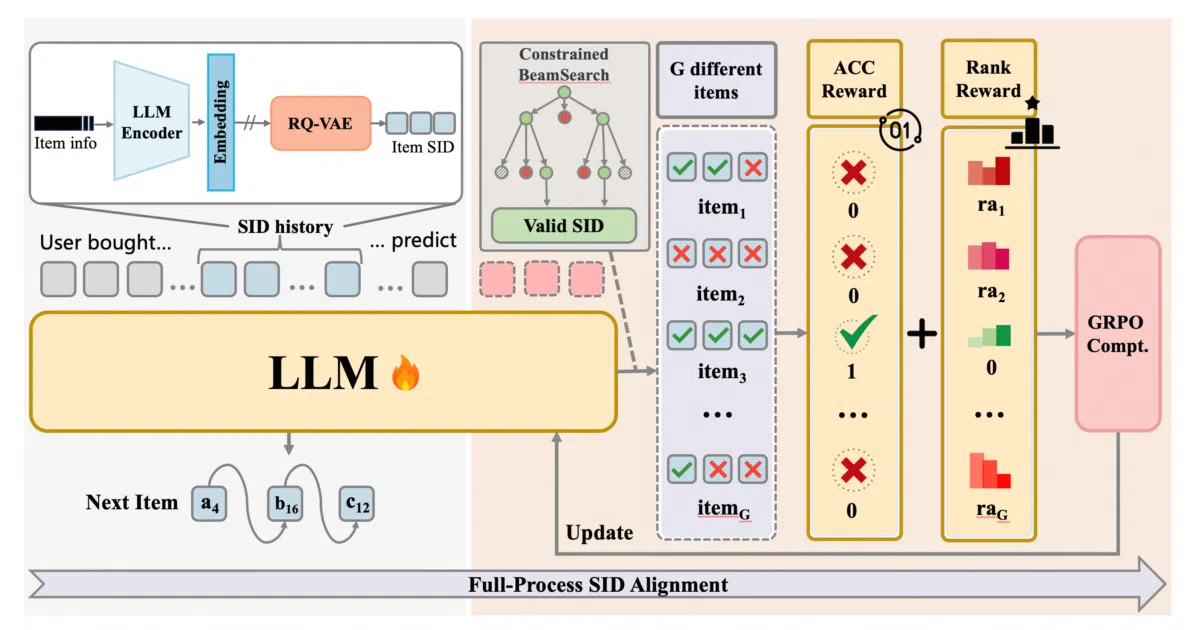
MiniOneRec treats recommendation as next-token prediction. It compresses each product—title, description, and all—into a compact Semantic ID using a three-level RQ-VAE quantizer. An LLM then learns to continue a user’s chronologically ordered history, and a subsequent GRPO phase refines the policy with recommendation-specific rewards.
The interesting bit
Because the action space is a closed catalog of item tokens, the system uses constrained beam search to ensure every generated recommendation is a valid, unique product. That neatly avoids the classic generative-recommender failure mode of hallucinating items that do not exist.
Key highlights
- End-to-end open-source pipeline covering SID construction, supervised fine-tuning, and RL
- Semantic IDs derived from frozen text-encoder embeddings rather than arbitrary indices
- GRPO training with group-normalized rewards, a KL penalty, and rank-aware penalties for incorrect high-probability items
- Constrained decoding guarantees valid and unique beam outputs
- Targets heavy hardware: expects 4–8 A100/H100 GPUs for reproduction
Caveats
- Reproducibility rough edges exist: constrained decoding can break with Instruct-tuned models, producing invalid items; the authors suspect
transformerslibrary drift and currently recommend switching to base models likeQwen2.5-base - The data pipeline and preprocessing scripts are tightly bound to Amazon review datasets (2018/2023), so bringing your own catalog requires writing new adapters
Verdict
A solid reference for researchers exploring LLM-based recommendation. Production teams without a rack of A100s should look elsewhere.
Frequently asked
- What is AkaliKong/MiniOneRec?
- MiniOneRec open-sources the full pipeline for treating recommendation as language modeling, from product quantization to GRPO-based reinforcement learning.
- Is MiniOneRec open source?
- Yes — AkaliKong/MiniOneRec is open source, released under the Apache-2.0 license.
- What language is MiniOneRec written in?
- AkaliKong/MiniOneRec is primarily written in Python.
- How popular is MiniOneRec?
- AkaliKong/MiniOneRec has 1.9k stars on GitHub.
- Where can I find MiniOneRec?
- AkaliKong/MiniOneRec is on GitHub at https://github.com/AkaliKong/MiniOneRec.