AgnostiqHQ/covalent
Swap a decorator, run Python on SLURM, AWS, or a quantum rig
Covalent exists so AI/ML researchers can move Python jobs from laptop to SLURM or the cloud by changing one decorator, not rewriting code or touching Terraform.
Not currently ranked — collecting fresh signals.
star history
What it does
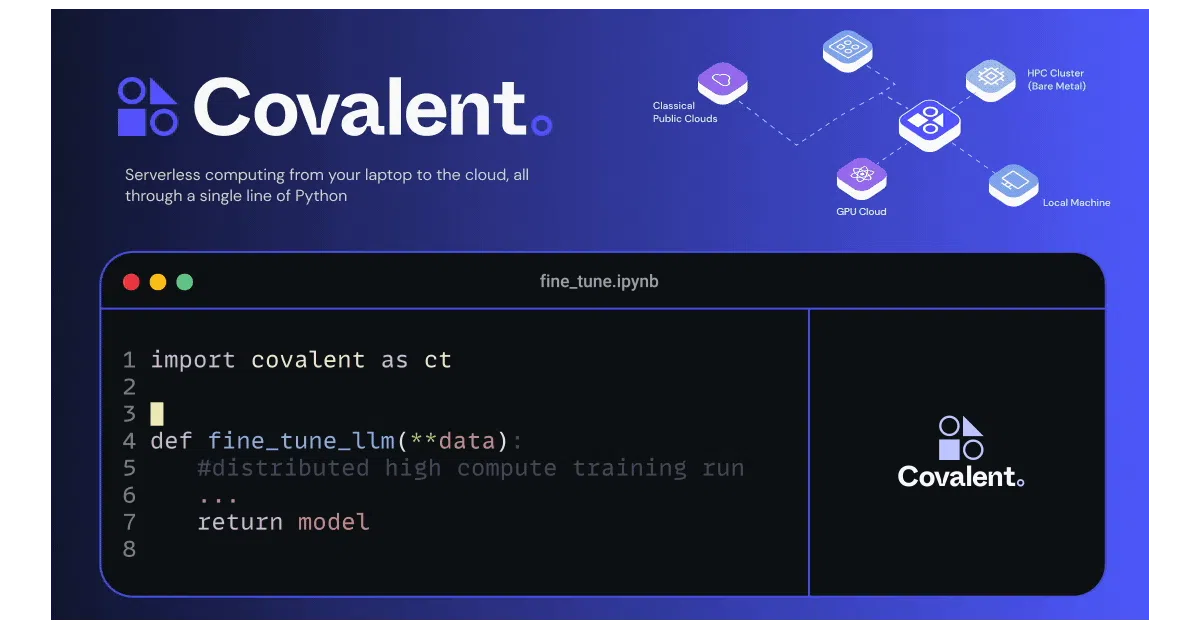
Covalent is a Python workflow orchestrator that wraps functions in decorators to dispatch compute jobs across heterogeneous environments. You write ordinary Python, swap the executor decorator, and the job runs on a local machine, an on-prem SLURM cluster, or a cloud provider like AWS, GCP, or Azure. A built-in web UI tracks execution in real time, so you get observability without building your own dashboards.
The interesting bit
The core trick is treating infrastructure backends as interchangeable executor plugins. Instead of writing deployment manifests or SSH scripts, you decorate a function and let Covalent handle the transport, turning clusters and cloud instances into what it calls a “serverless” target. It is essentially glue code, but it is glue code that spares you from writing yet another Terraform wrapper.
Key highlights
- Decorator-based dispatch to AWS, Azure, GCP, Kubernetes, SLURM, Dask, and IBM Quantum.
- Claims to abstract cloud consoles, Terraform, and other infrastructure-as-code tooling.
- Web UI for real-time workflow monitoring (there is a live demo).
- Plugin ecosystem with a template for adding custom backends.
- Apache 2.0 licensed; actively maintained with documented release history.
Caveats
- The claim that it “automatically converts any infrastructure… into a serverless setup” is vague; the README does not clarify what agents, sidecars, or cluster prerequisites are required.
- “Changing just a single line of code” is marketing shorthand for swapping a decorator; you will still need to manage executor plugins and cloud credentials separately.
Verdict
Worth a look if you are a Python-first AI/ML researcher or data scientist who frequently bounces between local prototyping and institutional HPC or cloud clusters. If you already live inside Kubernetes with Argo or Airflow and love YAML, this probably will not displace your stack.
Frequently asked
- What is AgnostiqHQ/covalent?
- Covalent exists so AI/ML researchers can move Python jobs from laptop to SLURM or the cloud by changing one decorator, not rewriting code or touching Terraform.
- Is covalent open source?
- Yes — AgnostiqHQ/covalent is open source, released under the Apache-2.0 license.
- What language is covalent written in?
- AgnostiqHQ/covalent is primarily written in Python.
- How popular is covalent?
- AgnostiqHQ/covalent has 868 stars on GitHub.
- Where can I find covalent?
- AgnostiqHQ/covalent is on GitHub at https://github.com/AgnostiqHQ/covalent.