AILab-CVC/UniRepLKNet
Large-kernel ConvNets stage a comeback across modalities
UniRepLKNet tests whether ConvNets can match Transformers' universal perception by scaling kernel sizes instead of attention heads.
Not currently ranked — collecting fresh signals.
star history
What it does UniRepLKNet is a family of large-kernel convolutional networks built to handle vision, audio, and time-series tasks with a single architecture. The authors propose four design guidelines that exploit the essential characteristic of large kernels—seeing wide without going deep—then apply the same backbone, with only minimal preprocessing changes, to image recognition, detection, segmentation, audio recognition, and global weather forecasting. It inherits structural re-parameterization from the RepVGG lineage, so training-time branches fold away at inference.
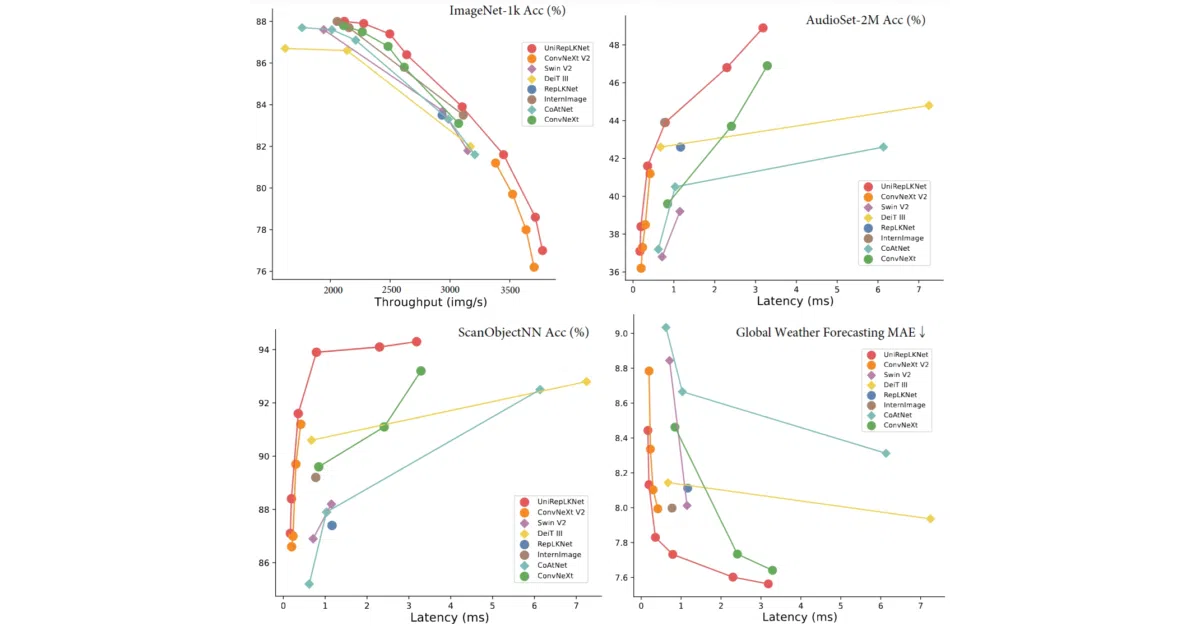
The interesting bit The pitch is that large kernels unlock multimodal performance in domains where CNNs traditionally struggle; the README specifically claims state-of-the-art results on global temperature and wind-speed forecasting, plus audio recognition, using the same backbone that hits 88.0% on ImageNet. That is either a genuine architectural insight or the kernels are now large enough to accidentally overlap with other modalities.
Key highlights
- ImageNet-1K accuracy up to 88.0%, COCO box AP of 56.4, and ADE20K mIoU of 55.6 with ImageNet-22K pretraining, per the README tables.
- Authors claim higher actual speed and accuracy than recent models like ConvNeXt v2 and InternImage.
- Supports structural re-parameterization: training-time auxiliary branches collapse into a single inference path, keeping deployment simple.
- Integrates with
timm, MMDetection, and MMSegmentation; weights auto-download via Hugging Face. - Scales from a 4.4M-parameter variant up to a 386M-parameter model.
Caveats
unireplknet.pycarries optional MMDetection and MMSegmentation integration code that you will need to strip out if you are not using those frameworks.- The README is rich with vision benchmark tables but sparse on details about the audio and time-series preprocessing required for the multimodal claims.
Verdict Worth a look if you want a ConvNet backbone that refuses to die and claims to work across modalities, or if you are curious about structural re-parameterization. Skip it if you are already all-in on vision transformers and allergic to kernel-size tuning.
Frequently asked
- What is AILab-CVC/UniRepLKNet?
- UniRepLKNet tests whether ConvNets can match Transformers' universal perception by scaling kernel sizes instead of attention heads.
- Is UniRepLKNet open source?
- Yes — AILab-CVC/UniRepLKNet is open source, released under the Apache-2.0 license.
- What language is UniRepLKNet written in?
- AILab-CVC/UniRepLKNet is primarily written in Python.
- How popular is UniRepLKNet?
- AILab-CVC/UniRepLKNet has 1.1k stars on GitHub.
- Where can I find UniRepLKNet?
- AILab-CVC/UniRepLKNet is on GitHub at https://github.com/AILab-CVC/UniRepLKNet.