AI4Finance-Foundation/FinGPT
Beating million-dollar finance LLMs on a single GPU
FinGPT offers lightweight, open-source financial LLMs and datasets as an alternative to million-dollar proprietary training runs like BloombergGPT.
Velocity · 7d
+7.4
★ / day
Trend
↗accelerating
star history
What it does
FinGPT is a collection of open-source financial large language models and datasets maintained by the AI4Finance Foundation. It provides instruction-tuned models for tasks like sentiment analysis, headline classification, relation extraction, and stock-price forecasting, all distributed via HuggingFace. The project explicitly positions itself as an accessible counterpoint to proprietary efforts, emphasizing low-cost fine-tuning rather than training foundation models from scratch.
The interesting bit
The project leans heavily on parameter-efficient fine-tuning—specifically LoRA and QLoRA—to squeeze competitive performance out of consumer hardware. According to their own benchmarks, a LoRA-tuned Llama2-13b model running on a single RTX 3090 for 17.25 hours (costing roughly $17.25) outperformed GPT-4 and BloombergGPT on several financial sentiment analysis datasets, though the comparison omits some datasets for the commercial models.
Key highlights
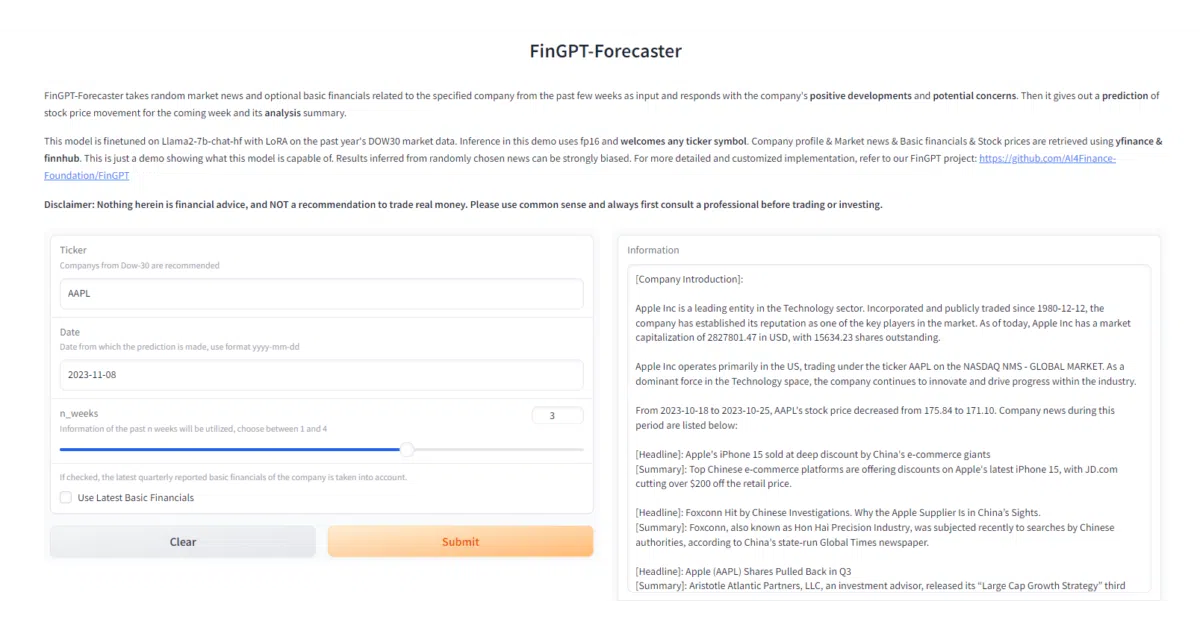
- Releases include FinGPT-Forecaster, a demo model that ingests ticker symbols, recent news, and basic financials to predict next-week price movement.
- Publishes multiple instruction-tuning datasets (sentiment, NER, QA, relation extraction) and multi-task financial LLMs on HuggingFace.
- Benchmarks claim a sub-$300 cost for fine-tuning, compared to the ~$3 million price tag cited for BloombergGPT.
- Several associated papers have been accepted at NeurIPS workshops, IJCAI, and ICAIF.
- Models are trained with 8-bit and 4-bit quantization methods so they fit on single consumer GPUs.
Caveats
- The repo reads more like a portfolio of separate research experiments (Forecaster, Sentiment v3, Benchmark) than a unified framework.
- The README notes that a detailed tutorial for reproducing benchmark results is “on the way,” suggesting some documentation remains incomplete.
- Benchmark comparisons against GPT-4 and BloombergGPT use different dataset coverage; several cells are blank for the proprietary models.
Verdict
Worth exploring if you are a researcher or quant developer looking for pre-trained financial LLMs and curated datasets without enterprise infrastructure. If you need a single, polished end-to-end product with guaranteed production support, this is still an academic research project.
Frequently asked
- What is AI4Finance-Foundation/FinGPT?
- FinGPT offers lightweight, open-source financial LLMs and datasets as an alternative to million-dollar proprietary training runs like BloombergGPT.
- Is FinGPT open source?
- Yes — AI4Finance-Foundation/FinGPT is open source, released under the MIT license.
- What language is FinGPT written in?
- AI4Finance-Foundation/FinGPT is primarily written in Jupyter Notebook.
- How popular is FinGPT?
- AI4Finance-Foundation/FinGPT has 21.5k stars on GitHub and is currently accelerating.
- Where can I find FinGPT?
- AI4Finance-Foundation/FinGPT is on GitHub at https://github.com/AI4Finance-Foundation/FinGPT.