A-EVO-Lab/a-evolve
A universal harness that mutates agent files to improve them
It treats an agent's workspace as an evolvable genome, automatically mutating prompts and skills across benchmark-gated generations.
Velocity · 7d
+22
★ / day
Trend
↗accelerating
star history
What it does
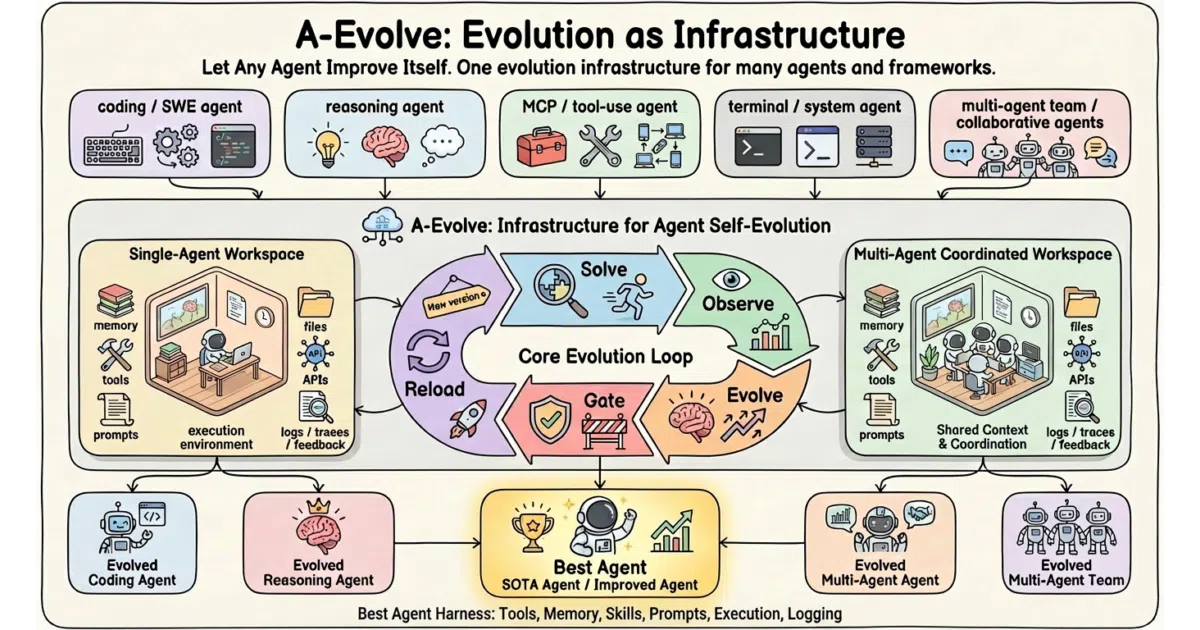
A-Evolve is an open-source Python infrastructure that runs an autonomous improvement loop on LLM agents. You point it at an agent workspace—a standard directory of prompts, skills, memory, and configuration files—and it iteratively mutates those files based on benchmark feedback, rolling back regressions via git tags. The project ships with built-in adapters for benchmarks like SWE-bench Verified, MCP-Atlas, and Terminal-Bench 2.0, and reports pushing a base Claude Opus-4.6 model to top-tier results with zero manual harness engineering.
The interesting bit
The core insight is the file-system contract: instead of tweaking weights or architectures, A-Evolve treats the agent’s entire state as a directory tree that an LLM can rewrite. This decouples the evolution engine from the agent’s internals—your agent just needs to reload its files after each cycle—making the framework agnostic to what actually runs inside the black box.
Key highlights
- Reported top-tier results evolving a single base model, including #1 on MCP-Atlas (79.4%), ~#5 on SWE-bench Verified (76.8%), and #2 on SkillsBench (34.9%).
- Every accepted mutation is git-tagged (
evo-1,evo-2, …) and regressed mutations are rolled back automatically after holdout validation. - The evolution engine operates entirely through file-system mutations—prompts,
SKILL.mdfiles, and memory JSONL—so the agent itself remains a black box. - Ships with built-in seed workspaces and benchmark adapters for software engineering, terminal operations, tool-calling, and skill discovery.
Caveats
- Several benchmark slots (CL Bench, WebArena-infinity) are still marked “To Be Announced,” so the coverage picture is incomplete.
- The “any agent, any domain” promise requires strict adoption of the project’s file-system workspace contract, which may not map cleanly to agents with heavy internal state.
- The README notes results were checked March 2026—a date that has not yet occurred—so treat the timeline as aspirational or a typo.
Verdict
Researchers and framework builders who want to automate prompt and skill optimization across standardized benchmarks should look here; if your agent can’t easily externalize its entire state to a directory of markdown and JSONL files, the “universal” label won’t apply to you.
Frequently asked
- What is A-EVO-Lab/a-evolve?
- It treats an agent's workspace as an evolvable genome, automatically mutating prompts and skills across benchmark-gated generations.
- Is a-evolve open source?
- Yes — A-EVO-Lab/a-evolve is an open-source project tracked on heatdrop.
- What language is a-evolve written in?
- A-EVO-Lab/a-evolve is primarily written in Python.
- How popular is a-evolve?
- A-EVO-Lab/a-evolve has 827 stars on GitHub and is currently accelerating.
- Where can I find a-evolve?
- A-EVO-Lab/a-evolve is on GitHub at https://github.com/A-EVO-Lab/a-evolve.