666ghj/BettaFish
Built-from-scratch agent swarm for Chinese public-opinion deep dives
A framework-free Python multi-agent system built to scrape, debate, and report on public sentiment across 30+ Chinese and international social platforms.
Velocity · 7d
+10
★ / day
Trend
→steady
star history
What it does
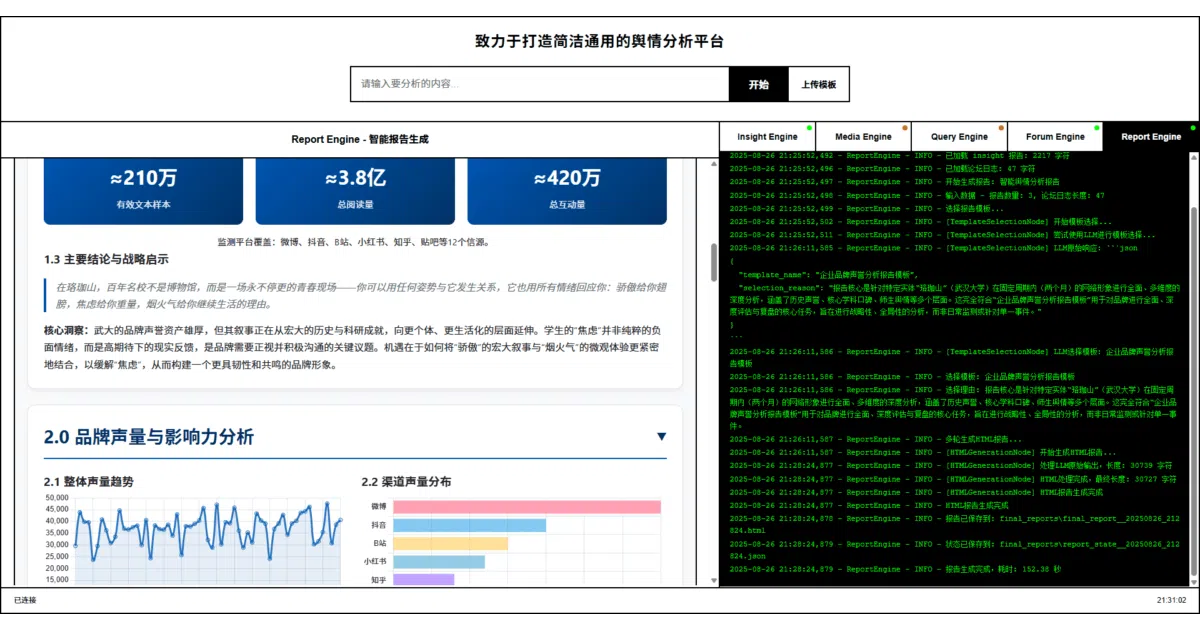
BettaFish is a pure-Python multi-agent system that takes a natural-language query and autonomously researches public opinion across social media platforms like Weibo, Xiaohongshu, Douyin, and Kuaishou. It dispatches specialized agents for web search, multimodal video and image analysis, private database mining, and report generation, then renders the findings into an interactive HTML report. The whole thing is built from scratch without relying on LangChain, LlamaIndex, or similar frameworks.
The interesting bit
The agents do not just work in parallel; they talk to each other. A dedicated ForumEngine moderates a multi-round debate where agents present findings, challenge assumptions, and adjust their research direction based on the discussion, aiming to reduce the groupthink that often homogenizes single-model output. The system also mixes in fine-tuned models and statistical middleware rather than trusting a single LLM to do all the reasoning.
Key highlights
- Framework-free implementation: every agent, node, and tool is handwritten Python, not a wrapper around an existing orchestration library.
- Multimodal scraping: it parses short-video platforms and extracts structured cards—weather, stocks, calendars—from modern search engines.
- Private data bridge: includes secure interfaces to fuse external public-opinion data with internal business databases.
- Agent debate loop: a moderator model runs chained discussion rounds between agents before the final report is synthesized.
- Modular engines:
QueryEngine,MediaEngine,InsightEngine, andReportEngineare cleanly separated with their own prompts, state management, and toolsets.
Caveats
- The README trumpets “six major advantages” and “break information cocoons” but never supplies benchmarks, accuracy metrics, or comparative data to back them up.
- It is unclear how the crawler layer handles rate limiting or anti-bot defenses on the 30+ platforms it claims to cover.
- While the code structure is modular, the provided examples and default toolsets center almost entirely on Chinese social-media platforms.
Verdict
Worth a look if you are building domain-specific agent workflows in Python and want to study a complete, self-contained architecture without framework magic. Skip it if you need a battle-tested, framework-backed orchestrator with mature observability and community plugins.
Frequently asked
- What is 666ghj/BettaFish?
- A framework-free Python multi-agent system built to scrape, debate, and report on public sentiment across 30+ Chinese and international social platforms.
- Is BettaFish open source?
- Yes — 666ghj/BettaFish is open source, released under the GPL-2.0 license.
- What language is BettaFish written in?
- 666ghj/BettaFish is primarily written in Python.
- How popular is BettaFish?
- 666ghj/BettaFish has 42.5k stars on GitHub and is currently holding steady.
- Where can I find BettaFish?
- 666ghj/BettaFish is on GitHub at https://github.com/666ghj/BettaFish.