1sdv/TripStar
Your travel agent now scrapes Xiaohongshu
TripStar turns Chinese social-media travel posts into structured itineraries via multi-agent LLM pipelines.
Velocity · 7d
+2.1
★ / day
Trend
→steady
star history
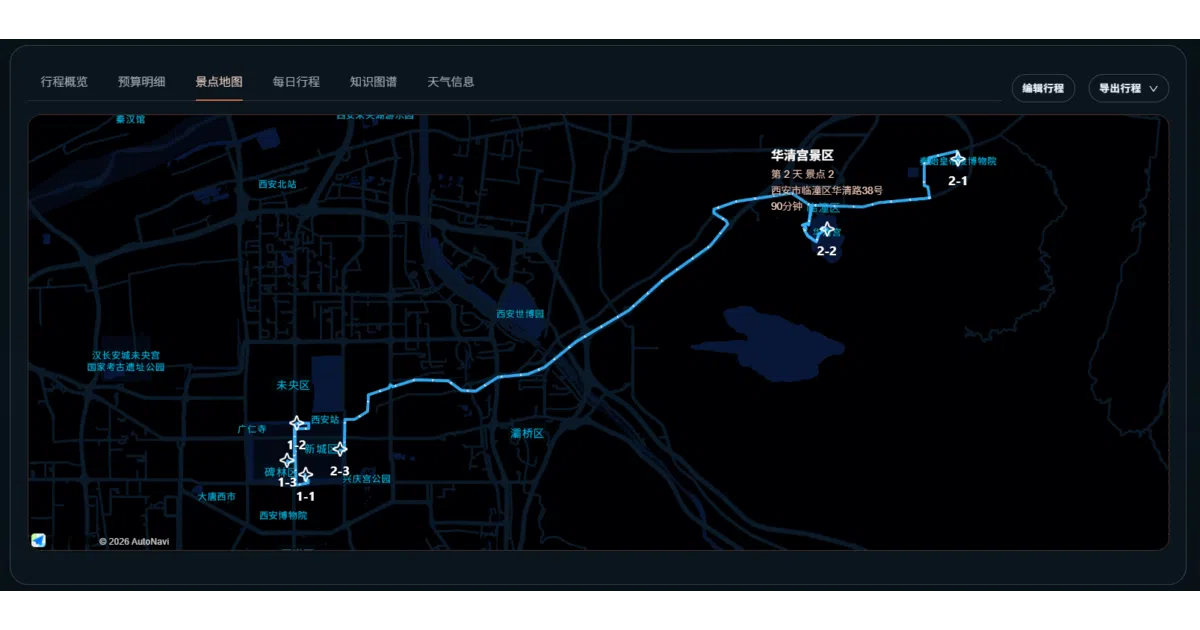
What it does TripStar is a full-stack travel planner that ingests raw Xiaohongshu (Little Red Book) posts, extracts structured sightseeing data with an LLM, then orchestrates weather, hotel, and routing agents to produce a day-by-day itinerary with budgets, maps, and booking reminders. The frontend renders it all in a dark glassmorphism UI with interactive knowledge graphs and a floating chat window for follow-up questions.
The interesting bit The project treats a consumer social platform as its primary travel database. It signs native Xiaohongshu API requests, falls back to SSR scraping, pipes the prose through an LLM prompt to distill JSON arrays of attractions, then geocodes each via Google Maps (falling back to AMap) so the itinerary can be plotted. The README even diagrams a five-stage LLM-output repair pipeline for when the model returns malformed JSON—clean, escape, bracket-fix, brute-force extract, and finally ask the LLM to patch its own mess.
Key highlights
- Multi-agent backend (FastAPI + Vue 3) with async task queues and WebSocket progress streaming to dodge 504 timeouts from long LLM generations.
- Dual-map engine: Google Maps abroad, AMap at home, with automatic geocoding fallback.
- Xiaohongshu integration for both data (LLM-extracted tips, durations, reservation warnings) and images (lazy-loaded first-photo search per POI).
- Multi-language output (CN/EN/JP) propagated through LLM prompts, UI i18n, and knowledge-graph node labels.
- Docker Compose deployment with explicit env-var injection for API keys and proxy settings.
Caveats
- Requires a pile of third-party credentials: LLM key, two AMap keys, Google Maps key (with five enabled APIs, billing card required), and an active Xiaohongshu cookie.
- The README is Chinese-first; English and Japanese versions exist but may lag.
- “HelloAgents framework” is named as the base, but the README does not clarify what that is or how it differs from vanilla LangChain/SmolAgents-style orchestration.
Verdict Worth a spin if you plan travel in China and want an open-source alternative to commercial itinerary apps. Skip it if you lack the patience (or VPN) to harvest Xiaohongshu cookies and Google Cloud billing details.
Frequently asked
- What is 1sdv/TripStar?
- TripStar turns Chinese social-media travel posts into structured itineraries via multi-agent LLM pipelines.
- Is TripStar open source?
- Yes — 1sdv/TripStar is open source, released under the GPL-2.0 license.
- What language is TripStar written in?
- 1sdv/TripStar is primarily written in Vue.
- How popular is TripStar?
- 1sdv/TripStar has 2.5k stars on GitHub and is currently holding steady.
- Where can I find TripStar?
- 1sdv/TripStar is on GitHub at https://github.com/1sdv/TripStar.