rocketride-org/rocketride-server · 08 Oct 2026 · Feature
A C++ Engine Walks Into the Python Orchestration Party

Samantha Lowe
Staff Writer
RocketRide bets that AI pipelines deserve a compiled runtime, portable JSON definitions, and a home inside your IDE rather than a browser tab.
rocketride-org/rocketride-server
★17.8k stars Velocity · 7d +677 ★/day ↗accelerating
star history
The LLM orchestration space has settled into a comfortable shape: Python or TypeScript frameworks, a browser-based canvas if you’re lucky, and a managed cloud that holds your pipelines hostage somewhere behind a login screen. LangChain, LlamaIndex, Haystack — all useful, all variations on the same theme. Into this crowded room walks RocketRide, an open-source pipeline builder and runtime whose most conspicuous choice is the one nobody else made: the engine is written in C++.
That decision is the whole story. It explains what RocketRide is trying to displace, why its founders think the incumbents are structurally misbuilt, and why — two weeks after launch, by their own admission “rough around the edges” — it’s worth paying attention to anyway.
The bet: throughput, not demos
RocketRide’s positioning page is unusually blunt about its target. It describes the competition as “Python workflow wrappers with cloud orchestration UIs” — a swipe that lands on most of the category. The claim underneath the swagger is that when you push concurrent workloads through Python- and TypeScript-based harnesses, they “silently drop data or crash,” while the C++ runtime reports zero lost items, zero errors, and fault isolation on every benchmark run.
Those numbers come from the project’s own benchmark repository, which publishes reproducible comparisons against LangChain, so treat them as a vendor’s benchmarks until someone independent runs them. But the architectural argument stands on its own. AI pipelines are, at bottom, data pipelines with expensive I/O at the ends — LLM calls, vector searches, OCR passes — and a multithreaded native runtime is a genuinely different substrate than an interpreter with a GIL. The project also claims full process isolation, so one agent’s failure doesn’t cascade across a fleet. Whether that matters at your scale is a fair question; that it matters at some scale is not really disputed.
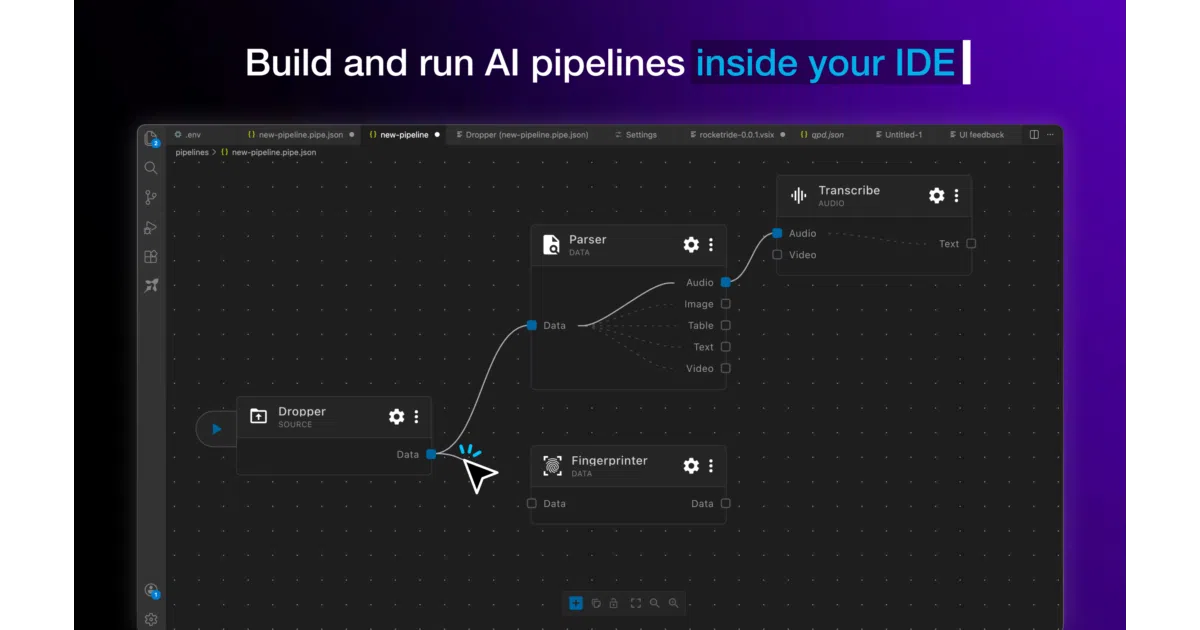
The boring part is where the value usually hides, and here the boring part is the pipeline definition itself. Every RocketRide pipeline is a single declarative JSON artifact — a .pipe file, rendered as a visual canvas by the IDE extension but readable, diffable, and version-controllable as plain text. Swap a model provider or a vector database and, per the project, you change configuration rather than refactoring code. That’s the kind of unglamorous promise that sounds obvious and turns out to be rare: most orchestration tools entangle your workflow logic with their SDK idioms, which is precisely the “framework glue code and tribal knowledge” RocketRide says it wants to eliminate.
Why the field is shaped the way it is
To see what RocketRide is arguing against, it helps to look at how the orchestration layer got defined. IBM’s primer on LLM orchestration frames it as the “backbone” of the LLM application stack — the thing that manages prompt templates, chains calls, retrieves context, and maintains state across conversations. The frameworks that grew into that backbone were built by ML engineers, in the languages ML engineers live in, and optimized for iteration speed over execution speed. That was the right trade for prototyping. RocketRide’s thesis is that it’s the wrong trade now that nearly nine in ten companies have deployed AI in at least one business function and those workloads are hitting production.
The Dataiku survey behind that statistic also found 95% of data leaders admitting they couldn’t fully trace AI decisions end-to-end if a regulator asked — which is the other half of RocketRide’s pitch. Its observability layer traces tokens, latency, and cost per node, per user, and per team, with spend attributed per pipeline and guardrails against non-work usage. Tracing is table stakes in this category now — MLflow makes the same case for its own tracing and evaluation tooling — but RocketRide’s angle is that observability built into a native runtime from day one beats observability bolted onto a Python harness after the first incident.
The node library, and what it’s actually for
The feature list reads like a checklist of the modern AI stack: 50+ pipeline nodes spanning 13 LLM providers, 8 vector databases, OCR, NER, PII anonymization, chunking strategies, and embedding models, with built-in CrewAI and LangChain support for multi-agent work. The vector-database coverage is the telling part. As AWS’s guide to vector databases lays out, these systems solve three concrete problems — LLMs don’t remember conversations, can’t search private data, and can’t retrieve the right document unaided — and they’ve become the storage-and-retrieval layer of nearly every RAG architecture. The ZenML comparison of ten vector databases shows how fragmented that market is, from managed Pinecone to Rust-based Qdrant to pgvector riding inside Postgres. Eight first-class integrations means the pipeline author picks the store that fits the workload instead of the one their framework happens to support well.
The nodes are Python-extensible, which is a pragmatic concession: the runtime is C++, but the ecosystem of integrations is where Python’s library gravity is an asset, not a liability. It’s a reasonable division of labor — native code for the execution substrate, Python for the long tail of connectors.
IDE-native, and aimed at coding agents
The other deliberate divergence is where the tool lives. Browser-based canvases — n8n, the various cloud workflow UIs — force a context switch: build in the browser, debug in the IDE, deploy somewhere else entirely. RocketRide renders its canvas inside VS Code, with the pipeline JSON sitting in your repository next to the code that consumes it. The Hacker News launch post framed this as eliminating the IDE-to-browser round trip, and one commenter specifically praised the fully local operation.
The more forward-looking hook is what the README calls “coding agent ready.” RocketRide auto-detects Claude, Cursor, and other coding agents, and pipelines can be built, modified, and deployed through natural language. Combined with the MCP server — which exposes pipelines as callable tools for AI assistants — this positions RocketRide less as a tool for developers than as a tool operated by the agents developers increasingly supervise. A declarative JSON artifact is exactly the kind of thing an agent can read, reason about, and edit; a proprietary cloud canvas is not. Whether that’s the real driver or post-hoc framing, it’s the most interesting strategic thread in the project.
The honest caveats
This is a young project wearing its rough edges on its sleeve. The Hacker News launch drew 5 points and 3 comments — attention, not a stampede. The GitHub organization lists nine repositories, five open issues marked “help wanted,” and no public members, which is either a small core team or a privacy setting; the sources don’t say. The top languages are Python and TypeScript, which means the C++ engine is a minority of the codebase by volume — the performance claim rests on the runtime’s role, not on the repo being a C++ project per se.
There are also unresolved tensions. The pitch leans hard on “runs entirely on your own infrastructure” and “data never leaves your machine” — a genuine differentiator in a market where Domo’s survey of orchestration platforms shows the category converging on centralized, governed, often cloud-hosted control planes. Yet RocketRide Cloud is “coming soon,” and a Marketplace is already in preview with eight apps including a pipeline builder, a profiler, and a server monitor. A hosted tier is how open-source infrastructure projects fund themselves, and there’s nothing sinister about it — but “your infrastructure, your data” and “our cloud, our marketplace” are pitches that pull in opposite directions, and how the company reconciles them will say a lot about who it becomes.
The benchmark claims deserve the standard skepticism too. “Correct-by-default concurrency” measured by the project that sells correct-by-default concurrency is a claim, not a finding. The reproducible benchmark repo is the right gesture; independent reproduction is the actual test.
Outlook
RocketRide’s fate probably doesn’t hinge on C++ versus Python. It hinges on whether declarative, portable pipeline artifacts become the standard way teams express AI workflows — the way SQL became the standard way to express queries — or whether pipelines remain framework-specific code that lives and dies with its SDK. If the former, a fast runtime that executes those artifacts anywhere, from laptop to on-prem cluster, is well placed. If the latter, RocketRide is a nicer tool in a category where network effects already favor the incumbents.
The planned move to independent governance under a non-profit foundation, slated for mid-2026, would help on the trust front — enterprise buyers burned by orchestration-layer access-control flaws like the one documented in the 2025 National Vulnerability Database tend to prefer infrastructure they can audit and a vendor they can outlive. And the agentic-authoring story — agents building pipelines through MCP while humans supervise from the IDE — is a credible bet on where the work is heading, not just where it sits today.
For now, the honest summary is this: a small team has built a real engine with a defensible architectural thesis, shipped it with unusual candor about its own immaturity, and entered a market where the incumbents are entrenched but the workloads are outgrowing them. The C++ runtime is the headline. The portable JSON pipeline is the idea that might actually matter.
Sources
- Best LLM Orchestration Frameworks for Enterprises in 2026
- Vector databases for AI agents, RAG, and semantic search on ...
- RocketRide
- What is LLM Orchestration?
- Embeddings, Vector database Agent,, RAG & MCP
- rocketride.org
- Examples of AI Workflow Orchestration for Engineers
- Vector Databases for RAG
- RocketRide – Build and run AI/data pipelines within VS ...
- 10 AI Orchestration Platform Options Compared for 2026
- We Tried and Tested 10 Best Vector Databases for RAG ...
- Marketplace