re4/LibreCode · 15 Jul 2026 · Feature
LibreCode Bets AI Editing Is Native, Local, and Slightly Paranoid

Eleanor Hughes
Senior Editor
A cross-platform .NET editor wraps local Ollama agents around ILSpy decompilers, WASM debuggers, and anti-debug scanners—though its license demands all contributions while forbidding forks.
re4/LibreCode
★82 stars
star history
The modern code editor is mostly a web browser in a trench coat. VS Code, Cursor, and their imitators run on Electron, render HTML, and treat your codebase as fuel for cloud-hosted large language models. LibreCode, built in .NET 10 atop the Avalonia UI framework, rejects both premises. It renders natively. It runs AI locally via Ollama. And it ships with a reverse engineering toolkit deep enough to make a malware analyst pause and look up from Ghidra.
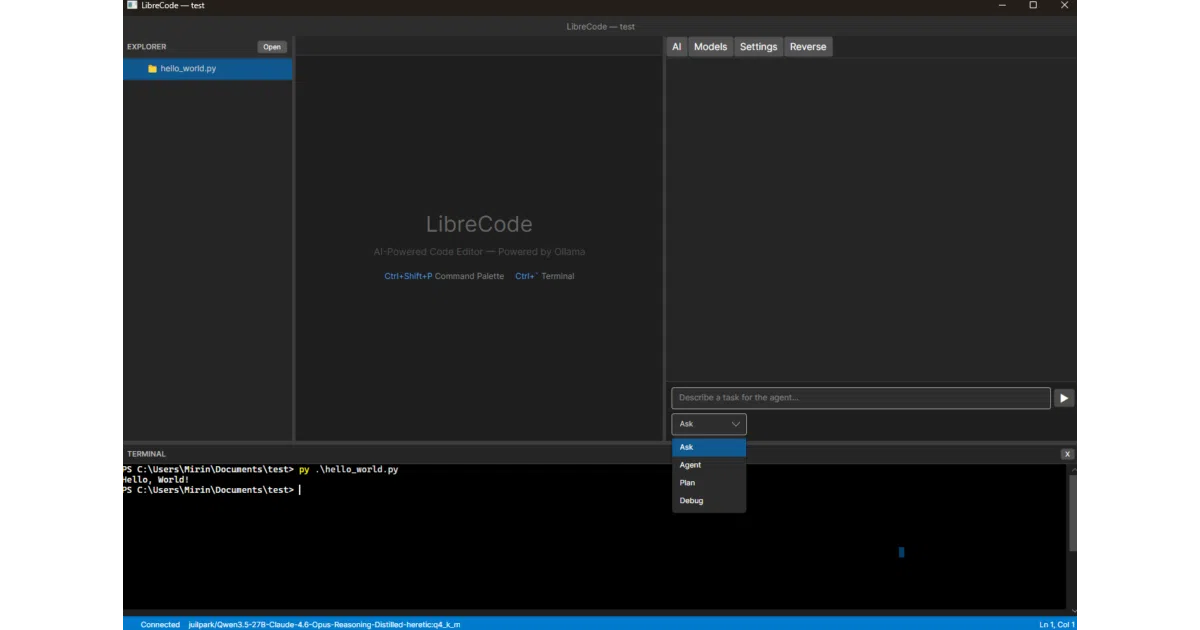
That combination—local AI, native performance, and binary transparency—is the project’s pitch. Whether it can survive its own legal fine print is the open question.
The Anti-Electron, Anti-Cloud Pitch
LibreCode’s opening argument is architectural. Where most new editors wrap a Chromium instance in native window chrome, this one uses Avalonia UI for cross-platform rendering on Windows, Linux, and macOS. The result is a single codebase that starts fast and avoids the memory tax of a bundled browser runtime. In an era where even terminals have succumbed to Electron, that is a genuine aesthetic choice.
The AI layer doubles down on local-first principles. There are no API keys for OpenAI or Anthropic, no telemetry pings, and no subscription tiers. The editor talks to a local Ollama instance, indexes your project files into chunks, generates embeddings via models like nomic-embed-text, and injects relevant snippets into conversations using cosine similarity search. The assistant offers four modes—Ask, Agent, Plan, and Debug—that range from simple chat to autonomous file editing and shell command execution, all within the guardrails of your own GPU and VRAM budget. A built-in model marketplace browses the Ollama library and warns you if a model exceeds your available video memory.
This is a direct challenge to the dominant model of AI-assisted development, where the market has split into cloud-dependent pair-programming tools and agentic services that stream your code to remote infrastructure. LibreCode bets that a meaningful slice of developers would rather buy more RAM than rent API tokens.
A Reversing Workbench Disguised as an IDE
Where LibreCode stops being “another AI editor” and becomes something stranger is the Reverse tab. The project integrates a full .NET decompilation engine borrowed from the ILSpy project, a zero-dependency WebAssembly parser and interpreter, and an ELF analyzer for Linux and Android libraries. These are not thin wrappers around command-line tools. They are first-class subsystems with their own debuggers, disassemblers, and deobfuscators.
For .NET assemblies, you get C# decompilation, raw IL disassembly, PE header inspection, and a step-through IL debugger that simulates the CLR evaluation stack without ever attaching a real debugger. There is a Harmony patch generator that inspects a method signature and emits a ready-to-compile HarmonyPatch class with the correct typeof bindings, injected parameters, and prefix or postfix stubs. For WebAssembly, the editor includes a custom interpreter covering roughly two hundred opcodes, plus a live debugger that connects to Chrome or Edge over the Chrome DevTools Protocol to step through WASM executing in a real browser. For ELF shared objects, it disassembles x86 and x86-64 code via Iced, inspects dynamic linking metadata, and even attempts to detect Obfuscator-LLVM artifacts—control-flow flattening, opaque predicates, and instruction substitution—by building basic-block control-flow graphs and annotating the disassembly rather than rewriting the binary.
Then there is the Stealth tab, available across all three formats. It scans loaded modules for anti-debugging and anti-analysis techniques—Debugger.IsAttached checks in .NET IL, ptrace syscalls in ELF .text, host-side timing imports in WASM—and produces evasion playbooks. Because LibreCode’s own IL and WASM debuggers are interpreters rather than native debuggers, they bypass in-process detection by construction. The Stealth tab tells you what an external debugger would need to defeat, and hands you the Harmony patch or preload shim to do it.
This is not glue code. It is a serious, multi-format reversing workbench bolted onto a code editor, aimed at an audience that reads binaries as often as it writes them. In a landscape where developers already worry that AI will soon reconstruct obfuscated source code with near-perfect fidelity, LibreCode offers the tooling to inspect, annotate, and evade exactly that kind of automated analysis.
Local Intelligence in a Crowded Agent Market
The AI assistant market in 2026 is saturated. Tools have bifurcated into reactive pair-programming assistants and task-oriented agents that plan, edit, and execute across files. LibreCode sits in the agent camp, but with a local-only constraint. Its autonomous Agent mode can read files, write files, search the project, and run shell commands in a loop until a task is done. Custom rules let you set persistent instructions—“always use TypeScript,” “prefer functional style”—that survive across sessions.
The trade-off is hardware and maintenance. You are the sysadmin for your own model stack. The editor helps with VRAM detection and model browsing, but you are still downloading weights, quantizing if necessary, and living within the reasoning limits of local LLMs. For developers already running Ollama for other tasks, this is frictionless. For those accustomed to the zero-setup onboarding of Copilot or Cursor, it is a tax.
The License Paradox
The most unusual feature of LibreCode may be its legal structure. The README opens by calling the project “free, open-source.” The license file tells a different story. It explicitly prohibits redistribution, forbids forks except for the purpose of contributing back to the original repository, bans SaaS or competing offerings, and states that all contributions become the property of the original author. The Contributor License Agreement requires assignation of all rights.
By the Open Source Initiative’s definition, this is not open source. It is source-available software with a proprietary shared-source model. That tension matters because the project’s target audience—security researchers, reverse engineers, and privacy-conscious developers—is exactly the demographic most likely to audit code, demand transparency, and fork projects to fix bugs or add architectures. Telling that community they cannot fork the tool they use to analyze malware is a bold choice, and not necessarily a sustainable one.
Outlook
LibreCode occupies a narrow but compelling niche. It is the only new editor attempting to pair local AI agents with deep binary analysis in a single native window. The engineering ambition is real: a custom WASM interpreter, a CDP debugger, an OLLVM heuristic scanner, and a Harmony patch generator are not features you assemble from npm packages. They require domain expertise and maintenance.
Whether the project thrives depends on two bets. First, that enough developers want local AI badly enough to tolerate managing their own Ollama instances. Second, that the author can sustain the engineering load across both fast-moving AI editor features and deep, finicky reversing tools. The license, however, places a hard ceiling on community growth. Without the ability to fork, redistribute, or independently audit, LibreCode lives or dies by its original maintainer. If that maintainer keeps pace, it could become the standard workbench for .NET and WASM reverse engineers who want AI assistance without cloud exposure. If not, its technical ideas deserve a second life under a license that lets hackers actually hack on them.
Sources
- omarluq/librecode: free and open source terminal agent harness
- The Best AI Coding Assistants: 20 Tools Reviewed for 2026
- DecompAI – an LLM-powered reverse engineering agent ...
- Libre Barcode 39
- 13 Best AI Coding Tools for Complex Codebases in 2026
- Development Journey on Game Decompilation Using AI
- Libre Barcode Project
- Top 15 AI Coding Assistant Tools to Try in 2026
- AI will reconstruct 99% of original source code :(
- 8 best AI coding tools for developers: tested & compared!
- AI-Powered Reverse Engineering: Decompiling Binaries with AI
- librecode (x86_64) | openmamba | Linux distribution