pewdiepie-archdaemon/odysseus · 10 Jun 2026 · Feature
The Anti-Platform: One Developer's Rebellion Against Cloud AI Subscriptions
Odysseus bundles chat, agents, email, calendar, and research into a single self-hosted workspace that treats your hardware as first-class infrastructure, not an afterthought.
The Jank That Works
The README opens with an ASCII cat and a promise of “more jank and fun.” This is not enterprise marketing. It is, however, a surprisingly accurate thesis statement. Odysseus is a single-developer project that has accumulated features the way a ship accumulates barnacles—each one adding drag, but also the particular character that makes the vessel seaworthy.
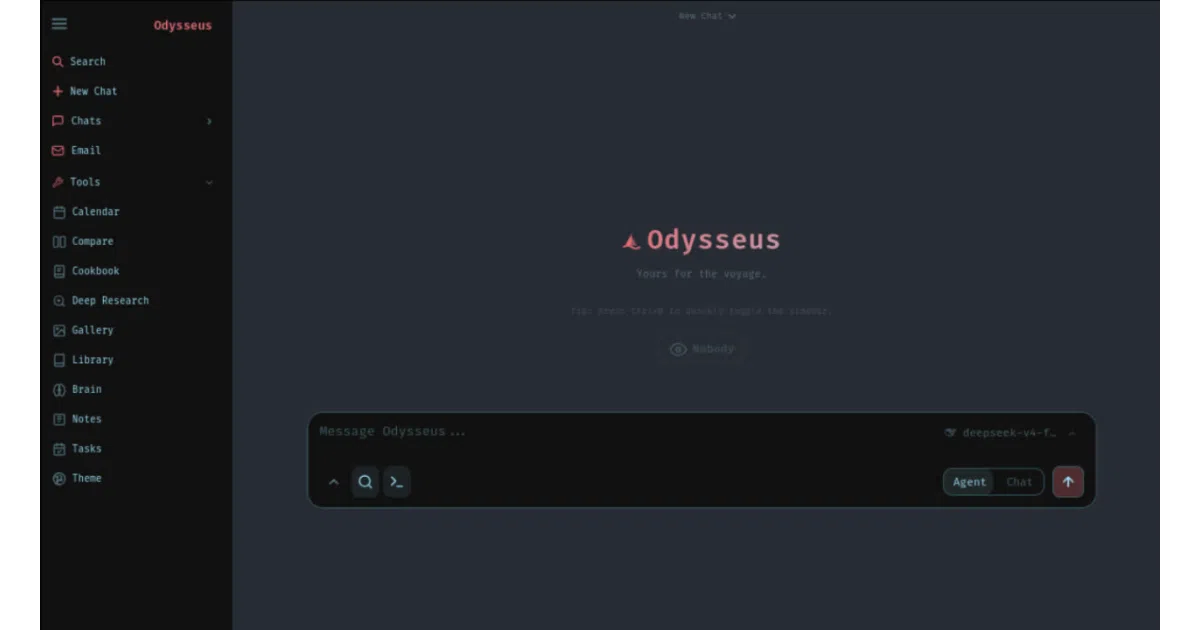
The project sits at an odd intersection. On one side, the self-hosted AI space has professionalized rapidly. Coder now sells enterprise-grade AI development environments with “agent boundaries” and “dynamic policy governance” to Fortune 500 companies. On the other, most personal AI tools remain either toy projects or thin wrappers around someone else’s API. Odysseus attempts something more ambitious: a complete workspace that replaces the subscription bundle of ChatGPT Plus, Claude Pro, and a half-dozen specialized SaaS tools, while running entirely on hardware you already own.
The origin story, per the project’s own landing page, is almost too perfect: “idk what to make come up with something oh make an AI chat but make it good and make it look nice.” The creator’s stated motivation is more telling—existing local AI tools “felt like taking steps back” from the polished cloud experience, and the subscription model offended a particular developer sensibility. The result is software that treats self-hosting not as a compromise but as a feature, with the rough edges acknowledged rather than hidden.
What “Workspace” Actually Means Here
The feature list reads like someone kept a running tally of every AI-adjacent task they performed in a given week and decided to build a tool for each. Chat with local or remote models. Autonomous agents with tool use. Hardware-aware model recommendation and serving. Deep research with source synthesis. Side-by-side model comparison. A document editor where “YOU write the text, AI is there to assist.” Email triage with IMAP/SMTP integration. Calendar with CalDAV sync. Notes, tasks, scheduled agent runs. Image editing. Theme customization. Two-factor authentication.
This is not modular architecture in the clean microservices sense. It is modular in the sense of a well-organized workshop where every tool has its place and some tools get used more than others. The technical implementation reflects this: a FastAPI backend with a modular JavaScript frontend, ChromaDB for vector memory, SQLite for application state, with Docker Compose bundling SearXNG for search and ntfy for notifications.
The “Cookbook” feature deserves particular attention because it addresses the genuine friction point that stops most users from running local models. Hardware detection, VRAM-aware model recommendation, format selection across GGUF/FP8/AWQ, and one-click serving through vLLM or llama.cpp—this is the kind of integration work that is tedious to do manually and rarely done well in open-source tools. The project explicitly notes that it builds on llmfit for this functionality, which is the honest kind of dependency acknowledgment that builds trust.
The Agent Question
IBM’s taxonomy distinguishes between “AI assistants” (reactive, prompt-dependent) and “AI agents” (proactive, goal-directed). Odysseus straddles this boundary uncomfortably, which is probably correct for where the technology actually stands in 2025. The “Agent” feature hands tools to a model and “let[s] it run the whole task itself,” built on the opencode framework with MCP (Model Context Protocol) support. The “Skills” feature claims the assistant “writes, refines, and reuses its own skills—getting more capable over time.”
These are ambitious claims. The project itself acknowledges the dependency on external frameworks for core agent behavior, and the “self-evolving” skills mechanism is the kind of feature that works well in demo and requires careful scrutiny in production. What is genuinely implemented, based on the source, is persistent memory with vector + keyword retrieval through ChromaDB and fastembed, plus scheduled task execution with cron-style triggers. The agent can act on your behalf; whether it acts wisely is left to the model and the user’s prompt engineering.
The comparison to enterprise offerings is instructive. Coder’s platform provides “fully isolated, ephemeral environments” with “dual-firewall” agent boundaries and Terraform-managed infrastructure. Odysseus provides a shell tool and file access with per-user privilege controls and admin gating. The security model is explicitly “treat it like an admin console”—which is honest about the tradeoffs, if less reassuring to a CISO.
The Self-Hosting Landscape
Odysseus enters a crowded field that has sorted itself into roughly three tiers. At the bottom are model runners and chat interfaces—Jan.ai, with 5.3 million downloads, offers “zero setup” local model execution. AnythingLLM specializes in private document RAG. These are tools, not workspaces.
At the top are enterprise platforms like Coder’s, or the n8n self-hosted AI starter kit, which provides a Docker Compose template integrating n8n workflow automation, Ollama, Qdrant, and PostgreSQL. The n8n kit is explicitly a starting point for building workflows; Odysseus is a finished (if perpetually evolving) application.
The middle ground—personal AI assistants with genuine multi-channel, proactive capability—is sparser and more contested. Vellum, OpenClaw, and QwenPaw occupy this space with varying architectures. Vellum’s “identity-driven, proactive” approach and OpenClaw’s 500+ plugin ecosystem represent different bets on how users will want to interact with persistent AI. Odysseus’s bet is simpler: users want a familiar interface (it “looks and runs great on your phone, not just desktop”) with their data physically under their control.
The landing page’s fake testimonials—“Odysseus helped us ship more ships while shipping ships”—are a joke that lands because the project is not selling anything. There is no sales team, no demo request form, no “contact us for enterprise pricing.” This is the genuine open-source value proposition, increasingly rare as the field matures: the code is the product, and the product is free.
Where the Rough Edges Show
The documentation is unusually frank about limitations. Docker on macOS cannot use Metal GPU acceleration, so Apple Silicon users must run natively. vLLM and SGLang are CUDA/ROCm-only. MLX-only models are not served. GPU passthrough requires manual configuration with diagnostic scripts that the project provides but does not automate. The optional dependencies list includes AGPL-licensed PyMuPDF with a warning.
This transparency is a feature, not a bug. The project knows its audience: technically capable users who would rather understand constraints than discover them through failure. The security notes are particularly extensive, covering everything from .env file management to the specific ports exposed by default Docker Compose bindings. The recommendation to keep AUTH_ENABLED=true and bind to 127.0.0.1 unless intentionally exposing to LAN/VPN is the kind of conservative default that prevents the most common self-hosting disasters.
The “jank” acknowledged in the README manifests in small ways: the macOS start script uses port 7860 because “AirPlay often holds 7000.” The Windows launcher is a PowerShell script with execution policy bypass. The browser MCP server only starts if its npm package is already cached, to avoid blocking startup on a 300MB download. These are the compromises of a project with one primary developer and limited CI/CD infrastructure.
The Name, and the Myth
The project’s classical namesake was, per Britannica, “known for his wisdom, resourcefulness, and strategic planning”—but also for a journey home that took ten years, involved numerous detours, and ended with an accidental death by stingray spear. The landing page includes a testimonial from “Polyphemus, Cyclops, Cave Solutions (on leave)” rating the project one star with “AHHHHHHHHHHHHHHHHHHHHHHHHHHHHH.”
This is not the branding of a venture-backed startup. It is the branding of a project that knows exactly what it is: a personal obsession made public, with all the charm and limitations that implies. The creator’s stated goal was to make self-hosted AI feel “fun and powerful” rather than like “taking steps back” from cloud offerings. Whether it succeeds depends on what you value—polish or control, integration or modularity, convenience or the particular satisfaction of running software that answers to no one but you.
The broader trend is clear. Stanford HAI’s 2026 AI Index identified “sharp acceleration in agentic AI deployment” as a defining theme. The personal AI assistant market is growing at 41.9% CAGR, with privacy-first deployment increasingly cited as a primary adoption driver. Odysseus is a small boat in this current, but it is pointed in an interesting direction: not toward enterprise adoption or venture scale, but toward a future where AI infrastructure is as personal and customizable as a well-tuned development environment.
Whether that future arrives depends partly on whether projects like this can sustain themselves without the resources that fuel commercial alternatives. For now, it is enough that they exist—as proof that the centralized, subscription-model AI workspace is not the only possible future, and that one developer with a specific grievance against cloud AI can still build something worth using.
Sources
- Coder Unveils Enterprise-Grade Platform for Self-Hosted AI ...
- AI Agents vs. AI Assistants - IBM
- Odysseus — A Self-Hosted AI Workspace
- n8n-io/self-hosted-ai-starter-kit - GitHub
- 8 Best Open-Source Personal AI Assistants in 2026 - Vellum
- Odysseus | Book, Story, Film, Wife, Myth, Significance, Trojan War ...
- Self-hosted AI coding that just works : r/LocalLLaMA - Reddit
- What are some potential use cases of AI agents in people's daily life?
- Who Was Odysseus? Facts About the Legendary Greek Hero
- The Best Self-Hosted AI Tools You Can Actually Run in ... - YouTube
- How I Built an AI Personal Assistant That Works 24/7
- Video: Odysseus in Greek Mythology | Overview, Story & Adventures