nexu-io/open-design · 10 Jun 2026 · Feature
The Open-Source Bet Against Anthropic's Design Lock-In

Camila Reyes
Senior Editor
Open Design treats your existing coding agents as a design studio, wiring Claude Code, Codex, Cursor and nineteen others into a local-first artifact engine that exports real HTML, not mockups.
nexu-io/open-design
★104k stars Velocity · 7d +250 ★/day ↗accelerating
star history
The Hinge Moment
In April 2026, Anthropic shipped Claude Design. For the first time, a major LLM stopped writing prose and started emitting design artifacts directly—streamed into a sandboxed preview, critiqued in place, delivered as product. The loop went viral. It also went closed: cloud-only, Anthropic-model-only, Anthropic-skills-only, no checkout, no self-host, no swap-in-your-own-agent. The design world noticed the capability and the cage simultaneously.
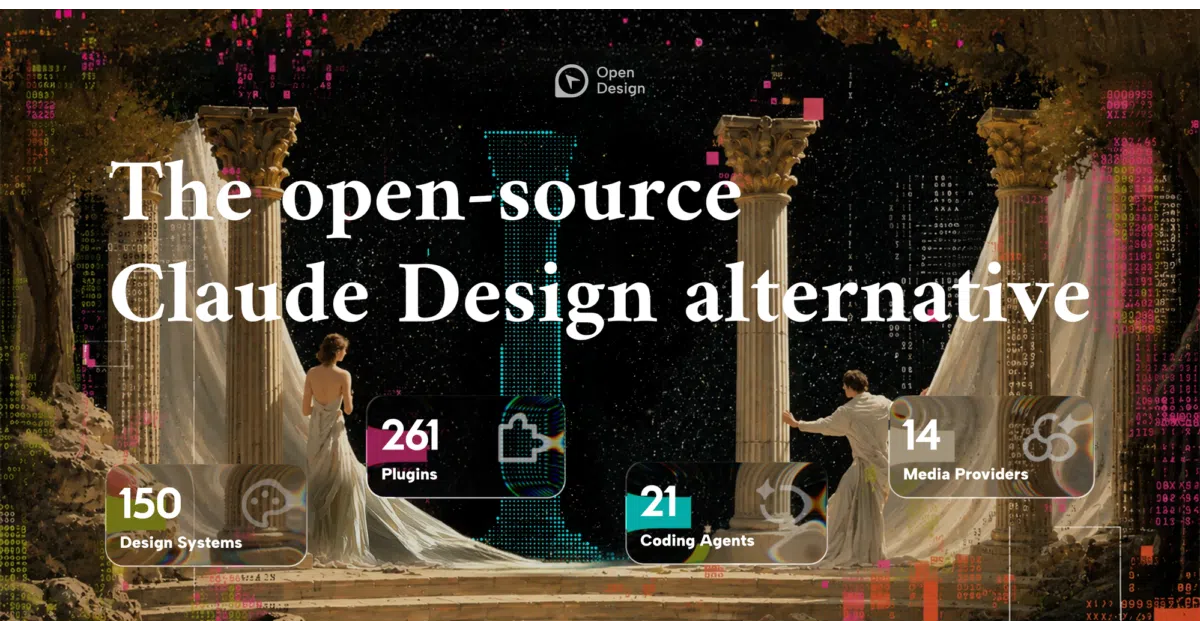
Open Design arrived as the explicit counter-bet. The project, maintained by a studio called Nexu, is not a clone in the usual sense. It is a filesystem-level rearchitecture of the same mental model—discover brief, lock direction, stream artifact, critique, deliver—except the engine is whatever coding agent already sits on your PATH, and the outputs are real CSS, real components, real files you can hand to engineering without a translation layer.
The timing matters. AI prototyping tools have become standard equipment: one survey cited by industry observers claims over 58% of product managers now use no-code or AI prototyping generators. The field includes chatbot-based flows (Claude’s Artifacts, ChatGPT’s canvas), cloud environments (Lovable, Bolt, v0), and local developer assistants (Cursor, GitHub Copilot, Windsurf). Open Design occupies a peculiar middle ground—it is local-first and agent-native, but produces single-page artifacts rather than full-stack applications. It is, in the maintainers’ framing, “the Figma alternative for the agent era.”
What “Agent-Native” Actually Means Here
The core technical insight is simple enough to miss: Open Design does not ship its own LLM, its own inference stack, or its own chat interface. It ships a local daemon, a desktop shell, and a protocol. The daemon scans your PATH for coding-agent CLIs—Claude Code, OpenAI’s Codex, Cursor’s agent, GitHub Copilot CLI, Gemini, OpenCode, OpenClaw, Antigravity, Hermes, Kimi, and eleven others—then exposes them to a unified skill-and-design-system runtime. A single od mcp install <agent> command wires the Model Context Protocol server into that agent’s configuration, after which the agent can read Open Design’s skill files, design systems, and project files as a structured API.
This is not merely an integration strategy. It is a structural bet that the agent ecosystem will remain fragmented, and that value accrues to the orchestration layer rather than any single model provider. The comparison table in Open Design’s own documentation is unsparing: Claude Design is “Anthropic only,” cloud-only, closed-source; Figma is closed-source with no agent-native loop; Lovable, v0, and Bolt use “cloud agent only.” Open Design claims twenty-one CLIs plus bring-your-own-key compatibility with any OpenAI-compatible endpoint, including self-hosted vLLM and Ollama.
The BYOK proxy is worth examining. It sits at POST /api/proxy/{anthropic,openai,azure,google,ollama,senseaudio}/stream, accepts baseUrl + apiKey + model, and streams back the same artifact-generation loop with per-target SSRF protection blocking internal IPs, link-local addresses, and CGNAT ranges at the daemon edge. The security model is deliberately paranoid: read-only by default, loopback-only for credentials and live previews, LAN exposure requiring explicit OD_BIND_HOST and OD_ALLOWED_ORIGINS configuration. This is the architecture of a tool that expects to run inside enterprise environments and on individual laptops with equal comfort.
The DESIGN.md Contract
Where Claude Design embeds taste through proprietary prompt engineering and closed skills, Open Design externalizes it as a file format. The DESIGN.md schema has nine sections: color, typography, spacing, layout, components, motion, voice, brand, and anti-patterns. One hundred and fifty systems ship with the repository—Linear, Stripe, Vercel, Airbnb, Apple, Tesla, Notion, Anthropic, Cursor, Supabase, Figma—each a single Markdown file that any agent can read, any version control system can diff, any team can fork.
This is the boring part that carries the value. Design systems in conventional tools live as JSON tokens, Figma libraries, or proprietary theme formats. Open Design’s DESIGN.md is plain text, structured for LLM consumption, human-readable without tooling, and portable across the twenty-one supported agents. Switching a system means changing a file reference; the next render picks up the new palette, type scale, and motion curves automatically. The anti-patterns section is particularly notable—it encodes what the brand does not do, a negation space that most design-token formats ignore.
The skill protocol extends this file-centric approach. Each skill is a folder with a SKILL.md following Anthropic’s established convention, plus Open Design-specific frontmatter declaring mode, platform, scenario, preview type, and design system requirements. Drop a folder into skills/, restart the daemon, it appears in the picker. The catalog includes 100+ skills across scenarios from marketing to finance to HR, with modes for prototypes, decks, live artifacts, images, video, and audio. The scenario field groups by audience—design, marketing, operation, engineering, product—so a product manager and a brand designer see different entry points to the same underlying engine.
Plugins as Portable Agent Workflows
The plugin layer, introduced in version 0.8.0, pushes the file-centric philosophy further. Two hundred sixty-one official plugins ship in categories ranging from complete design scenarios to one-shot image prompts to HyperFrames motion templates. Each plugin is a portable agent-skill folder: a SKILL.md readable by any agent that supports the convention, plus an optional open-design.json manifest for marketplace metadata, inputs, pipelines, and capability declarations.
The capability system is worth attention. Plugins declare what they need—prompt:inject, file:read, file:write, shell:exec—and the runtime grants only what is requested. A restricted install defaults to prompt:inject only. This is a sandboxing model adapted from browser security, applied to agent workflows that may run arbitrary code generation. The plugin can migrate Figma designs to React, refresh an existing git repository against a new DESIGN.md, or generate a 30-second SaaS product promo via HyperFrames, but it does so with explicitly bounded permissions.
HyperFrames itself is not an Open Design invention; it is HeyGen’s open-source HTML-to-MP4 framework, integrated as a first-class citizen. The agent writes HTML, CSS, and GSAP animations; HyperFrames renders via headless Chrome and FFmpeg to deterministic MP4 output. Eleven templates and thirty-nine Seedance prompts ship with the repository. The integration is characteristic of Open Design’s assembly strategy: take proven open-source components, wire them into the skill-and-design-system runtime, expose them through the same MCP interface.
The Desktop App as Trojan Horse
Version 0.9.0, released recently, adds what the maintainers call the “official Model Router”—built into the desktop app, zero configuration, one-click sign-in, no CLI installation, no API key preparation. This is a significant pivot in accessibility. The prior path required Node 24, pnpm, and comfort with terminal commands; the new path offers macOS (Apple Silicon and Intel), Windows x64, and Linux AppImage builds that auto-detect installed agents and present the skill picker to non-technical users.
The desktop shell is Electron with a sandboxed renderer and sidecar IPC for status, evaluation, screenshot, console, click, and shutdown messages. The web layer is Next.js 16 App Router with React 18. Storage is SQLite at .od/app.sqlite and files at .od/projects/<id>/, relocatable via OD_DATA_DIR. No telemetry, no cloud round-trip for core operations. The architecture is explicitly “local-first” in the CRDT tradition, though without the collaborative editing complexity—this is single-user software that happens to speak agent protocols.
The Model Router is the concession to commercial reality. Running local inference or even API calls requires configuration that filters out most users. By offering a managed routing layer with sign-in, Open Design gets the casual user without sacrificing the BYOK path for the paranoid or the self-hosted. It is the same tension every open-source infrastructure project faces: purity versus adoption. The maintainers have chosen a both/and position, with the open-source daemon and desktop app as the guaranteed baseline and the router as the convenience layer.
Position in a Crowded Field
The AI prototyping landscape has stratified quickly. At the chatbot layer, Claude’s Artifacts and ChatGPT’s canvas offer simple, single-page prototypes without code editing capability. At the cloud environment layer, Lovable, Bolt, and v0 generate working applications with backend logic, suitable for founders shipping MVPs. At the local assistant layer, Cursor and GitHub Copilot remain code-centric, with design as a secondary concern. Open Design sits awkwardly between these—more capable than chatbot artifacts, less full-stack than cloud environments, more design-native than coding assistants.
Industry evaluations reflect this ambiguity. UX Pilot, rated highly for customization flexibility, offers Figma import and multi-screen flows. Relume generates sitemaps and wireframes with early-stage control. Banani AI produces up to five editable, interactive high-fidelity variants from a single prompt. Open Design’s differentiation is not output fidelity per se but the combination of local execution, agent portability, and the DESIGN.md contract. It is a tool for teams that already have design systems, already use multiple agents, and want the agent loop to respect their brand rather than inventing one per session.
The “refresh existing codebase” capability points to this target user. Point Open Design at a git repository plus a DESIGN.md, and the agent refactors real components to the brand spec. This is not prototyping; it is maintenance and migration, the unglamorous work that consumes most design-system teams. The Figma-to-React and Pencil-to-Vue migration plugins, currently in alpha, extend this into toolchain bridge-building.
What Remains Unproven
The project carries the usual burdens of ambitious open-source software. The roadmap lists unimplemented features: comment-mode surgical edits, AI-emitted tweaks panel UX, npx od init scaffolding, plugin SDK with full CLI, and the refresh-existing-codebase plugin. The Figma and Pencil migration plugins are alpha. The Linux AppImage is on an “optional release lane.” These are not fatal gaps, but they are the difference between a promising architecture and a daily-driver tool.
The twenty-one agent adapters are also a maintenance surface. Each CLI evolves independently; the adapter contract and stream parsers in apps/daemon/src/agents.ts must track upstream changes. The documentation notes that “adding a new CLI is one entry,” which is true for the initial integration and optimistic for the ongoing compatibility burden. The MCP protocol reduces but does not eliminate this friction.
Community traction is difficult to assess independently. The repository lists eleven contributors and claims presence across twenty-three cities, but without download metrics or external adoption studies, these figures are unverified. The Discord server and GitHub Discussions are active by report, though the Reddit threads attempting community discussion were blocked by network security controls, yielding no substantive user feedback. The project is young enough that real-world stress testing at scale remains ahead of it.
The Broader Wager
Open Design is ultimately a bet on two structural trends: the fragmentation of the AI agent market, and the desire of design-system teams to own their brand contracts as files rather than as cloud service configurations. If Anthropic, OpenAI, Google, and a dozen smaller providers continue to compete for coding-agent dominance, an orchestration layer that treats them interchangeably gains value. If design systems continue to mature as engineering artifacts rather than Figma libraries, a plain-text schema that agents can read and write becomes infrastructure.
The risk is that either trend reverses. If one agent provider achieves sufficient capability and convenience lock-in, the multi-agent flexibility becomes unnecessary complexity. If design systems remain visually managed in proprietary tools, the DESIGN.md file format is a solution in search of an adoption path. Open Design’s maintainers are betting against both reversals, and building the tool they want to exist if the bets pay out.
For now, the project stands as the most architecturally thoughtful open-source response to Claude Design’s closed loop. Whether it becomes the standard or remains a niche tool for the paranoid and the polyglot-agent depends on execution of the roadmap and the trajectory of the agent wars it sits astride.
Sources
- My 9 Best AI Prototyping Tools in 2026 - UX Pilot
- Open Design — Official open-source Claude Design alternative
- A guide to AI prototyping for product managers - Lenny's Newsletter
- Design System folks! Is there a perfect tool/solution/ ...
- Has anyone tried Open Design yet? : r/SideProject - Reddit
- Best Prototyping Tools in 2026 are AI-powered. Here's My Top 10.
- Top 10 Open-Source Workflow Automation Software in 2026
- Open Design Alliance: Home
- We tested 7 tools for AI prototyping—here are the results - GoPractice
- Open design systems from the Figma Community
- Open-design movement - Wikipedia
- What's the best AI mockups/prototype tool ? : r/ProductManagement