lyogavin/airllm · 05 Aug 2026 · Feature
AirLLM fits 70B models on a 4GB GPU by abandoning the all-at-once load

Amara Okonkwo
Staff Writer
AirLLM decomposes transformer models into layer-wise shards, loading and computing one slice at a time to make colossal inference possible on commodity hardware—at a steep latency cost.
lyogavin/airllm
★34.6k stars Velocity · 7d +51 ★/day ↘cooling
star history
The Hype Moment: Numbers That Sound Like Typos
The project documentation opens with a figure that stops most engineers mid-scroll: a 70-billion-parameter large language model running inference on a single 4GB GPU, no quantization, no distillation, no pruning. Push further, and the claim gets more audacious—Meta’s Llama 3.1 405B, a model whose weights alone dwarf most laptops, allegedly fits into 8GB of VRAM. In a field where serving a 7B model at FP16 can strain a 16GB consumer card, these numbers read like category errors. The Hacker News submission that drove the project’s visibility carried the same disbelief in its title, and the comment section quickly converged on the only metric that matters when memory constraints are relaxed this aggressively: speed [3]. The repository’s star history and PyPI download metrics suggest the curiosity is not merely performative—developers are actually installing it to see if the trick holds.
The Core Idea: Inference as Streaming, Not Residence
AirLLM’s mechanism is conceptually blunt. It takes a standard transformer checkpoint—typically a monolithic blob of safetensors or PyTorch shards—and decomposes it into per-layer files saved on local disk. During the first initialization, the original model is split and cached layer-wise, a transformation so disk-hungry that the documentation explicitly warns users to ensure sufficient cache directory space. Once the shards exist, inference begins. The library does not map the full weight matrix into GPU memory. Instead, it treats VRAM as a temporary scratchpad, pulling one layer at a time from storage, running the forward pass, and immediately evicting it before fetching the next. The GPU never holds more than a thin slice of the model.
This is possible because autoregressive inference requires only a forward pass. Unlike training, where backpropagation demands that every layer’s activations remain resident for gradient computation, inference allows a layer to be discarded the moment its output has been fed forward. AirLLM exploits that asymmetry. The original insight traces back to layer-wise tricks used in Kaggle competitions, later generalized into a wrapper that auto-detects architectures ranging from Llama and Mistral to Qwen, ChatGLM, Baichuan, InternLM, and Mixtral. Recent updates have extended this to CPU inference and non-sharded model sources, broadening the range of hardware that can attempt the trick.
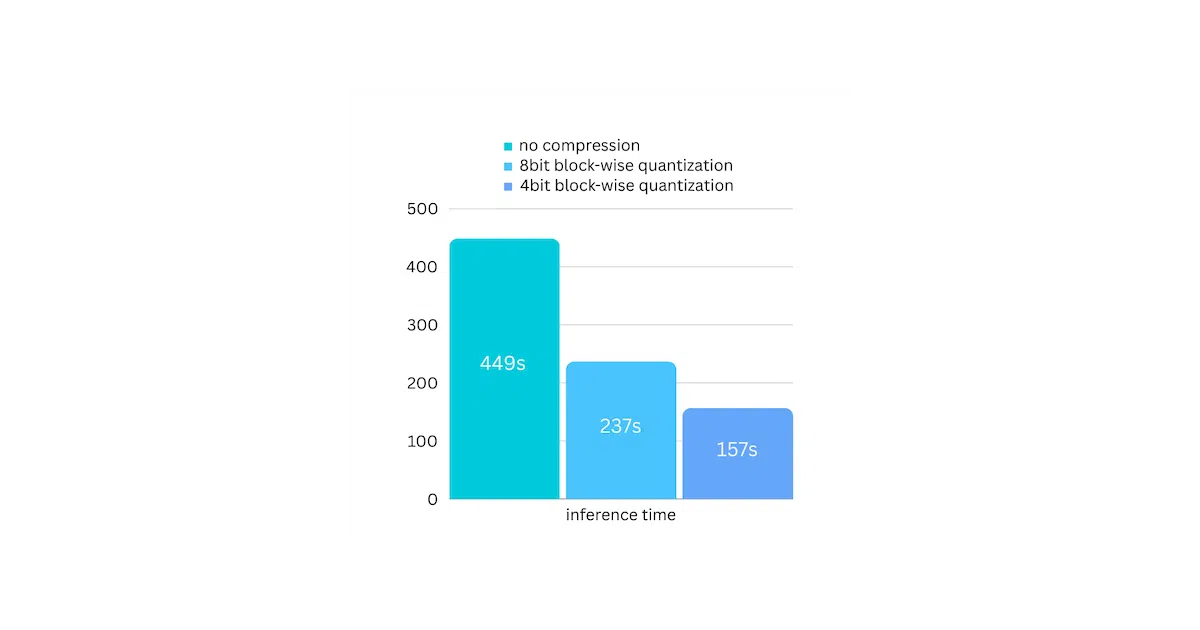
What the library does not do is alter the model mathematically. There is no low-rank approximation, no sparse attention rewrite, no 4-bit kernel fusion by default. The weights remain full-precision during the layer-wise shuffle, though the project later added optional 4-bit and 8-bit block-wise quantization for users who want to compress the disk shards and gain a claimed 3× throughput boost with “almost ignorable accuracy loss.” The core value proposition is residency reduction, not compute reduction.
Why It Works: The Memory Wall
Modern LLM inference is already governed by memory bandwidth, not arithmetic. NVIDIA’s technical survey of inference optimization notes that the decode phase—where tokens are generated one by one—is a memory-bound operation in which the cost of moving weights and key-value caches to the compute units dominates latency [1]. AirLLM leans into this reality and simply removes the largest resident consumer: the full weight tensor. By streaming layers from disk through PCIe (or, on Apple Silicon, unified memory), it substitutes storage bandwidth for VRAM capacity.
NVIDIA’s breakdown distinguishes between the prefill phase, where the full input context is processed in parallel, and the decode phase, where each new token depends on the last [1]. AirLLM’s layer-wise streaming hurts both: prefill must still touch every layer, and decode must repeat the full disk-to-GPU shuffle for each successive token. The library does not attempt to optimize the attention mechanism itself—there is no FlashAttention rewrite, no grouped-query attention compression, no PagedAttention-style KV cache management. It simply removes the weight residency problem by making the weights a streaming asset.
The trade-off is severe and intentional. Every generated token triggers a complete pass through the entire model depth, meaning the library must read the full stack of layer shards from disk for each single token. A Hacker News commenter, citing the project’s v3.1.0 release notes, floated a latency figure of 292 seconds per token on an RTX 6000 Ada workstation with 48 GB of VRAM [3]. Even if that number reflects a worst-case configuration or a specific model variant, the order of magnitude is clarifying. This is not an alternative to vLLM, TensorRT-LLM, or NVIDIA’s NIM workflow, which batch requests, manage KV caches with page-table schemes, and select optimized backends automatically to maximize throughput [1][8]. AirLLM is the inverse: batch size of one, throughput measured in tokens per hour, and a user experience closer to watching a mainframe batch job than chatting with an API.
The Audience: Hobbyists, Not Datacenters
So who is this for? A write-up in Towards AI described the library as a way to run large models on an old laptop without cloud GPUs or paid APIs, reframing the question from whether you own monster hardware to whether your system can handle a model “intelligently, one piece at a time” [6]. The Hacker News thread offered a similar verdict: the utility depends entirely on expectations. For developers running local LLMs “just for the sake of it,” or for students who need to probe a 70B model’s behavior without institutional cloud budgets, AirLLM is a democratizing tool [3]. It also runs on Apple Silicon—specifically requiring mlx and torch on Apple silicon Macs—and has added explicit CPU inference support, expanding the addressable hardware to anything with sufficient disk space and patience [6].
This is not, however, a solution for the production deployment questions raised in enterprise forums. A typical on-premise query about a 7B Mistral model on an A40 GPU revolves around managing KV-cache growth and clearing memory between requests to keep latency predictable [5]. AirLLM does not solve those serving problems; it sidesteps them by making the model so slow that concurrent request handling is a non-issue.
Quantization, SLMs, and the Bifurcating Landscape
AirLLM occupies an odd corner of an ecosystem that is increasingly split. On one side, researchers and enterprises are aggressively optimizing small language models—under 13B parameters—for edge and cloud deployment, recognizing that most production tasks do not require frontier-scale weights [11]. These models fit comfortably into consumer VRAM when quantized, and they serve efficiently with production-grade runtimes. On the other side, a vocal open-source community insists on touching the frontier directly, running 70B and 405B models locally for privacy, curiosity, or the simple satisfaction of avoiding a third-party API.
AirLLM serves the second camp. It is orthogonal to the quantization techniques surveyed in recent literature, which reduce precision to shrink weights and accelerate low-bit matrix multiplication [10]. The library can optionally apply block-wise 4-bit or 8-bit compression to its layer shards, but its primary trick is topological—where the weights live during inference—not numerical. In a world where Phi-3 Mini can run on 3GB of VRAM and match older GPT-3.5 benchmarks, the practical need to stream a 70B model through a 4GB card may shrink. Yet the technical point remains: the boundary between commodity hardware and frontier-scale AI is more permeable than GPU spec sheets suggest.
Rough Edges
The README is candid about the operational friction. The initial model decomposition is so disk-intensive that running out of space produces a cryptic safetensor header error. Load the wrong model class—say, a Qwen checkpoint with a Llama2 wrapper—and you get an empty-sequence crash. Gated models require Hugging Face tokens, and some tokenizers lack padding tokens, demanding manual configuration. The project’s own FAQ reads like a troubleshooting log from a busy lab: disk space, class mismatches, authentication tokens, and tokenizer edge cases. It is refreshingly unvarnished. These are the minor indignities of a wrapper that prioritizes function over polish, and they reinforce that AirLLM is a research and hobbyist utility, not a managed inference platform.
Outlook: Proof of Life vs. Proof of Product
The project continues to expand its model support—Qwen 2.5, Llama 3.1, Mixtral—and has added prefetching to overlap layer loading with compute for a modest 10% speedup. But the fundamental tension is unresolvable: storage bandwidth is not keeping pace with model size, and every layer fetched from disk adds latency to an already memory-bound decode loop. AirLLM proves that a 405B model can execute on an 8GB GPU. It does not prove that doing so is useful for anything beyond the demonstration itself.
That may be enough. In the same way that early Linux ports to obscure architectures proved software portability before commercial viability, AirLLM proves that inference residency is a choice, not a law. As Small Language Models improve and production stacks like NIM and vLLM make 7B serving trivial, the library’s lasting contribution may be conceptual: it showed that the GPU memory wall could be tunneled under, one layer at a time, provided you are willing to wait.
Sources
- Mastering LLM Techniques: Inference Optimization | NVIDIA Technical Blog
- Decision for LLM Model and GPU for production deployment
- AirLLM 70B inference with single 4GB GPU
- LLM Inference Optimization Techniques: A Comprehensive ...
- On-premise deployment of LLM solution
- I Ran a 70B AI Model on My Old Laptop — Here's How AirLLM Did It
- Mastering LLM Inference Optimization From Theory to Cost Effective ...
- Simplify LLM Deployment and AI Inference with a Unified NVIDIA NIM ...
- AirLLM make 8GB MacBook run 70B : r/LocalLLaMA
- A Comprehensive Study on Quantization Techniques for Large ...
- Deploy Small Language Models on GPU Cloud: Enterprise SLM Guide ...
- AirLLM download