diegosouzapw/OmniRoute · 23 Jul 2026 · Feature
Inside the Gateway That Compresses Prompts and Chains Free AI

Yuki Tanaka
Editor
OmniRoute unifies 177 LLM providers behind a single local endpoint, stacking prompt compression with cascading fallbacks to keep coding agents running on free tiers.
diegosouzapw/OmniRoute
★25.4k stars Velocity · 7d +1088 ★/day ↗accelerating
star history
Developers today collect AI subscriptions like trading cards. Claude Code for terminal work, Cursor for the IDE, GitHub Copilot for inline suggestions, OpenAI Codex for the new hotness. Each demands its own API key, its own rate-limit psychology, its own billing dashboard. OmniRoute enters this chaos with a deliberately confrontational premise: one local endpoint, a catalog of 177 providers, and a curated stack of free tiers that promises to keep your agents running even when your credit card begs for mercy.
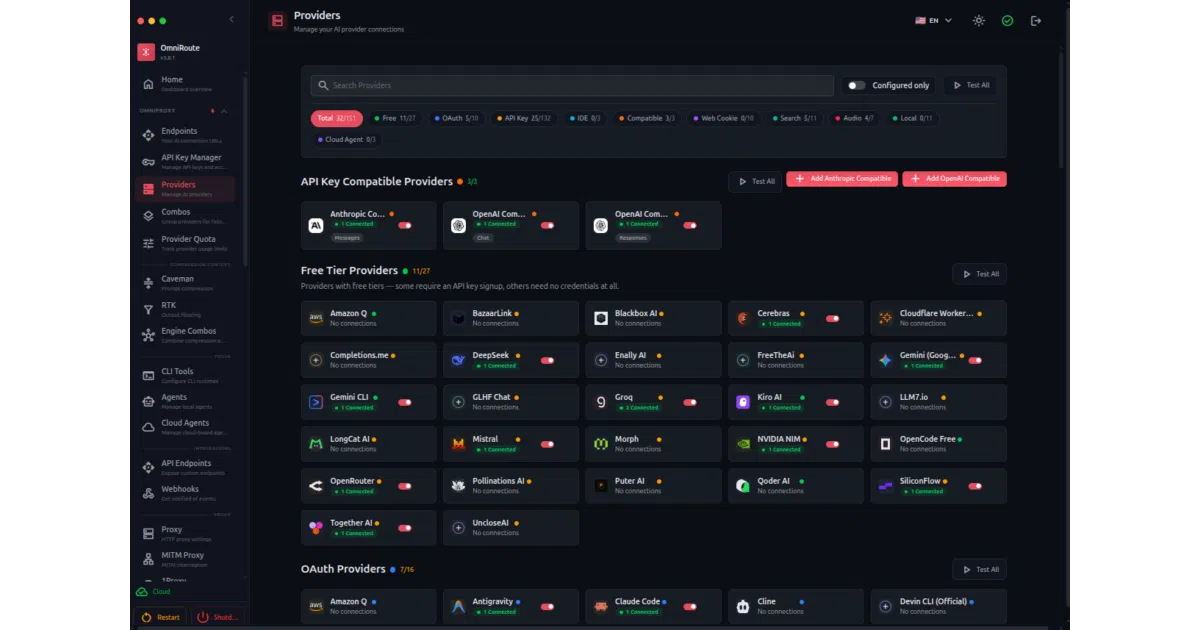
The README frames the value proposition as pain relief. Subscription quotas expire unused because you forgot to drain them. Rate limits interrupt flow state mid-refactor. Tool outputs—git diffs, grep results, build logs—bloat prompts and burn tokens. OmniRoute proposes to solve all three with a local proxy that runs on your laptop, your server, or even your phone. It is pitched as financial infrastructure as much as technical infrastructure: the dashboard tracks “savings,” not charges, because the software itself never bills you. That positioning is telling. It is not asking to be your vendor; it wants to be your ad blocker for AI subscription fatigue.
The desperation is real. Developers have already resorted to reverse-engineering IDE handshakes and building MITM proxies just to use a Copilot license inside Cursor or to trick Claude Code into talking to a different backend. OmniRoute offers the same outcome—use one subscription or free tier to power another tool—without the AST mutation and certificate pinning wars.
Combos and Three-Layer Resilience
At the heart of OmniRoute is the “combo,” a chain of models that the router traverses automatically. A user might configure a priority chain: drain a Claude Code subscription first, fall back to a Groq API key, slide to a cheap GLM endpoint, and finally land on a free-forever Kiro instance. If any link fails—quota exhaustion, rate limiting, upstream outage—the request moves to the next link in milliseconds. The system offers fourteen routing strategies, including round-robin, weighted load spreading, cost-optimized selection, and even context-relay for long-context handoffs between models.
For those who prefer zero configuration, the auto model invokes a live scoring engine that ranks every available provider across nine factors: health, quota headroom, per-token cost, latency, success rate, and freshness. Variants like auto-coding, auto-fast, and auto-cheap bias the scoring for quality, latency, or price. It is an admission that static configuration cannot keep pace with the volatility of the LLM market.
What separates this from the retry logic baked into any HTTP client is a three-layer resilience model. A circuit breaker stops all traffic to a provider when upstream failure is detected, probing gently to recover. A connection cooldown isolates a single exhausted API key while other keys on the same provider continue to serve. A model lockout quarantines one quota-limited model without killing the entire connection. The result is failure isolation at millimeter scale rather than meter scale. When a free tier runs dry, only that specific model is locked out; the rest of the provider and your other backends keep working. It is the kind of defensive design you expect from a CDN, not a hobbyist proxy.
Prompt Compression and the Caveman Philosophy
Most API gateways are polite pass-throughs. They authenticate, route, and log, but they treat the prompt as sacred text. OmniRoute treats the prompt as a compression target. Every request passes through a pipeline that can stack two distinct engines: Caveman, which condenses natural language into terse, telegraphic prose, and RTK, which strips redundant noise from terminal output, build logs, and tool results. The README claims the stacked pipeline averages roughly 89 percent token savings on tool-heavy sessions, with a theoretical ceiling of 95 percent.
The philosophical inspiration is explicit. Caveman, one of the acknowledged upstream projects, operates on the “why use many token when few token do trick” principle. RTK specializes in the brutal redundancy of command-line output—repetitive git statuses, verbose test runners, bloated JSON logs. OmniRoute applies both: RTK scrubs the tool context, then Caveman compresses the natural language. A preservation engine promises to leave code blocks, URLs, and JSON schemas untouched, and the system supports language-specific packs including Brazilian Portuguese. Whether the compression preserves nuance in every edge case is a question the user must answer, but the integration is unusually deep: pipelines can be assigned per combo, triggered by token thresholds, and tuned across five aggression levels from lite to ultra. It is rare to see a gateway treat prompt bandwidth as a scarce resource rather than an unlimited pipe.
A Local Operating System for Agents
OmniRoute is not a cloud service. It is a local proxy that listens on a localhost port, encrypts credentials at rest with AES-256-GCM, and claims zero telemetry by default. The distribution strategy is aggressively multi-platform: distributed via npm, packaged for Docker on AMD64 and ARM64, wrapped in an Electron desktop shell, offered as a Progressive Web App, and even ported to Termux on Android. The goal is to make the gateway as ubiquitous as the browser.
Beyond routing, the project exposes itself as an agent-capable server. It implements the Model Context Protocol with dozens of tools across multiple transports, and the Agent-to-Agent protocol with JSON-RPC 2.0 and five skills. A capable IDE or autonomous agent can therefore send chat requests through OmniRoute while also querying its health, adjusting routing tables, and invoking its built-in memory layer—a hybrid of SQLite FTS5 keyword search and vector recall. Add guardrails for PII and prompt injection, an evaluation framework, and semantic caching, and the scope begins to look less like a reverse proxy and more like a miniature operating system for local AI orchestration.
The Sustainability of Free
OmniRoute arrives in a crowded field. LiteLLM, OpenRouter, Portkey, and a growing list of cloud-native gateways already unify endpoints with observability and fallback. The broader gateway landscape is increasingly treated as essential infrastructure for any production AI team. OmniRoute’s own comparison table argues it wins on catalog breadth, free-tier count, token compression, and built-in agent protocols. Some claims are easily verified—the built-in MCP server is genuinely unusual among open-source routers—while others depend on how one weights routing strategies or internationalization locales.
The deeper tension is economic. OmniRoute’s identity is anchored to free and cheap inference. It catalogs providers like Kiro, Qoder, Pollinations, and LongCat that offer unlimited or high-capacity free tiers, and the README insists there is “no catch.” History suggests that unlimited free tiers are marketing budgets with expiration dates. If a major free backend tightens its quota, the “unbreakable” combos reconfigure, but the user experience shifts. The project is essentially a bet that the aggregate generosity of the AI provider ecosystem will remain high enough to subsidize a permanent free tier for developers. That is a plausible near-term assumption, but not a law of physics.
There are also signs of velocity outrunning consistency. The GitHub README advertises 177 providers, while the project’s own website claims 268. The test suite is substantial—over 4,600 cases—and the contributor base is active, yet the documentation and marketing numbers are not always in sync. For a technically literate adopter, this is a signal to treat the most exuberant claims as aspirational rather than contractual.
Outlook: The Local Control Plane
What OmniRoute is building is a control plane for the fragmented LLM economy. It assumes that the future of developer AI is not a single provider but a volatile marketplace of subscriptions, free tiers, and geo-blocked endpoints. By combining surgical routing, aggressive prompt compression, and agent protocols in one local package, it offers a genuinely distinct alternative to cloud-native gateways. Whether it becomes durable infrastructure or merely the most sophisticated way to arbitrage free AI APIs will depend on whether its free-tier providers keep the lights on, and whether its compression engine preserves enough signal to keep the code compiling. For now, it is one of the more ambitious attempts to turn the chaos of the LLM market into a single, local endpoint.
Sources
- LLM Gateway - Unified API for Multiple LLM Providers
- raine/claude-code-proxy: Use Claude Code with your ChatGPT ...
- OmniRoute — Free AI Gateway for Multi-Provider LLMs
- 7 best unified LLM API providers in 2026 - Articles - Braintrust
- I made a proxy to use Claude subscription in Cursor IDE
- OmniRoute download
- How do you guys handle using multiple AI APIs? : r/ArtificialInteligence
- Using the Claude model in GitHub Copilot · community · Discussion #189084
- OmniRoute — open-source AI gateway that pools ALL your ...
- Top LLM Gateways 2025
- How I Reverse-Engineered Cursor IDE to Run on GitHub Copilot (A Proxy ...
- New FREE Unlimited AI Coder | OmniRoute