deepseek-ai/DeepInfer · 24 Oct 2026 · Feature
DeepSeek Open-Sources the Engine Room

Minh Tran
Contributing Editor
DeepInfer is the inference framework that actually runs DeepSeek's production traffic — minus the parts that make it a service.
deepseek-ai/DeepInfer
★19.9k stars
On October 20, 2026, a user named “beginlner” pushed the first commit to a new repository under the deepseek-ai GitHub organization. Within a day, DeepInfer was being discussed across the local-LLM corners of the internet — a day-old repo with no history, no issue backlog, and no release track record, yet carrying a claim that almost no inference project can make: this is the framework that powers DeepSeek’s large-scale production services. Not a research prototype. Not a community reimplementation. The thing itself, or at least a meaningful slice of it.
That distinction matters more than it might first appear. The inference-framework landscape is crowded — one recent survey counts a dozen options spanning vLLM, TensorRT-LLM, SGLang, LMDeploy, and various Kubernetes-native and serverless wrappers — and nearly all of them are built by people guessing at what production traffic looks like. DeepInfer arrives with the guesswork pre-removed. It is the rare case of a lab publishing the load-bearing code.
What actually shipped
The release is scoped tightly and honestly. DeepInfer supports exactly one model — DeepSeek-V4.1-Flash, the fast variant of DeepSeek’s V4 line, which BentoML’s model guide situates at the end of a lineage stretching from the famous 671-billion-parameter V3 through R1, V3.2, and V4’s Pro and Flash tiers. It runs on two hardware targets: NVIDIA’s SM100 GPUs and Huawei’s Ascend 950 NPUs. That second target is doing a lot of quiet work — a Chinese lab shipping first-class NPU support alongside CUDA is less a technical footnote than a statement about where it expects its compute to come from.
The framework is Apache 2.0 licensed, commercially usable, and — per the Activepieces writeup published two days after the initial commit — provides offline inference only. There is no hosted endpoint, no pricing, no managed anything. You bring the GPUs; the repo brings the engine.
Under the hood, DeepInfer is less a monolith than an assembly of parts DeepSeek has been releasing piecemeal for a while. The kernel layer is a reunion tour: FlashMLA for multi-head latent attention, DeepGEMM for matrix multiplication, DeepEP for expert-parallel communication, plus TileKernels, DeepSelect, and custom TileLang kernels. If you’ve followed DeepSeek’s GitHub output over the past two years, DeepInfer is the moment the band gets back together and plays the whole album — the production runtime that was always meant to sit on top of those components, finally published as the thing that wires them together.
The README is candid about the lineage in the other direction too: DeepInfer was “originally built primarily on vLLM,” with inspiration from SGLang and TensorRT-LLM. This is glue code in the most respectable sense — DeepSeek took the community’s best serving abstractions and replaced the parts that couldn’t survive their traffic. The acknowledgment is worth pausing on, because it closes a loop: vLLM’s ecosystem has absorbed plenty of DeepSeek’s research output, and now DeepSeek has returned a production-hardened fork of the favor.
The features that earn the hype
Strip away the kernel name-dropping and three design decisions in DeepInfer are genuinely interesting, because they address problems most frameworks either ignore or hand-wave.
Batch-invariant inference. In a conventional serving stack, the same prompt can produce different outputs depending on what else happens to be in the batch — floating-point reduction order shifts as batch composition changes, and numerically identical requests diverge. DeepInfer can hold model results identical across different batch compositions (NVIDIA only, per the README). This sounds like an academic nicety until you’ve debugged a production incident where a user’s output changed because someone else’s request happened to land in the same batch. It’s the kind of guarantee that costs throughput to provide, which is precisely why most stacks don’t provide it.
Deterministic sampling. Building on batch invariance, DeepInfer can produce byte-identical outputs for identical input tokens and sampling parameters, given a fixed sequence seed. Reproducibility is the eternal promise of software engineering that distributed GPU inference has spent a decade quietly breaking. DeepSeek treating it as a shippable feature rather than a known limitation is a small but real cultural signal.
DSpark with confidence-scheduled verification. Speculative decoding — generating cheap draft tokens and verifying them in parallel — is now standard across serious inference stacks. DeepInfer’s twist is using confidence estimates to schedule the verification, with a default maximum draft length of five tokens. The scheduling question in speculative decoding is where the real engineering lives: verify too eagerly and you waste compute on low-confidence drafts, too lazily and you leave latency on the table. Confidence-scheduled verification is DeepSeek’s answer, and it’s the kind of detail you only bother optimizing when draft tokens are flowing through at production volume.
Alongside these sit the more operational refinements: asynchronous scheduling that overlaps CPU batch construction with device execution (on by default, described as a zero-overhead scheduler), and a decoder optimization the README calls SWA bounded replay — for sliding-window-attention decoders, prefill work is reduced by replaying only a bounded suffix of the context rather than the whole thing, with the default V4.1 settings retaining 140 tokens, enough to cover the attention window plus the maximum backtracking length. It’s an unglamorous optimization with a glamorous payoff: for long-context workloads on YaRN-style decoders, it cuts the redundant prefill work that sliding windows were supposed to eliminate but often didn’t, in practice, at the serving layer.
The parallelism story rounds it out: attention data parallelism with balanced context parallelism, and MoE expert parallelism with EPLB — expert-parallel load balancing, the piece that keeps a Mixture-of-Experts model from stranding capacity on hot experts. Given that every DeepSeek model since V3 has been MoE, this is less a feature than a structural requirement.
What’s conspicuously absent
The README contains a section that deserves more attention than it will get: “Required for a complete inference service (not included in this release).” The list names a KV cache system, VE/prefill/decode disaggregation (with the caveat that most required engine functionality is already implemented), and load balancing across data-parallel replicas.
This is the honest part. DeepInfer is an engine, not a service. The IBM primer on LLM inference frames the production problem as four simultaneous requirements — low latency, high throughput, memory efficiency, real-time responsiveness — and the missing pieces here are exactly the ones that live above the engine: caching layers, prefill/decode separation, and the traffic-shaping glue that turns a fast model runner into a resilient endpoint. Anyone hoping to serve traffic with this repo on day one will be assembling the rest of the stack themselves, or waiting for the vLLM-adjacent infrastructure ecosystem — the AIBrixes and LLM-Ds of the world — to grow adapters.
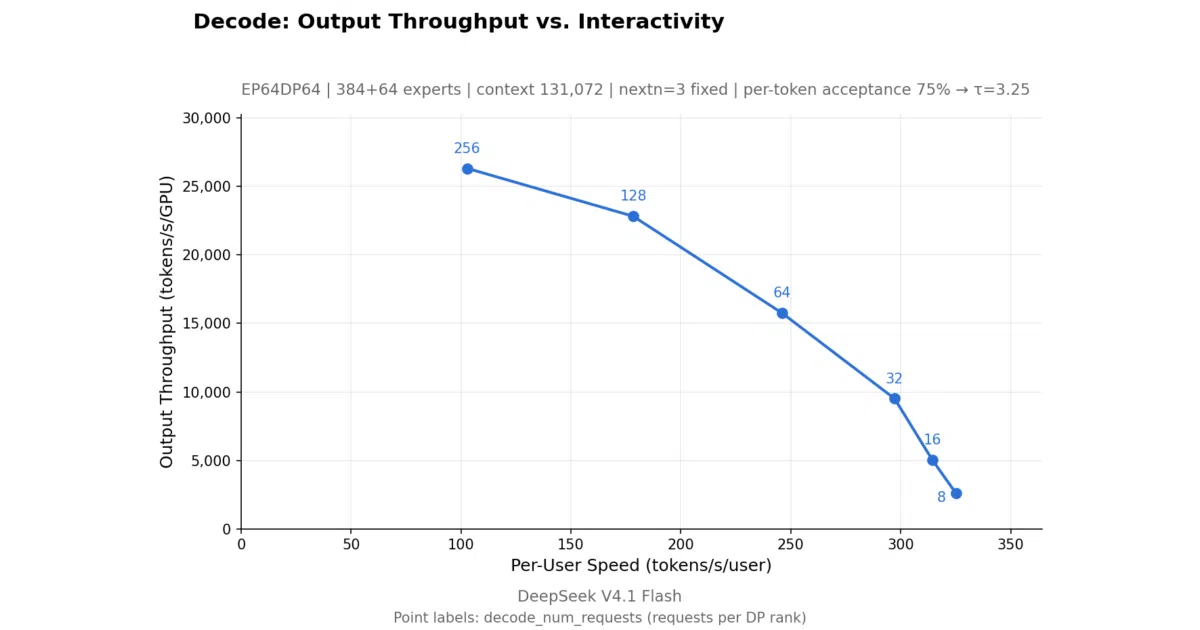
The single-model scope is another limit worth stating plainly. DeepSeek-V4.1-Flash only. No Llama, no Qwen, no distilled DeepSeek variants, no versioning information in the repo at all. The benchmark pareto charts in the README were measured on 4 SM100 GPUs for prefill and 64 for decode, each within one scale-up domain — serious hardware, seriously arranged, and a reminder that “large-scale” in the README is not marketing language. This is not a framework for the machine on your desk; it is a framework for the machine room, published for anyone who has one.
The day-old repo problem
For all the substance, the hype is currently outrunning the evidence. The repository has no history, no issues, no releases, and — as the Activepieces guide drily notes — none of its claims independently verified beyond checking the maker’s own pages. The Reddit thread announcing it exists mainly as a monument to Reddit’s network-security wall, so community reception is, at time of writing, mostly inference from the README itself. There’s a reasonable reading in which DeepInfer is a dump of internal code that will take weeks to build cleanly outside DeepSeek’s own environment, and a more optimistic reading in which the FlashMLA/DeepGEMM/DeepEP components — already battle-tested in the open — mean the integration layer is the only new surface. The truth will surface in the issue tracker, once it has one.
There is also a naming trap that the Activepieces piece flags correctly: deepinfer.org is an entirely different project — a Harvard- and UBC-affiliated model store for medical image analysis, currently celebrating version 1.2 and new models for radiology. Search engines are going to conflate these two for years. The medical-imaging DeepInfer predates the DeepSeek one by a wide margin and shares nothing with it but a name and a fondness for deep learning. If you found this article by searching “DeepInfer benchmarks,” make sure you know which one you were looking for.
Why this release fits the pattern
Context makes DeepInfer less surprising than it looks. DeepSeek has spent two years establishing itself as the lab that open-sources its infrastructure: the V3 model weights, R1, the MLA and GEMM and EP kernels, and now the runtime that orchestrates them. The BentoML guide traces the model lineage; DeepInfer completes the infrastructure lineage. The commercial logic is straightforward — DeepSeek’s moat, if it has one, is not the code but the operational knowledge of running it at scale, and releasing the code costs little while recruiting an ecosystem of contributors who debug your stack for free.
For the broader inference landscape, the significance is competitive pressure with a specific shape. vLLM, SGLang, and TensorRT-LLM now compete against a stack that runs DeepSeek’s actual production traffic on DeepSeek’s actual kernels for DeepSeek’s actual models. For DeepSeek-model workloads specifically, that’s a hard combination to beat. For everything else, DeepInfer is currently irrelevant — one model, two hardware targets, no serving layer. The framework-landscape surveys that frame inference as a trade-off between speed, scale, and flexibility have a new data point at the extreme end of speed-and-scale, and it’s a data point that happens to come with a receipts drawer.
The open questions are the obvious ones: whether the missing service components arrive in later releases, whether the Ascend support matures into a genuinely dual-stack framework or remains a CUDA project with an NPU port, and whether a repo with no history can attract the contributor base that its vLLM-derived architecture implies it wants. What’s not in question is the release’s basic character. DeepSeek has published the engine room — the boring, load-bearing, production-scarred machinery that most labs keep behind the wall. The parts they kept are the parts that were always about running a business. The parts they gave away are the ones that make everyone else’s engines better.
Sources
- Deepseek released DeepInfer - Open Source high- ...
- Choosing the right inference framework
- DeepSeek Use Cases: Top 10 Applications of AI Reasoning
- LLM Inference Frameworks 2025: Complete Guide
- Platform For AI:Deploy DeepSeek-V4 and DeepSeek-R1
- DeepInfer- Deep learning deployment toolkit and model ...
- What is LLM Inference? | IBM
- The Complete Guide to DeepSeek Models: V3, R1, V4 and ...
- DeepInfer
- An AI Engineer's complete LLM Inference Frameworks landscape 👇 | Alex ...
- DeepSeek Enterprise On-Premise AI Deployment: Full Guide
- Deepinfer (2026 Guide)