anomalyco/opencode · 10 Jun 2026 · Feature
OpenCode's 160K Stars Hide a Messier Truth About Open-Source AI Agents

Mateo Vargas
Contributing Editor
An open-source coding agent with staggering adoption and a privacy-first pitch, built on a foundation of breakneck releases, silent cloud calls, and a TypeScript monolith that chews through a gigabyte of RAM.
anomalyco/opencode
★221.6k stars Velocity · 7d +702 ★/day ↗accelerating
star history
The Hype Moment
OpenCode landed on Hacker News with the gravitational pull of a project that had already won. The numbers are, by any open-source standard, absurd: 160,000 GitHub stars, 900 contributors, 13,000 commits, and a claimed 7.5 million monthly developers [1]. For context, that star count puts it in the same stratosphere as projects like React or Kubernetes after years of accumulation, not months. The landing page—polished, multilingual, available in twenty-one languages—reads like the product of a well-funded company, not a scrappy GitHub repo.
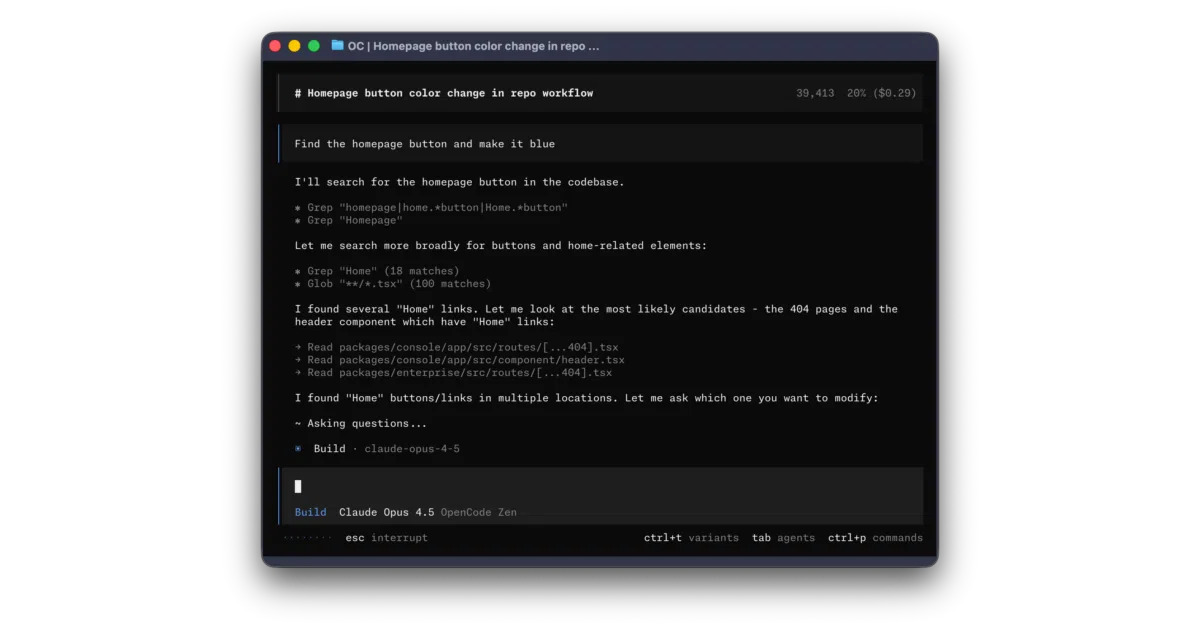
The timing helped. By early 2026, the AI coding assistant market had become a crowded bazaar: GitHub Copilot, Cursor, Claude Code, Cline, Windsurf, and dozens of others competing for terminal real estate [2][8]. Developers were exhausted by subscription fatigue and vendor lock-in. OpenCode’s pitch—“free models included or connect any model from any provider”—arrived like a pressure release. The project promised to absorb your existing subscriptions (GitHub Copilot, ChatGPT Plus/Pro) while offering its own “Zen” model tier, a curated set of benchmarked models for coding agents [1].
The installation story is aggressively frictionless: a curl-pipe-to-bash one-liner, every package manager imaginable, a desktop app in beta for all three major platforms, even a Nix flake for the reproducibility cultists [1]. This is distribution engineering as competitive advantage. Where other open-source agents make you clone and build, OpenCode meets you wherever you already live.
What It Actually Does
At its core, OpenCode is a terminal-based AI coding agent with a TUI (terminal user interface), a desktop application, and IDE extensions. It operates in the now-familiar agentic loop: plan, edit files, run terminal commands, browse documentation, validate results. The project distinguishes itself with two built-in agent modes—“build” (full access, default) and “plan” (read-only, asks permission before bash commands)—switchable with the Tab key [1]. There’s also a “general” subagent for complex searches, invoked with @general.
The technical architecture reveals both ambition and excess. LSP (Language Server Protocol) integration loads the right language servers for the LLM automatically. Multi-session support runs parallel agents on the same project. Shareable links allow session debugging and reference. The model routing is genuinely flexible: 75+ providers through Models.dev, including local models, plus direct integrations for GitHub Copilot and OpenAI accounts [1].
This model-agnosticism is the project’s genuine differentiator in a field increasingly defined by walled gardens. Claude Code works with Anthropic’s models. GitHub Copilot works with OpenAI’s. Cursor has its own orchestration. OpenCode’s bet is that developers will want to bring their own keys, switch providers, run local inference—treating the LLM as a commodity layer rather than a product identity.
The privacy positioning is equally deliberate: “OpenCode does not store any of your code or context data” [1]. In an era where enterprises are waking up to the legal and compliance risks of sending proprietary code to cloud APIs, this is a selling point with teeth.
The Mess Underneath
The Hacker News thread, however, reads like a post-mortem in real-time [12]. The top comment from user logicprog—who wanted to love the project—delivers a devastating inventory of structural problems. The development velocity is “extremely high cadence” to the point of dysfunction: releases ship without proper testing, changelogs, or stability. Features are added, removed, refined, changed, and broken in a continuous churn that makes the tool unpredictable.
The codebase itself is described as “an extremely large and complex TypeScript code base — probably larger and more complex than it needs to be.” The resource footprint is correspondingly bloated: “often uses 1GB of RAM or more. For a TUI.” The interface is “overbearing and a little bit buggy,” the agent “so full of features that I don’t really need — also mildly buggy — that it sort of becomes hard to use and remember how everything is supposed to work and interact.”
This is the classic open-source trap: infinite contributor energy without product discipline. More features, more surface area, more bugs, more confusion. The 900 contributors become less a sign of health than of coordination failure.
The Security Reckoning
More alarming are the security and transparency issues. User rbehrends identified that OpenCode “tries to pull its config from the web (provider-based URL) by default” and referenced an open GitHub issue suggesting a potential RCE vulnerability [12]. User heavyset_go discovered that “it also sends all of your prompts to Grok’s free tier by default, and the free tier trains on your submitted information.” The escape hatch—setting an explicit “small model”—is buried, not advertised.
User integralid confirmed the worst-case scenario for privacy-sensitive users: even with only a local model configured, prompts were silently sent to the cloud for session title generation. User lukewarm707 ran mitmproxy on version 1.2.20 and found that rather than falling back to the main model, OpenCode “silently calls opencode zen and uses gpt-5-nano” [12].
This is not merely a configuration issue. It is a design philosophy problem. The privacy-first marketing—“operate in privacy sensitive environments”—is undermined by default behaviors that prioritize convenience over disclosure. The “small_model” documentation states it “tries to use a cheaper model if one is available from your provider, otherwise it falls back to your main model” [12], but the observed behavior is different: it calls OpenCode’s own Zen service with a specific cloud model, regardless of user configuration.
The defense—that users should audit every update in a containerized, air-gapped environment—misses the point. If the project requires that level of operational paranoia to use safely, its accessibility promise becomes hollow.
The Competitive Landscape
OpenCode enters a field where the primitives of agentic coding are being established by others. Cline, the VS Code extension, has built its reputation on “permissioned tool use with diff previews and command approvals,” detailed logs, and offline-friendly local model support [3]. Its evaluation framework—openness, control, tooling depth, model flexibility—reads like a direct response to the problems OpenCode exhibits [3].
The broader market has bifurcated. On one side: closed, polished products (GitHub Copilot, Cursor, Claude Code) with predictable pricing and behavior. On the other: open-source agents (Cline, Continue, TabbyML) trading polish for control [2][8]. OpenCode straddles uncomfortably, claiming open-source virtue while operating with the opacity and resource appetite of a commercial product.
The 160,000 stars, it must be said, are not purely organic. The project’s marketing engine—Discord, X presence, multilingual documentation, desktop app distribution—suggests significant backing. The “Anomaly” copyright and .ai domain hint at venture funding. This is not a criticism; building infrastructure at this scale requires resources. But it complicates the open-source narrative. Is this a community project or a product acquisition funnel?
What It Means for AI Development
OpenCode’s trajectory illuminates a tension in the agentic coding movement. Developers are asking for “agents they can run, extend, and trust” [3]—transparent, scriptable, open. But trust requires more than source code availability. It requires predictable behavior, clear defaults, honest documentation, and development practices that respect the user’s operational context.
The project’s technical choices—a TypeScript monolith, web-fetched configuration, silent cloud fallbacks—reflect assumptions from web application development applied to local tooling. The gigabyte of RAM for a TUI suggests Electron or similar frameworks, convenient for developers but punishing for users. The cloud-dependent defaults assume always-on connectivity, ignoring the air-gapped, compliance-bound environments where open-source tools should shine.
There is a genuine need for what OpenCode attempts: a universal router for AI coding assistance, model-agnostic, privacy-respecting, deployable anywhere. The market is real—76% of developers already use or plan to use AI tools, per Stack Overflow’s 2024 survey [2]. But the implementation matters as much as the vision. An agent that silently exfiltrates prompts to trainable cloud models is not a privacy tool, whatever the README claims.
The Path Forward
OpenCode’s future depends on whether its maintainers can convert momentum into discipline. The feature churn must slow. The security defaults must flip—local-first, explicit opt-in for cloud calls, not opt-out. The codebase needs architectural attention, not more contributors. The 900 existing contributors are a liability if coordination mechanisms don’t scale.
The project has assets: genuine model flexibility, broad distribution, a privacy story that could be true if made operational, and a community that wants to believe. But the Hacker News thread is a warning. Developers who experimented early, who wanted to evangelize, are instead documenting failure modes. In a market where alternatives are maturing rapidly—Cline’s permissioned loops, Claude Code’s reliability, Cursor’s polish—OpenCode’s window for correction is not infinite.
The 7.5 million monthly developers deserve a tool that matches its marketing. The question is whether OpenCode can become that tool before its stars become a monument to what might have been.
Sources
- OpenCode | The open source AI coding agent
- The Best AI Coding Assistants: A Full Comparison of 17 Tools
- 12 Coding Agents Defining the Future of AI Development
- All AI Coding Agents You Know : r/OpenAI - Reddit
- 8 Best AI Coding Assistants [Updated May 2026]
- What is your opinion on Open Code? : r/opencodeCLI - Reddit
- 13 Best AI Coding Tools for Complex Codebases in 2026
- sourcegraph/awesome-code-ai: A list of AI coding tools ...
- OpenCode (@opencode) / Posts / X - Twitter
- Best AI Coding Agents Summer 2025 | by Martin ter Haak - Medium
- Best 50+ Open Source AI Agents Listed
- OpenCode – Open source AI coding agent - Hacker News