aiprodcoder/MIXAPI · 09 Jul 2026 · Feature
An Open-Source Gateway Bets AI-Optimized Code Can Tame LLM Chaos

Conor Walsh
Staff Writer
MIXAPI exists to collapse the sprawl of incompatible large-language-model APIs into a single, self-hosted OpenAI-compatible gateway with built-in key management, billing, and enterprise access controls.
aiprodcoder/MIXAPI
★734 stars
star history
The API Explosion and the Gateway Gap
The industry consensus is that AI is not merely another workload but a structural shift in how software consumes infrastructure. Marco Palladino, CTO at Kong, argues that the rise of large language models is comparable to the advent of mobile, cloud, or microservices, with one critical distinction: AI is fundamentally API-driven [2]. Users talk to models through APIs, and increasingly, agents talk to the world through APIs. Kong’s analysis notes that over 83 percent of current internet traffic is already API traffic, and AI is positioned to capture the lion’s share of net-new growth [2].
That volume creates a governance vacuum. Traditional API gateways were built for RESTful microservices; they do not natively understand token-based rate limiting, semantic caching, or model-context-protocol federation. A 2026 survey of the landscape by Zuplo observes that conventional gateways lack the primitives required for production AI workloads—specifically token-based throttling, multi-provider model routing, prompt-injection defense, and Model Context Protocol (MCP) support [6]. Without these, an enterprise cannot enforce per-user token budgets, route reasoning tasks to GPT-4 and summarization to Gemini, or sanitize prompts before they leave the perimeter. The result is a rush of specialized AI gateways, from cloud-native offerings like Azure API Management’s AI capabilities [5] to commercial proxies such as Gravitee’s LLM Proxy [8] and TrueFoundry’s middleware layer [3]. Into this crowded field steps MIXAPI, an open-source project that attempts to package all of these concerns into a single, self-hosted binary [12].
Fork, Merge, Conquer
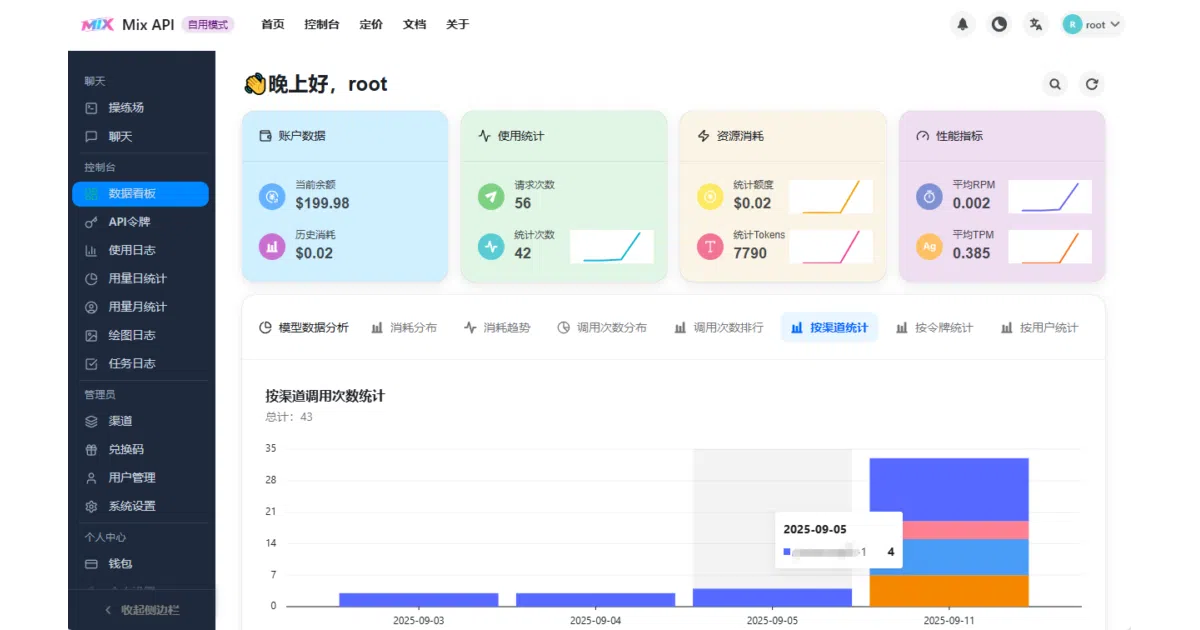
MIXAPI is not a clean-room implementation. It is explicitly built atop New-API and One-API, two earlier open-source gateways, and its authors describe it as having “integrated all important functions and issue improvements” from both predecessors [12]. The repository layers on a wide array of third-party plugins, billing modules, and administrative dashboards, billing itself as a “hexagonal warrior”—an all-rounder that handles routing, key management, secondary key distribution, usage analytics, and per-model access controls in one place [12].
The feature list reads like a product manager’s wish list for a multi-tenant LLM platform. It supports model routing for Gemini, Claude, Qwen3, Kimi-K2, Doubao, and others; it translates their native protocols into OpenAI-compatible, Claude-compatible, or Gemini-compatible endpoints [12]. It adds package-based billing (per-request and monthly plans), token-level rate limiting, channel-weighted random routing, and cache-aware charging so that repeated prompts can be billed at a reduced rate [12]. Administrative conveniences include data dashboards, daily and monthly usage statistics, Excel import/export for channel configuration, granular audit logging, and support for rerank models from Cohere and Jina [12]. The project even ships a separate enterprise edition, MIXAPI-PRO, that strips out user registration and public billing to focus on internal governance, security auditing, and privacy leak prevention [12].
In other words, MIXAPI’s primary technical insight is integrative rather than architectural. It treats the fragmentation of LLM backends as a UI and policy problem, not a networking protocol problem, and wraps the resulting complexity in a new interface.
The Performance Claim That Writes Itself
Where MIXAPI attempts to distinguish itself from its upstream ancestors is performance. The README states that the project used “AI large models for multi-round special optimization” of its core forwarding path, producing “efficient code that humans cannot imagine,” and claims this improves throughput in high-concurrency scenarios by more than 50 percent [12].
This is where the prose gets interesting and the evidence gets thin. The sources provide no benchmarks, no latency numbers under load, and no comparison methodology. The claim rests entirely on the romantic notion that an LLM can out-optimize a human on low-level request routing. Commercial proxies such as TrueFoundry cite specific figures—roughly 10 ms latency under load and 350 requests per second per vCPU [3]—while Gravitee offers out-of-the-box Elasticsearch-based metrics on model consumption, token usage, and configured costs, plus hard input-and-output token quotas per invocation [8]. MIXAPI offers only the rhetorical flourish of “using magic to beat magic” [12]. Whether the optimization is real, placebo, or merely standard Go concurrency patterns reframed as AI-generated remains unclear from the available material. What is clear is the irony: a gateway that routes AI traffic is marketing itself as having been written by the very kind of model it serves.
Two Products, One Governance Problem
Perhaps the most telling design choice is the split between MIXAPI and MIXAPI-PRO. The standard version is a full-service gateway with online recharge, user registration, and public token issuance—essentially a small SaaS platform in a box. The PRO edition, by contrast, removes the commercial surface area entirely and zeroes in on the anxieties that dominate enterprise AI adoption: internal API unification, call-frequency limits, sensitive-data auditing, and compliance [12].
This bifurcation mirrors a broader industry pivot. A recent analysis of enterprise LLM deployment argues that by 2026, open-source models have matured enough for most business use cases, and the primary constraint has shifted from raw model capability to governance—specifically, demonstrating appropriate data handling, access control, and accountability [11]. Regulatory frameworks such as the EU AI Act and India’s DPDP are pushing regulated industries toward hybrid or on-premise proxy architectures that keep sensitive data away from public endpoints [11]. MIXAPI-PRO is positioned squarely for this use case: a self-hosted, “autonomous and controllable” control point that sits between internal applications and cloud model providers [12]. It is the kind of on-premise proxy solution that the article identifies as gaining adoption in regulated industries that need to balance compliance with capability [11].
Where the Moat Is Shallow
For all its feature density, MIXAPI faces a market that is moving faster than its changelog. The 2026 gateway survey by Zuplo identifies MCP support as an emerging requirement for agentic AI infrastructure, alongside semantic caching and hierarchical budget controls [6]. Gravitee’s 4.10 release already bundles an LLM Proxy, an MCP Proxy, and an A2A Proxy into a single AI Agent Management Platform [8]. Azure API Management offers a unified model API that automatically translates formats across OpenAI, Anthropic, and Google Vertex while embedding governance directly into Microsoft Foundry [5]. TrueFoundry’s proxy adds input sanitization, PII filtering, and prompt-injection defense [3]. MIXAPI’s README, by contrast, makes no mention of MCP, A2A, semantic caching, or adversarial prompt filtering.
What MIXAPI offers instead is immediacy. It ships as a single executable and a container image, targets local deployment, and provides a Mandarin-friendly administrative interface with Excel import/export for channel management [12]. For individual developers or small teams in China navigating a domestic LLM landscape that includes Qwen, Kimi, and Doubao alongside Western models, that convenience may outweigh the absence of bleeding-edge protocol support. It is, in the most generous reading, ambitious glue code: a consolidation layer for a market that is still standardizing.
Outlook
The project’s trajectory depends on whether it can evolve from a feature-aggregating fork into a distinct architectural voice. The commercial gateway sector is already converging on agent-to-agent protocols, token-based rate limiting with hard enforcement, and cloud-agnostic edge deployment [6][8]. MIXAPI’s current value lies in packaging existing open-source components into a turnkey, self-hosted system with native billing and access controls. If the team behind it can substantiate those AI-driven performance claims with reproducible benchmarks, and if it can add support for emerging standards like MCP before the market locks in around larger vendors, it may carve out a durable niche. Otherwise, it risks becoming a transitional convenience—a stepping stone between raw API chaos and the mature, enterprise-grade AI gateways that are now arriving in force.
Sources
- mixapi: Home
- What is an AI Gateway? Concepts and Examples
- What Is LLM Proxy?
- mixmaster-app/mixapi - GitHub
- AI gateway capabilities in Azure API Management
- Best API Gateways for AI and LLM Workloads (2026)
- Mix.api - Nuance Docs
- LLM Proxy: One Front Door to Multiple LLM Providers
- The Mix API | Laravel Mix Documentation
- API Gateways vs AI Gateways - Boomi
- On-Prem vs. Proxy Solutions for Secure LLM Usage
- MIXAPI - AI Model Interface Management - Shyft