affaan-m/ECC · 10 Jun 2026 · Feature
The Config Pack That Treats AI Agents Like a Production Stack

Mateo Vargas
Contributing Editor
ECC is a cross-harness operator system that packages institutional knowledge for Claude Code, Cursor, Codex, and OpenCode—because prompt engineering alone doesn't scale.
affaan-m/ECC
★288.9k stars Velocity · 7d +799 ★/day ↘cooling
star history
The Problem with Agentic Workflows
By early 2026, the AI coding assistant market had fragmented into a dozen competing harnesses—Claude Code, Cursor, OpenCode, Codex, GitHub Copilot, Zed, Gemini CLI—each with its own plugin format, context window behavior, and hook architecture. Developers who switched tools lost their carefully tuned prompts. Teams who adopted agents found that raw model access produced inconsistent output: the same task that worked Tuesday hallucinated a deprecated library on Wednesday. The productivity gains were real but fragile, contingent on individual operators remembering which prompts worked and which models handled which tasks.
Enterprise adoption stalled for related reasons. A survey of engineering leaders found that while 70% cited velocity as their top goal, 59% worried about security threat vectors from AI-generated code, 53% distrusted output quality, and maintainability emerged as the critical blocker for low-adoption teams. The tools were being treated as productivity enhancers rather than as infrastructure requiring governance, versioning, and operational discipline.
What ECC Actually Ships
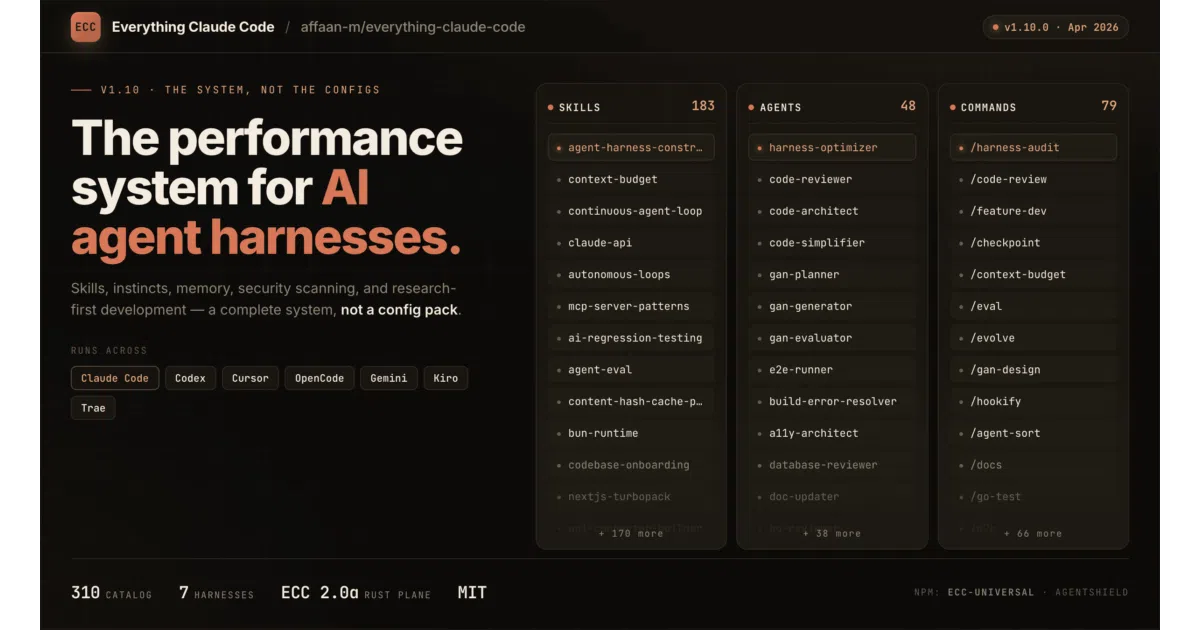
ECC (the repository is affaan-m/ECC, though the acronym appears to have no fixed expansion in the project itself) is a harness-native operator system: a structured collection of 63 agents, 249 skills, 79 legacy command shims, and cross-platform hook scripts designed to make AI-assisted development reproducible across tools. It is not a model or a framework in the conventional sense. It is institutional knowledge encoded as markdown files, JSON configurations, and Node.js scripts—versioned, installable, and incrementally updatable.
The project distinguishes between several surfaces. Agents are subagent definitions with scoped tool access and model routing: code-reviewer gets Read, Grep, Glob, and Bash; planner gets a broader set; security-reviewer runs with stricter sandboxing. Skills are the primary workflow surface—markdown files with YAML frontmatter that define how to execute a task (TDD workflow, security review, e2e testing) rather than merely describing it. Rules are always-follow guidelines organized into common/ (language-agnostic principles) and language-specific directories. Hooks are trigger-based automations that fire on tool events—warn about console.log in TypeScript files, block dev servers outside tmux, detect secrets in prompts before submission.
This structure matters because it separates what the operator wants done from how any particular harness executes it. The same tdd-workflow skill runs under Claude Code’s plugin system, Cursor’s hook adapter, OpenCode’s event pipeline, or Codex’s instruction-based AGENTS.md—with format translations handled by install scripts rather than human memory.
Cross-Harness Architecture: The DRY Adapter Pattern
The technical insight that makes this feasible is what the project calls the DRY adapter pattern. Cursor exposes 20 hook events to Claude Code’s 8; OpenCode exposes 11 with a different plugin API. Rather than maintaining separate hook implementations, ECC’s Cursor adapter transforms Cursor’s stdin JSON into Claude Code’s format, then delegates to shared scripts/hooks/*.js files. The Codex path lacks hooks entirely, so ECC compensates with AGENTS.md instructions, sandbox permissions, and optional model_instructions_file overrides.
This is not seamless integration—it is explicit translation with acknowledged limitations. The project documents where each harness falls short: GitHub Copilot has no hook system or subagent API; Codex has no hook execution parity; Cursor’s native agent loading behavior varies by build. ECC does not paper over these gaps. It provides fallback paths and warns when features are unavailable.
The install system reflects this pragmatism. A selective install architecture with install-plan.js and install-apply.js lets users target specific components for specific harnesses. The state store tracks what’s installed and enables incremental updates. A configure-ecc skill provides guided setup with merge/overwrite detection. The project explicitly warns against stacking install methods—running ./install.sh --profile full after /plugin install ecc@ecc creates duplicate skills and runtime behavior.
Token Optimization as Operational Discipline
One of ECC’s more distinctive contributions is treating context window management as a production concern rather than a user inconvenience. The project documents specific settings: cap MAX_THINKING_TOKENS at 10,000 rather than the default 31,999; override CLAUDE_AUTOCOMPACT_PCT_OVERRIDE to 50% for earlier compaction; default to Sonnet rather than Opus for routine tasks. It warns that each MCP server description consumes tokens from the 200k window, potentially reducing effective context to ~70k, and recommends keeping under 10 MCPs enabled and under 80 tools active.
The strategic-compact skill suggests /compact at logical breakpoints—after research, after milestones, after failed approaches—rather than relying on auto-compaction at 95% context. This is boring operational advice, but it is exactly the kind of boring advice that prevents the 3 AM session where the agent forgets the variable names from the first half of the conversation.
Security: AgentShield and the Red-Team/Blue-Team Pipeline
Built at the Cerebral Valley x Anthropic hackathon in February 2026, AgentShield is ECC’s security auditor with 1,282 tests, 98% coverage, and 102 static analysis rules. It scans CLAUDE.md, settings.json, MCP configs, hooks, agent definitions, and skills across five categories: secrets detection (14 patterns), permission auditing, hook injection analysis, MCP server risk profiling, and agent config review.
The --opus flag runs three Claude Opus 4.6 agents in an adversarial pipeline: an attacker finds exploit chains, a defender evaluates protections, and an auditor synthesizes both into a prioritized risk assessment. This is adversarial reasoning rather than pattern matching, and it reflects a broader project philosophy that security cannot be bolted onto agentic workflows—it must be embedded in the operator system itself.
The Hermes Operator Story and ECC 2.0 Alpha
Version 2.0.0-rc.1, released April 2026, adds what the project calls the “public Hermes operator story”—a set of outbound workflows including brand-voice, social-graph-ranker, connections-optimizer, and customer-billing-ops. These are not coding tasks; they are business operations packaged with the same agentic discipline as software development workflows. The release also includes media tooling (manim-video, remotion-video-creation), prediction-market skill packs (ito-market-intelligence, ito-basket-compare), and optimization skills (parallel-execution-optimizer, benchmark-optimization-loop).
Beneath the surface, a Rust control-plane prototype in ecc2/ now builds locally and exposes dashboard, start, sessions, status, stop, resume, and daemon commands. The project describes this as “usable as an alpha, not yet a general release”—a candid assessment that matches the broader tone of the documentation, which freely acknowledges rough edges and version-specific behaviors.
Position in the Landscape
ECC occupies an unusual position in the 2026 AI coding ecosystem. It is not a model (OpenAI’s Codex ranks first on Terminal-Bench 2.0 with GPT-5.5; Claude Code places second with Opus 4.7). It is not an IDE (Cursor surpassed $2 billion in annualized revenue by March 2026; GitHub Copilot remains the most widely adopted assistant). It is infrastructure for making these tools consistent and governable.
The project’s own comparison table shows Claude Code leading in agents (63), commands (79), and skills (249), with OpenCode offering more hook events (11 vs. 8) and better custom tools. ECC’s value proposition is not that any single harness is best, but that teams can maintain operational continuity across harnesses as the market evolves. The 12 language ecosystems supported—from TypeScript and Python to Perl, ArkTS, and HarmonyOS—reflect a similar breadth-over-depth strategy.
Tensions and Unresolved Questions
The project faces the classic open-source sustainability challenge. A single maintainer ships weekly across seven harnesses, funded by GitHub Sponsors and a $19/seat/month Pro tier for private repositories. The GitHub App has 150 installs. The npm packages show weekly downloads but the README does not specify volumes. The 182K+ stars and 28K+ forks cited in the header appear to be aspirational or decorative—the actual GitHub star count at the time of the README’s writing is unclear from the sources provided.
More substantively, the project’s very breadth creates maintenance burden. Each new harness version risks breaking hook behavior, as documented in the repeated fix/revert cycles around Claude Code’s hooks.json auto-loading (issues #29, #52, #103). The Codex path’s lack of hook parity means security enforcement is instruction-based rather than runtime-guaranteed. And the prediction-market skills, while publicly documented, keep live API access “gated and separate from ECC Tools billing”—a separation that may prove fragile.
The broader market context is also mixed. While 85% of developers use AI tools, trust in accuracy has dropped to 29%, with senior engineers showing the highest distrust. Code verification has emerged as a distinct category, exemplified by Qodo’s $70 million raise. ECC’s emphasis on verification loops, eval harnesses, and pass@k metrics addresses this directly, but it cannot resolve the fundamental tension: models that generate plausible code do not necessarily generate correct or secure code, and institutionalizing their use does not eliminate this risk.
Sources
- Essex County College - Newark
- 8 Best AI Coding Assistants [Updated May 2026]
- AI code generation: Best practices for enterprise adoption in 2025 - DX
- ECC - Buffalo
- Beyond the Vibes: A Rigorous Guide to AI Coding Assistants and ...
- AI Code Generation Explained: A Developer's Guide - GitLab
- ECC - Home
- Best AI Coding Agents in 2026, Ranked - MightyBot
- Generative AI Tools for Software Development | Coding Temple
- Early Childhood Center
- Five Best Practices for Using AI Coding Assistants | Google Cloud Blog
- Why aren't more companies using AI coding tools? - LinkedIn