Nutlope/hallmark · 18 Aug 2026 · Feature
Hallmark Wants to Cure AI-Generated Design Sameness

Brandon Cole
Staff Writer
A rule set for AI coding agents that treats generic frontend output as a quality failure to be caught before commit.
Nutlope/hallmark
★29.7k stars Velocity · 7d +54 ★/day ↗accelerating
star history
The Slop Era
You can spot an AI-generated website from across a conference room. The hero section is always centered, the gradient is always purple-to-blue, and the headline is always some variation on “Unlock Your Potential.” This is frontend’s particular strain of AI slop: not broken, just aggressively median. An analysis of 211 million lines of code from 2020 through 2025 found that duplicated code blocks in AI-assisted repositories grew four- to eight-fold, with copy-pasted code exceeding refactored code for the first time in 2024 [12]. The same research notes that heavy AI users generated nine times more short-term churn. The problem is not that the code fails; it is that it is structurally correct yet architecturally thoughtless, polished enough to pass review while silently eroding coherence [12].
Frontend code is especially vulnerable. A survey of AI coding tools specifically identifies generated UI as suffering from incomplete validation, error handling, responsiveness, and accessibility, and singles out GPT for producing subpar designs [3]. One-shot prompts that generate entire application stacks deliver quick prototypes, but the resulting “AI slop” typically requires significant production rework [3]. The web is beginning to look like it was designed by a single large language model trained on every Dribbble shot from 2022—because, in many cases, it was.
Hallmark, a new open-source skill from Together AI, enters this landscape with a blunt premise: the default output of an LLM is a design bug, not a feature. It does not promise to build faster. It promises to build differently.
A Skill, Not a Framework
Hallmark is not a component library, a CSS framework, or a no-code builder. It is distributed as a markdown rule set and a folder of reference files that integrate with Claude Code, Cursor, or Codex. Users add it through standard skill registries or by copying the SKILL.md and references/ folder into the agent’s skills directory. The entire artifact lives in a single markdown file and a set of supporting documents. At its core, Hallmark is a very long and very opinionated prompt.
That distinction matters. Most attempts to improve AI-generated design have focused on better models, bigger context windows, or richer image inputs. Hallmark treats the model as a given and attacks the process instead. It assumes that LLMs are trained on average, on-distribution defaults, and that the only way to escape the beige is to force the agent to make a sequence of irreversible design decisions before it writes a single line of HTML. There is no runtime, no package to import, no build step. The enforcement is entirely conversational, which means the skill is only as strong as the agent’s willingness to obey it.
The Four Verbs
The project organizes its functionality around four verbs, and they reveal its real subject: quality governance disguised as code generation.
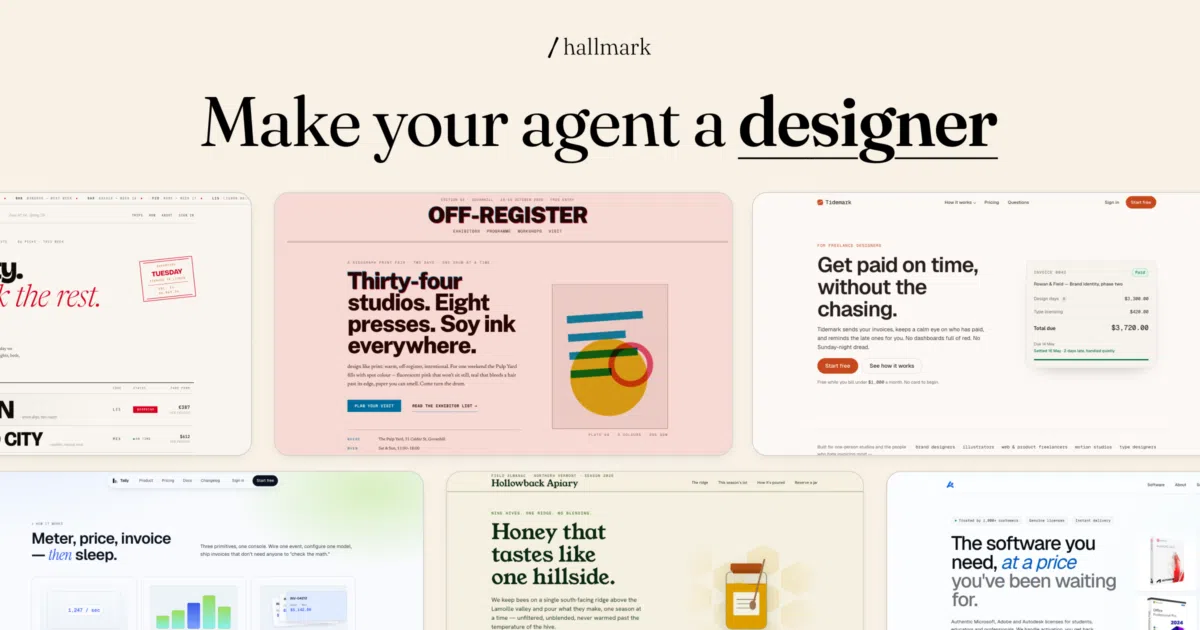
The default verb builds new UI. Rather than asking the model to “make a landing page,” Hallmark forces it to first pick a macrostructure—an editorial split-screen, an atmospheric hero, a dense SaaS grid, a playful studio layout—then dress it in one of twenty-two themes. Only after that structural commitment does it run what the project describes as sixty-five slop-test gates plus a pre-emit self-critique. The README claims that two pages generated for two different briefs feel like different sites, not color-swaps of the same template. The live demos support this: a SaaS product page, a travel booking site, a coffee subscription service, and a ceramics studio each carry distinct macrostructures, type pairings, and color anchors. Every page is self-contained HTML and CSS, stamped with its chosen structure in a CSS comment.
The audit verb scores existing code against the same anti-patterns, emitting a punch list without editing. This is an explicit recognition that slop is already in the codebase and that the first step toward recovery is measurement. The redesign verb keeps the copy, information architecture, and brand intact but throws out the structure and rebuilds with a different fingerprint. It is an admission that iterative tweaking will not cure default-ism; sometimes you have to burn the layout and start over.
The study verb is perhaps the most technically interesting. It ingests a screenshot or URL and extracts what Hallmark calls the “DNA”—macrostructure, type-pairing, colour anchor—while explicitly refusing to produce pixel-clones or copy paid templates. It can optionally emit a portable design.md for handoff to other AI tools. This is not scraping; it is an attempt to teach an agent to see like a designer, to identify why a layout works rather than simply what it looks like. In a landscape where agents are prone to drifting from project conventions over long conversations [9], having a structured, portable design brief becomes a form of context management.
Governance by Prompt
The broader software quality conversation suggests why this kind of intervention might be necessary. A GitHub Community discussion documents a persistent failure mode: even when projects maintain clear standards for folder structure, naming, and architecture, AI assistants gradually drift from conventions as a conversation lengthens [9]. The accepted remedy is to make rules machine-enforceable and to provide short, dedicated documents rather than vague, sprawling instruction blocks. Hallmark is essentially an extreme version of that prescription—a dedicated, machine-readable design constitution that sits in the agent’s context window.
Other research reinforces the need for governance layers as AI generation scales. An analysis of over 40,000 developers across more than one hundred companies found that while some organizations see modest quality gains from AI adoption, others watch their Change Failure Rate rise by more than fifty percent compared to pre-AI levels [2]. The nature of defects shifts toward hidden configuration issues, hardcoded secrets, and copy-pasted defaults that appear correct initially but fail in production [2]. Organizations with fast CI/CD feedback loops generally absorb AI-assisted velocity without major quality degradation, whereas teams with slow or brittle QA processes see CFR spikes because downstream systems cannot handle the increased throughput [2]. In testing, higher volumes of AI-generated tests do not automatically improve coverage; QA must govern scenario relevance, business context, and validation data [5]. Hallmark applies that same governance philosophy to the visual layer. It is, in effect, a QA engineer for taste, insisting that generation volume means nothing if every page shares the same macrostructure.
There is an irony here. The project warns against on-distribution defaults, yet any static rule set risks becoming its own kind of default. If thousands of developers feed Hallmark’s sixty-five gates into their agents, those gates could calcify into a new orthodoxy. The project attempts to dodge this by randomizing macrostructure selection and theme assignment per brief, but the long-term tension is unresolved. As one QA analysis notes, AI efficiency depends on data size and quality, and its hidden decision-making process complicates trust [11]. Hallmark’s gates are hidden inside a markdown file; we must trust that they are the right gates.
Limits and Open Questions
Hallmark is explicitly frontend-only. It will not catch the hardcoded secrets, hidden configuration issues, or backend architectural drift that plague AI-assisted codebases [2]. Its sixty-five slop-test gates are opaque; the README points to SKILL.md, but independent verification is difficult. And because it is a prompt-layer tool rather than a runtime linter, its enforcement depends entirely on the agent’s willingness to comply. If Claude Code or Cursor decides to prioritize recent user instructions over older skill rules—a known failure mode [9]—there is no compilation error.
There is also the matter of taste. Hallmark’s twenty-two themes and macrostructures are curated by its authors, which means it exports a specific aesthetic: clean, editorial, slightly quirky, web-native. That is a narrower domain than “all web design.” A brutalist or maximalist brief might find the gates as constraining as the defaults they seek to escape. The study verb’s refusal to clone paid templates is ethically sound, but it also means the tool cannot perfectly replicate a reference you might legitimately want to emulate.
Still, the project correctly identifies the real bottleneck in AI-assisted development. The industry has spent two years optimizing for tokens-per-second and context-window size, only to discover that speed without judgment produces slop [3]. Hallmark bets that the scarce resource is not generation velocity but decision-making quality: forcing an agent to choose a structure, defend it against its own critique, and refuse the on-distribution default.
Whether that bet pays off depends on whether developers use it as a starting point or a crutch. If it becomes another dependency to blindly install, it will eventually generate its own recognizable fingerprint—the Hallmark look. If it is used as a template for how to interrogate AI output, it may prove more valuable than any of its twenty-two themes.
Sources
- Hallmark Channel TV Official Site
- AI's impact on software quality is variable and unevenly distributed.
- 5 Things To Avoid When Working With AI Coding Tools
- Hallmark Greeting Cards, Gifts, Ornaments, Home Decor & Gift ...
- How QA must adapt to AI-assisted development - K2view
- One Simple Trick to Avoid AI Slop While Getting Better at ...
- Hallmark+ | Exclusive Series & Movies + Rewards
- Top 10 AI Tools Transforming Software Quality Assurance - Keploy
- How do you prevent AI coding assistants from gradually ...
- Hallmark (@hallmark) • Instagram photos and videos
- Incorporating AI in quality assurance testing | Valtech
- What Is AI Slop? Detect & Prevent Low-Quality AI Code