JCodesMore/ai-website-cloner-template · 30 Jun 2026 · Feature
How a Next.js Template Became the Assembly Line for AI Clones

Vanessa Cho
Staff Writer
This template orchestrates AI agents into a pipeline that reverse-engineers live websites into componentized Next.js code.
JCodesMore/ai-website-cloner-template
★36.2k stars Velocity · 7d +191 ★/day ↗accelerating
star history
The Hype Moment
Since appearing on GitHub on March 29, 2026, the repository has accumulated 23,153 stars and 3,306 forks. Those numbers do not accrue to a novel neural network or a new programming language. They belong to a template—a reusable scaffold that teaches AI coding agents how to dismantle a live website and rebuild it inside a modern React codebase. The attraction is a single automation that promises to turn a URL into a stack of components, design tokens, and assets without manual transcription.
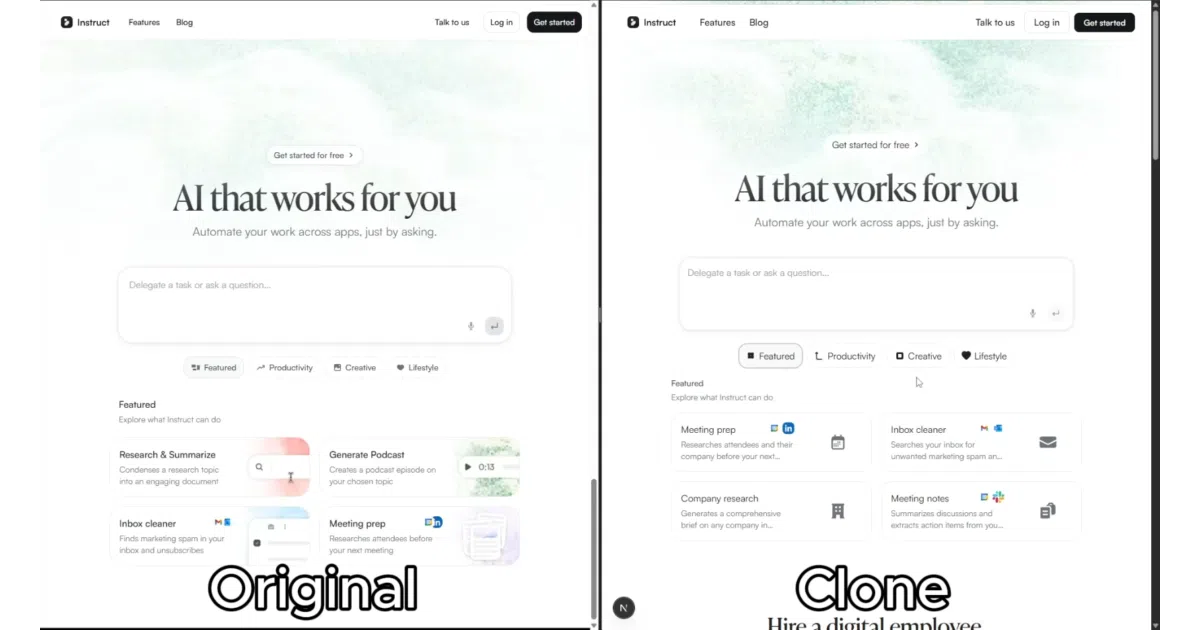
The timing matters. The developer tooling landscape of 2026 is crowded with agents competing to replace typing with orchestration. Cursor has become the default AI IDE for daily shipping, Claude Code is regarded as the strongest raw coding brain, and OpenAI’s Codex ranks first in several benchmarks after an April update. Against that backdrop, a template that does not ship its own model but instead harnesses whichever agent a developer already uses feels like a pragmatic bet. It acknowledges that the action has shifted from writing code to directing autonomous systems, a shift that some observers describe as the transition from builder to architect.
The Pipeline
What separates this project from a browser Save As or a static scraper is a five-phase pipeline that treats replication like a software engineering problem rather than a prompt engineering stunt.
The first phase is reconnaissance. The agent captures screenshots, extracts design tokens, and performs an interaction sweep—scrolling, clicking, hovering, and testing responsive breakpoints—to build a behavioral model of the target. The second phase lays the foundation: fonts, color globals, and asset downloads. The third phase is where the real work happens. The agent writes detailed component specifications to disk, recording exact computed CSS values, state definitions, interaction models, and responsive breakpoints. These are not guesses based on class names; they are measurements.
The fourth phase dispatches builder agents into parallel git worktrees, one per section or component. Each builder receives the full specification inline—computed styles, asset paths, and state logic—and constructs its assigned piece in isolation. The fifth phase merges the worktrees, wires the page together, and runs a visual diff against the original. The use of git worktrees for parallel agent execution is a genuinely interesting architectural choice. It prevents collision during simultaneous writes and mirrors the multi-agent worktree patterns that platforms like Codex are also beginning to adopt.
The output is a Next.js 16 application using the App Router, React 19, strict TypeScript, shadcn/ui with Radix primitives, Tailwind CSS v4 configured with oklch design tokens, and Lucide React icons that are replaced by extracted SVGs during the clone. The result is a living codebase, not a static HTML dump.
Agent Agnosticism in a Fragmented Market
The template supports more than a dozen agents: Claude Code with Opus 4.7 is recommended, but Codex CLI, OpenCode, GitHub Copilot, Cursor, Windsurf, Gemini CLI, Cline, Roo Code, Continue, Amazon Q, Augment Code, and Aider are all listed as compatible. This breadth is not accidental. The current agent market is fractured. Faros AI identifies Cursor, Claude Code, Codex, Copilot, and Cline as front-runners, while MightyBot’s rankings place Codex at number one following an April 2026 update and Claude Code at number two, noting that Anthropic recently issued a postmortem on quality issues tied to default effort changes and stale-session bugs.
Rather than betting on a single winner, the template treats agent support like a compilation target. Two files serve as the single source of truth for project instructions and the cloning skill. Sync scripts regenerate platform-specific copies automatically. This is a bet on standardization: if agents can read a common instruction format, the template becomes portable across the entire ecosystem. MightyBot notes that Codex already supports this instruction file format, suggesting the idea is gaining traction.
Code-First Cloning in a Design-Tool World
The project enters a field already occupied by polished SaaS tools. Anima’s Link to Code converts live public websites into editable React or HTML, emphasizing semantic components and responsive output. UX Pilot offers an AI website cloner that generates high-fidelity, multi-page sites from a URL, with export options to Figma and production-ready HTML. Figma Make generates fully interactive, code-backed prototypes from text prompts.
This template occupies a different niche. It is not a GUI application or a hosted service. It is a local, developer-owned pipeline that produces a modern, componentized codebase intended for ongoing maintenance. Where Anima and UX Pilot target designers and product managers who want immediate visual fidelity, this tool targets engineers who need to migrate a WordPress or Webflow property into Next.js, recover source code lost to a departed contractor, or deconstruct how a production site achieves a specific layout. The README is admirably upfront about the legal and ethical guardrails, explicitly prohibiting phishing, impersonation, and terms-of-service violations. That is what you do when you build a photocopier and want to avoid becoming a litigation magnet.
The Limits and Liabilities
For all its stars, the template is not without rough edges. A security scan from April 17, 2026, returned a WARNING status with five npm-audit findings, including two high-severity issues: a Next.js Denial of Service vulnerability involving Server Components and a path-to-regexp Denial of Service via sequential optional groups. Three medium-severity issues in unrelated dependencies were also flagged. These are fixable, but they are a reminder that scaffolding code still carries the liability of its dependency tree.
More fundamentally, the project is sophisticated glue code. Its value lies in orchestration—spec generation, worktree management, and visual diffing—not in a proprietary model or algorithm. That is both its strength and its ceiling. The quality of the final clone depends entirely on the agent doing the building, and agents have off months. Anthropic’s April postmortem on Claude Code quality issues is a timely reminder that autonomous coding tools are still subject to regression. If the recommended engine misfires, the assembly line slows down.
Outlook
The 23,000 stars suggest that demand for automated reverse-engineering is real and growing. The template’s architecture—spec-driven development, parallel agent worktrees, and cross-platform instruction files—points toward a future where cloning is table stakes. What remains unresolved is the gap between replication and comprehension. A pipeline can reproduce a website’s surface with mechanical precision, but maintaining, evolving, and securing that codebase still requires human judgment. The agentic era may have turned developers into architects, yet someone still has to read the blueprints.
Sources
- What is the best AI agent for Web dev prototyping? - Reddit
- Free Prototyping Tool: Build Interactive Prototype Designs - Figma
- ai-website-cloner-template - AI Agents on GitHub (23.2k ) | SkillsLLM
- Best AI Coding Agents for 2026: Real-World Developer Reviews
- My 9 Best AI Prototyping Tools in 2026 - UX Pilot
- AI Website Cloner Template download | SourceForge.net
- AI Agents for Web Development: From Code to Deployment - Lyzr
- Clone website: Turn any website into React or HTML code instantly
- I made this Claude Code skill to clone any website - Reddit
- Best AI Coding Agents in 2026, Ranked - MightyBot
- I know my way around Figma, what other prototyping tool ... - Reddit
- Website Cloner – Clone Any Website Design Instantly - UX Pilot