CyberStrikeus/CyberStrike · 29 Jun 2026 · Feature
The Open-Source Swarm Turning Your LLM Into a Red Team

Samantha Lowe
Staff Writer
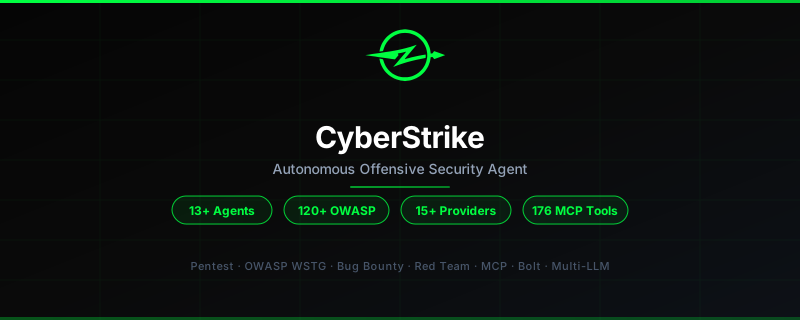
CyberStrike converts general-purpose language models into autonomous offensive-security agents by wrapping them in a domain-specific intelligence layer that orchestrates tools, browsers, and remote execution nodes.
CyberStrikeus/CyberStrike
★3k stars Velocity · 7d +20 ★/day ↗accelerating
star history
The security industry is currently obsessed with the idea that large language models can do more than draft phishing emails. Industry observers argue that AI is reshaping penetration testing from slow, manual, periodic assessments into continuous, autonomous simulations requiring minimal human input, and a wave of projects is pulling that capability into the open-source mainstream by treating the LLM as a reasoning engine rather than a chatbot. CyberStrike arrives at this moment with a specific proposition: take your existing Claude, GPT, or local Ollama subscription, plug it into an open-source framework, and deploy a swarm of thirteen specialized agents that conduct reconnaissance, exploitation, and reporting without billing you for a separate SaaS inference layer.
The timing is deliberate. The field is already crowded with commercial entrants—XBOW, which briefly held the top rank on HackerOne; Ghost Security’s Reaper; and the CAI framework, which claims to solve CTF challenges eleven times faster than human players. Meanwhile, managed security providers like Thrive and BreachLock market autonomous penetration testing as a lower-cost alternative to traditional red teams, and vendors such as Picus Security describe graph-based attack-path mapping that continuously enumerates identity relationships and infrastructure misconfigurations from an assumed-breach perspective. Even the publishing world has taken notice: Manning Publications is preparing a textbook on AI agents for offensive security by researcher Mark Foudy, suggesting the discipline is moving from experiment to curriculum. CyberStrike distinguishes itself from this wave by refusing to own the model. Its bring-your-own-key architecture means your data never transits through a vendor’s AI backend, and your costs scale with the API plan you already have. For air-gapped environments, it runs entirely offline via local models. That combination—open source, model-agnostic, and subscription-leveraging—has made it a focal point for developers who want the capabilities of a commercial autonomous pentest platform without the lock-in.
What prevents CyberStrike from being merely a thin wrapper around an LLM API is its insistence on an “intelligence layer” that sits between the model and the target. The problem with asking a general-purpose model to perform a penetration test is not just that it lacks tool access; it is that each provider returns structured data differently, drifts between conversational turns, and leaks context across phases. CyberStrike addresses this with four mechanisms: schema normalization, which forces consistent structured output regardless of whether the underlying model is Claude, GPT-4.1, or a local GGUF; a context guard that constrains the agent to the current test phase and prevents prompt leakage; provider auto-detection that removes manual endpoint configuration; and tool orchestration that chains security tools based on intermediate findings rather than executing rigid, pre-written scripts.
Supporting more than fifteen providers—from Anthropic and OpenAI to Groq, Mistral, DeepSeek, and fully offline Ollama deployments—means the framework cannot rely on any single model’s native tool-calling format. The intelligence layer abstracts these differences so that an agent expecting a structured vulnerability report receives the same schema whether the inference ran on Amazon Bedrock or a local vLLM instance. This provider agnosticism is the project’s central architectural bet: as models improve or cheaper alternatives emerge, the methodology layer remains constant.
The framework ships with thirteen domain-specific agents—covering web application, mobile, cloud, internal network, and general offensive operations—each loaded with proven methodology rather than generic reasoning patterns. The web-application agent follows OWASP WSTG and covers more than one hundred twenty test cases; the cloud agent references CIS benchmarks and executes over fifteen hundred checks; the mobile agent understands Frida and MASTG. This matters because autonomous pentesting lives or dies on methodological coverage. A model that improvises reconnaissance may miss subtle authorization bypasses; one that follows a checklist can still fail if it cannot adapt. CyberStrike attempts to split the difference by embedding the checklist into the agent’s system context while allowing the LLM to decide which tool to invoke next.
For vulnerability confirmation, the proxy testers employ a three-gate protocol: establish a baseline request, execute the attack variant, and compare the responses. A finding is reported only when a measurable, reproducible delta exists. Duplicate detections are suppressed across the session. This design directly engages with a central tension in AI-driven offensive security: large language models hallucinate and behave non-deterministically, but those weaknesses can be mitigated—or even exploited—when strong external verifiers are available. As NYU professor Brendan Dolan-Gavitt argued in a 2024 Samsung security keynote, offensive security is uniquely suited to AI adoption because the target system itself provides an unforgiving ground truth. CyberStrike’s three-gate protocol is a practical instantiation of that argument; the target’s response, not the model’s confidence, determines whether a vulnerability is real.
The framework’s built-in Chromium instance, HackBrowser, captures this philosophy in a concrete workflow. It operates in two modes: manual browsing, where the operator navigates the target and every HTTP request is silently routed into the proxy pipeline, and autonomous crawling, where the browser logs in as multiple users, maps reachable endpoints, and builds a live session context of credentials, roles, and accessible functions. That context is shared across eight parallel proxy sub-testers—IDOR, authorization bypass, mass assignment, injection, authentication, business logic, SSRF, and file attacks—without manual credential setup. The testers know which token represents a high-privilege baseline and which represents a low-privilege attack because the browser phase inferred it. Scope control is handled through domain restrictions that automatically cover subdomains under a registered domain, and the entire pipeline feeds a shared session context that eliminates the tedious account-management overhead typical of multi-role testing.
This local intelligence is paired with a distributed execution layer called Bolt. Rather than running scanners on the operator’s laptop, CyberStrike can orchestrate one or many remote tool servers over the Model Context Protocol, authenticated via Ed25519 key pairs. One local terminal instance can direct multiple Bolt nodes positioned at different network vantage points, each with its own toolkit and attack-surface access. Communication between the local terminal and remote Bolt nodes uses the Model Context Protocol over HTTPS, with Ed25519 key pairs replacing passwords or shared secrets. The result is a trust model with minimal attack surface: the operator’s machine holds no long-lived credentials for the remote servers beyond the paired keys, and the remote servers need only expose the MCP endpoint to the paired client. The separation of the reasoning layer from the execution layer is architecturally sound: it allows heavy scanning to run on cloud instances with better bandwidth while keeping the LLM inference and vulnerability database local. It also means the framework can scale horizontally without turning the operator’s machine into a noisy single point of failure.
The broader MCP ecosystem extends this modularity. CyberStrike integrates with open-source MCP servers for cloud auditing, GitHub security posture, CVE intelligence, and OSINT reconnaissance, adding up to over one hundred seventy-six security tools. These are not hard-coded adapters; they are discoverable services that any MCP-compatible client can consume. The project is therefore positioning itself less as a monolithic pentest suite and more as a platform for agentic security workflows. A plugin SDK allows custom agents and tools to be registered at runtime, and the web interface—accessible via a locally bound server—provides tabs for chat, MCP health, Bolt monitoring, and vulnerability triage.
Whether CyberStrike represents a genuine shift in offensive-security tooling or simply the best-marketed open-source entrant in a hype cycle remains an open question. The project claims over seven thousand offensive-security skills, support for more than eight hundred models across one hundred forty-four providers, and a seventy percent reduction in vulnerability-assessment time, but independent benchmarks are not available in the provided materials. The autonomous pentesting space is awash with bold claims—one competing framework reportedly solved CTF tasks three thousand six hundred times faster than humans—and CTF performance does not always translate to the messy, idiosyncratic reality of enterprise infrastructure.
There is also the unresolved tension of dual-use. CyberStrike’s AGPL-3.0 license and explicit ethical-use policy frame it as an authorized-testing tool, yet the same autonomous agents and remote execution nodes that streamline compliance assessments could streamline unauthorized intrusions. The architecture—local LLM inference, tunneled web access, and distributed Bolt servers—emphasizes privacy and operator control, which are virtues for legitimate red teams and equally attractive for evasion. The project offers commercial licensing for non-open-source use, a tacit acknowledgment that the business model depends on enterprises that need legal cover rather than community access.
What is clear is that CyberStrike has identified a specific gap: security professionals want the automation promised by AI pentesting startups, but they want it on their own hardware, with their own models, and under their own control. By wrapping general-purpose LLMs in a domain-specific intelligence layer, normalizing outputs across fifteen-plus providers, and wiring the result into a browser-driven proxy pipeline and remote tool mesh, the project treats the model as a commodity and the methodology as the product. The open-source release under AGPL-3.0 invites scrutiny, which is perhaps the most important feature of all. An offensive-security tool whose reasoning is hidden inside a proprietary black box can never be fully trusted by the paranoid culture that red teaming cultivates. By open-sourcing the intelligence layer, CyberStrike subjects its methodology to the same adversarial review it promises to inflict on target applications. Whether that review validates the hype or exposes brittle assumptions is now a question for the community, not the marketing department.
Sources
- Cyberstrike - AI-Powered Penetration Testing Agent
- AI Agents for Offensive Security - Mark Foudy - Manning Publications
- What is Autonomous Penetration Testing? - BreachLock
- CyberStrike Training - Idaho National Laboratory
- Offensive Security Through AI Agents | by Keval Jagani - Medium
- Automated Penetration Testing (APT) Guide - Picus Security
- Cleared & Defense Tech Recruiting | CyberStrike Group
- How we built an AI agent security swarm for offensive security testing
- How AI Is Changing Penetration Testing - IoT For All
- CyberStrike - Wikipedia
- [SSTF2024] Invited Talk 1 : AI Agents for Offensive Security - YouTube
- Autonomous Penetration Testing - Thrive's NextGen