AgriciDaniel/claude-seo · 30 Oct 2026 · Feature
An SEO Auditor That Tells You How to Prove It Wrong

Tyler Brennan
Staff Writer
Claude SEO turns the site audit — an industry built on unfalsifiable PDFs — into a local, parallel, primary-source-grounded Claude Code skill, and its most interesting feature is the failure check attached to every recommendation.
AgriciDaniel/claude-seo
★24k stars Velocity · 7d +801 ★/day ↗accelerating
star history
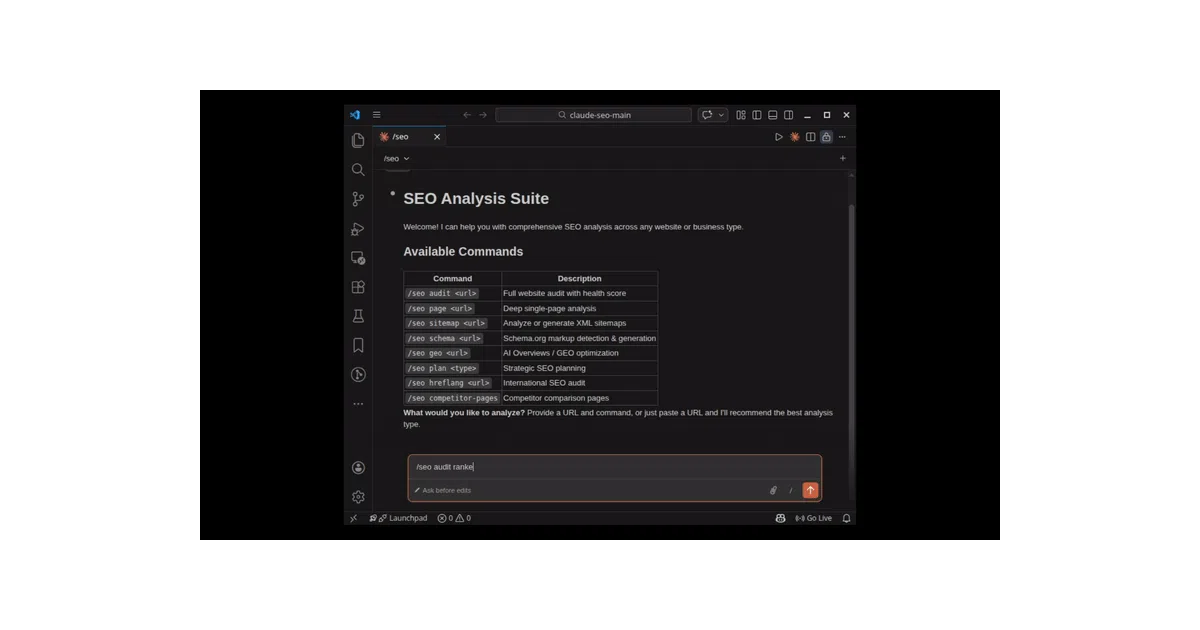
Every industry eventually gets the tool it deserves, and SEO has deserved a lot of things. The latest arrival is Claude SEO, an MIT-licensed plugin for Claude Code that runs a full site audit — technical SEO, content quality, Schema.org markup, AI-search readiness, local, e-commerce, international — by fanning work out across up to 15 parallel specialist agents and synthesizing the results into a prioritized action plan. What makes it worth a closer look is not the fan-out, which is now table stakes for agent frameworks, but a stranger commitment: every recommendation it emits carries an explicit “how would we know this failed?” check and a leading indicator to watch. In a field where audit deliverables are famously unfalsifiable walls of findings, that is close to heresy.
The moment: skills, GEO anxiety, and a very online maintainer
The attention around this project sits at the intersection of two currents. The first is the rapid maturation of Claude Code’s Agent Skills standard — composable, auto-discovered capability packages that turn a coding agent into a domain specialist. The second is the industry-wide panic about generative engine optimization, or GEO: the fear that as AI Overviews, ChatGPT, and Perplexity absorb the query stream, brands that aren’t cited by models will simply go unseen. Semrush’s practical guide to GEO frames the stakes bluntly — brands mentioned in AI answers enter the consideration set; those omitted may go unseen. Coursera now runs a dedicated GEO course with over ten thousand enrolled learners. Agencies have rebranded their service pages overnight.
Into this anxiety market walks a free, local, open-source tool. The project’s own marketing site claims 19.7K GitHub stars and a demo video past 31K YouTube views — figures I can’t independently verify, and the site is run by the project’s author, so treat them as self-reported. But the surrounding discourse is real: YouTube tutorials on Claude-based SEO workflows are pulling tens of thousands of views, and Reddit threads with titles like “Claude is my entire SEO team” signal a genuine grassroots shift of SEO work into the terminal. (The specific threads I attempted to check were blocked by Reddit’s network security, so I can’t verify their claims — but their existence is itself a data point about where the practice is moving.)
What it actually is: an orchestrator with a citation habit
Strip away the banner art and the command palette, and Claude SEO is a three-layer system: a directive layer, an orchestration layer, and an execution layer of 25 sub-skills and 18 specialist agents, auto-discovered from the repo’s skill and agent directories. The orchestrator detects the site’s industry — SaaS, local, e-commerce, publisher, agency — and dispatches parallel sub-agents across technical, content, schema, and AI-search dimensions before running everything through a scoring engine that emits the weighted 0–100 health score and the action plan. The project’s site is candid about what that score is: a triage heuristic, not a Google metric. That candor is a recurring and welcome trait.
The more interesting design decision is epistemic. The plugin’s methodology page describes a ten-principle framework across four phases — perceive, analyze, validate, act — and the validation phase is where the falsifiability requirement lives. Each recommendation ships with four fields: the first-principle observation it rests on, its dependency relationships to other recommendations, an explicit failure check, and a leading indicator. This is, roughly, the Popperian hygiene that software engineering adopted for tests and that SEO consulting has resisted for decades. An agency deck that says “improve E-E-A-T signals” cannot be wrong. A finding that says “this recommendation failed if the metric it names hasn’t moved by the checkpoint” can be. Clients can verify it. That is the whole point.
The other pillar is primary-source grounding. The plugin’s guidance is keyed to Google’s actual documents — the Search Quality Rater Guidelines as updated in September 2025, the Core Web Vitals spec where INP replaced FID in March 2024, the schema deprecation record (HowTo rich results removed September 2023, FAQ restricted to government and healthcare authority sites, a wave of type retirements in June 2025). This matters because the SEO tooling market, as the README itself puts it, tends to lag Google’s guidance by six to twelve months. A tool whose reference files track the changelog is a tool whose findings are less likely to be advice about a web that no longer exists.
The GEO posture: debunking the layer above it
Here is where Claude SEO is most contrarian, and most aligned with the boring truth. Google’s own AI optimization guide states that generative features are grounded in the same ranking systems as classic Search — retrieval-augmented generation pulls from the core index, and “AEO” and “GEO” are, in Google’s words, rebranded labels for SEO. Claude SEO takes this seriously enough to build evidence-based rebuttals of three popular influencer claims into its AI-search skill: that llms.txt is a citation lever (it isn’t, per the plugin’s primary-source evidence file), that content chunking is required, and that AI-specific keyword rewriting is necessary when synonym understanding suffices.
This puts it at odds with a chunk of the GEO industry. The agency Search Influence, for instance, promotes chunking as one of the three biggest GEO changes, arguing LLMs read 150–300 word blocks. Claude SEO’s citability scoring does have a structural analog — it scores self-contained answer passages in the 134–167 word range, question-based heading hierarchy, attribution density, and entity presence across Wikipedia, Reddit, YouTube, and LinkedIn — but it frames these as ordinary content quality, not a new discipline. The disagreement is instructive: one side sells a new science, the other insists the old science still applies with updated citations. Google’s documentation, at least, backs the second position.
Honest about the competition, honest about the edges
The README’s comparison section is unusually candid for a project README, and worth taking seriously precisely because it concedes ground. Screaming Frog crawls deeper and faster at the link-graph level; Ahrefs brings a proprietary backlink index that Claude SEO doesn’t attempt to replicate, instead integrating with Ahrefs through an MCP extension. The pitch is not “replaces your crawler” but “adds LLM-driven synthesis, conversational iteration, and AI-search-first auditing in the same environment as your other work.” That’s a fair description of the actual gap in the market. The commercial agentic-SEO space is moving the same direction — RankUp’s ranking of AI SEO agents describes tools with reasoning, tool access, and memory replacing the keyword-tool-to-dashboard pipeline — but those are hosted SaaS products with subscription pricing. Claude SEO’s counter-offer is that the audit runs locally, the data stays on your machine, the output is Markdown and PDF and JSON you own, and the license is MIT.
The limitations section is also honest, which is more than most. The v2 headless renderer — Playwright Chromium with trafilatura for content extraction — handles most single-page apps, but pages with scroll-bound hydration or post-interaction content fetches still produce noisy findings, and the recommended workaround is a manual cross-check against a visual snapshot. Without Google API credentials, Core Web Vitals are lab estimates only and indexation is inferred rather than observed. These are real boundaries, stated plainly.
The rough edges you should actually weigh
Now the skepticism, because a feature article owes you that. First, this is a single-maintainer project with a funnel. The author, who describes himself as an AI Workflow Architect, runs a free Skool community and a paid Pro community, and there’s a private mirror of the repo with early access for members. None of this is hidden — it’s disclosed at the top of the README — but it means the open-source repo is also, functionally, a lead-generation asset for a paid community. Whether that bothers you is a values question, not a technical one, but it should temper the “community project” framing. The contributor table does show genuine outside contributions from a community challenge — semantic clustering, an SXO skill, a drift monitor, hreflang enhancements — so it’s not purely a one-man show.
Second, the numbers drift. The README describes 25 sub-skills, 27 commands, and 271 passing tests; the project’s marketing site describes 26 sub-skills, 34 commands, and 9 extensions at version 2.5.0. Version skew between a README and a website is normal, but in a project whose entire value proposition is tracking fast-moving primary sources precisely, imprecision in its own self-description is a small irony. Third, the headline benchmarks — 10–15 minute audits, 4× audit cadence, the comparison table’s cost figures — are self-constructed, and the README admits your numbers may differ. The 271-test suite, including 83 SSRF and DNS-rebinding bypass tests, is a genuinely good sign for a tool that fetches arbitrary URLs; the marketing framing around it is marketing.
Fourth, and most fundamentally: an LLM-driven audit is only as good as its grounding, and grounding is exactly where LLMs are weakest. The project clearly knows this — the primary-source reference files, the falsifiability checks, and the per-PR audit gate are all mitigations — but a tool that synthesizes findings conversationally inherits the model’s tendency to sound confident about things it half-knows. The falsifiability requirement is the right structural defense: it converts the audit from an oracle into a hypothesis generator with receipts.
Where this is heading
The roadmap points toward “audit-as-code” in v3 — deterministic, scriptable, diffable audits — which is the natural endpoint of the falsifiability thread: if every finding carries a failure check, the audit itself becomes a regression test for your website. The surrounding ecosystem is already interoperating: a sibling blog-writing skill, an image-generation skill, a Codex port for OpenAI’s CLI, and a community marketing skill, all designed to chain audit findings into content production. That chaining — audit, then write, then generate assets — is the real workflow bet: not one tool, but a local pipeline.
The broader context supports the direction. A widely shared experiment in agentic SEO workflows found that a single LLM silently ignored two-thirds of 900 keywords, while a designed workflow — batching, independent processing, a second model for cleanup — clustered 3,000 keywords flawlessly in seconds. The lesson was that the value lives in the system around the model, not the model. Claude SEO is that lesson, applied to auditing: structure, constraints, and primary sources enforced by design, with parallelism where it helps and falsifiability where it counts.
Whether it survives its single-maintainer fragility and its community-funnel economics is an open question. But as a statement of what an SEO audit should be — local, grounded, parallel, and disprovable — it’s the most intellectually honest thing the GEO gold rush has produced so far. Which, granted, is a low bar. Still, it clears it.
Sources
- Google's Guide to Optimizing for Generative AI Features on ...
- 9 Best AI Agents for SEO, Ranked by Workflow and Output ...
- Claude is my entire SEO team. 1.5M+ impressions in 3 ...
- AI SEO: Mastering Generative Engine Optimization (GEO)
- The 2026 Guide to Agentic SEO Workflows
- Claude SEO - Free AI SEO Audit Tool for Claude Code
- AI SEO / GEO / Generative Engine Optimization
- Do AI SEO Agents actually work? Looking for real results
- Claude SEO Skill — AI-Powered SEO, GEO & AEO Audits
- Generative Engine Optimization (GEO): A Practical Guide
- How AI Agents Make SEOs More Valuable (Not Less!)
- How I Use Claude Skills For SEO To Rank #1 On Google (Step- ...