znxlwm/UGATIT-pytorch
Teaching GANs to focus before they redraw your selfies
This PyTorch port exists because image-to-image translation works better when the model actually looks at what needs changing before it redraws anything.
Not currently ranked — collecting fresh signals.
star history
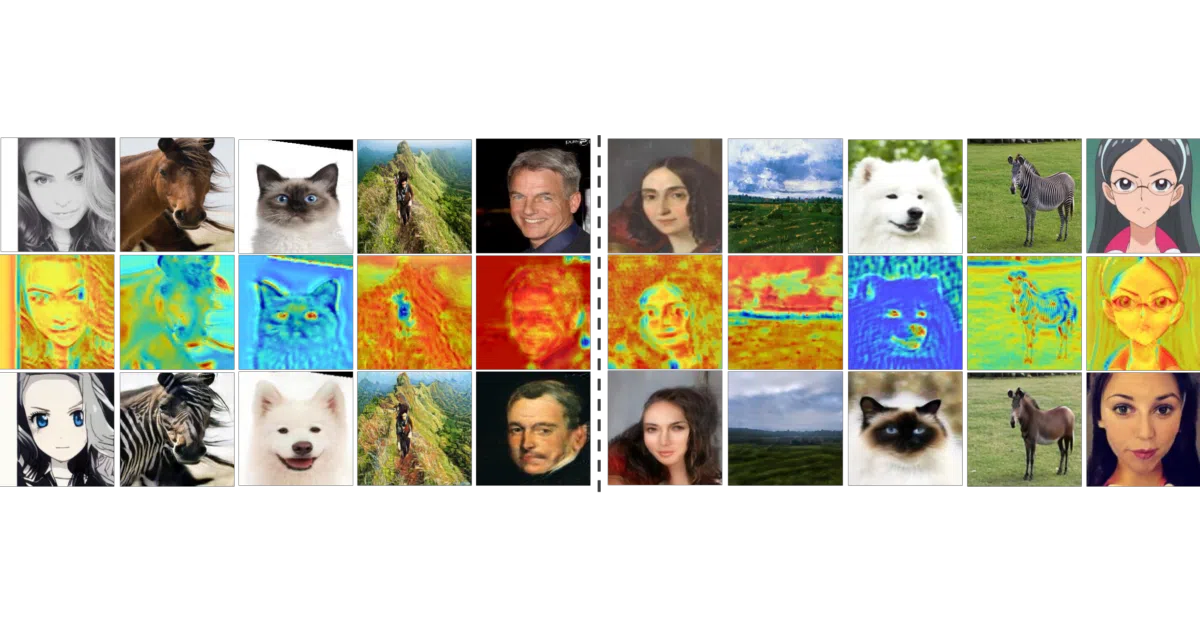
What it does U-GAT-IT performs unsupervised image-to-image translation—think selfies to anime—by training on unpaired photos from two domains. An attention module, fed by an auxiliary classifier, highlights the regions that actually separate the domains, while an adaptive normalization layer called AdaLIN decides how strongly to alter shape versus texture. The goal is to handle both subtle retexturing and dramatic geometric changes in one fixed architecture.
The interesting bit Most attention-based image translators choke when domains differ in overall geometry; this one claims to survive large shape changes because its attention maps explicitly guide the generator toward structurally important regions. AdaLIN then learns per-dataset how to balance layer and instance normalization, effectively tuning the aggressiveness of the rewrite on the fly.
Key highlights
- Uses an auxiliary classifier to generate attention maps that focus domain-specific changes.
- AdaLIN adaptively controls the trade-off between shape deformation and texture transfer.
- Includes a
--lightmode for training on memory-constrained GPUs. - The README notes that all paper results were produced with the original TensorFlow code.
Caveats
- Paper results came from the TensorFlow implementation, so it is unclear whether this PyTorch port matches reported performance.
- No pre-trained checkpoints or detailed benchmark tables are shown in the provided sources.
Verdict Useful if you want a PyTorch-native reference for attention-guided translation or need to experiment with adaptive normalization. Avoid if you require out-of-the-box reproduction of the paper’s exact metrics.
Frequently asked
- What is znxlwm/UGATIT-pytorch?
- This PyTorch port exists because image-to-image translation works better when the model actually looks at what needs changing before it redraws anything.
- Is UGATIT-pytorch open source?
- Yes — znxlwm/UGATIT-pytorch is open source, released under the MIT license.
- What language is UGATIT-pytorch written in?
- znxlwm/UGATIT-pytorch is primarily written in Python.
- How popular is UGATIT-pytorch?
- znxlwm/UGATIT-pytorch has 2.5k stars on GitHub.
- Where can I find UGATIT-pytorch?
- znxlwm/UGATIT-pytorch is on GitHub at https://github.com/znxlwm/UGATIT-pytorch.