xxlong0/Wonder3D
Single-image 3D reconstruction via coupled RGB-normal diffusion
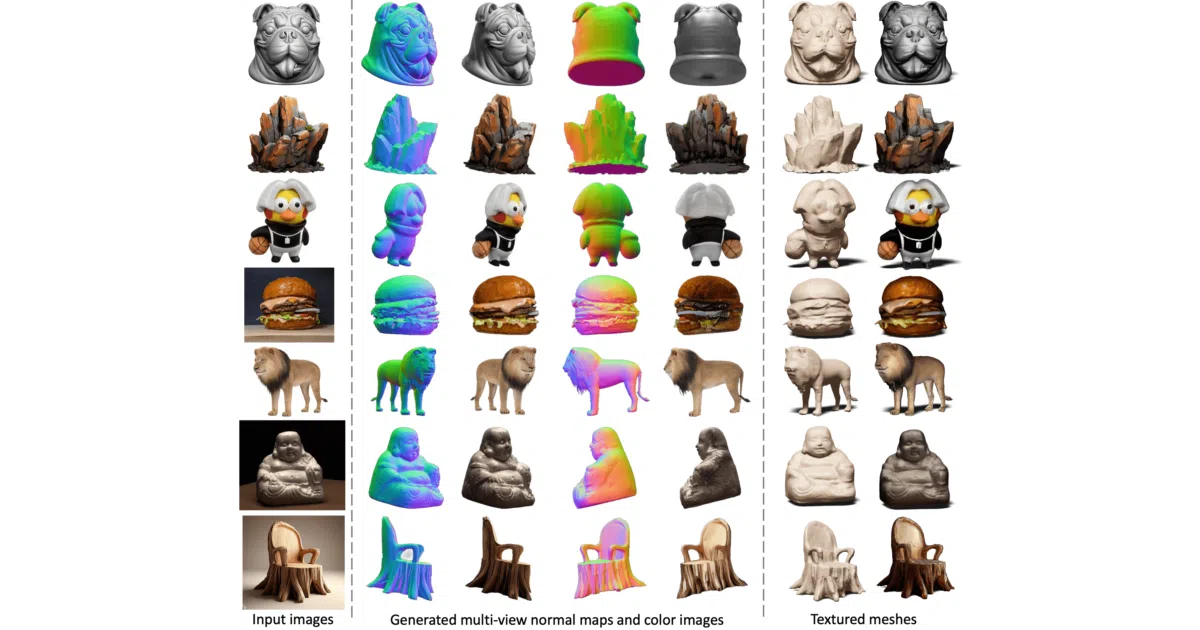
Wonder3D turns one photo into a textured 3D mesh by jointly diffusing multi-view color images and surface normals, then fusing them.
Not currently ranked — collecting fresh signals.
star history
What it does
Wonder3D takes a single image and reconstructs a textured mesh in roughly two to three minutes. It first uses a cross-domain diffusion model to generate six orthographic views—both RGB color images and corresponding normal maps—then reconstructs geometry via normal fusion. The authors bill it as a CVPR 2024 Highlight.
The interesting bit
Rather than estimating camera elevation or focal length, the model assumes an orthographic camera tied to the input image’s own coordinate system. A cross-domain attention mechanism keeps the RGB and normal generation aligned, though the README notes this required a non-standard batch ordering to work correctly with classifier-free guidance.
Key highlights
- Jointly generates multi-view color images and normal maps via cross-domain diffusion.
- Reconstructs meshes using a normal fusion method rather than direct regression.
- Runs inference in about 2–3 minutes per image.
- Offers both
Instant-NSRandNeuSback-ends for mesh extraction, trading speed against robustness. - Training and inference code are both available, alongside a Hugging Face demo and Colab notebook.
Caveats
- Output is limited to six views at 256×256 resolution, so fine detail is constrained.
- Front-facing, centered objects with minimal occlusion work best; real-captured photos can suffer from focal-length distortion because the model assumes orthographic projection.
- The pipeline is sensitive to mask quality, and the default
Instant-NSRreconstruction has drawn Windows setup complaints.
Verdict
Worth a look if you need quick, single-image 3D prototypes and can live with low-resolution, front-facing assets. If you need arbitrary camera angles, high fidelity, or clean Windows support out of the box, the authors themselves point to newer successors like Era3D.
Frequently asked
- What is xxlong0/Wonder3D?
- Wonder3D turns one photo into a textured 3D mesh by jointly diffusing multi-view color images and surface normals, then fusing them.
- Is Wonder3D open source?
- Yes — xxlong0/Wonder3D is open source, released under the MIT license.
- What language is Wonder3D written in?
- xxlong0/Wonder3D is primarily written in Python.
- How popular is Wonder3D?
- xxlong0/Wonder3D has 5.4k stars on GitHub.
- Where can I find Wonder3D?
- xxlong0/Wonder3D is on GitHub at https://github.com/xxlong0/Wonder3D.