wq2012/SpectralCluster
Google's speaker diarization clustering, rebuilt in Python
A faithful-ish Python port of the spectral clustering algorithms behind Google's diarization papers — refinements, constraints, streaming and all.
Collecting fresh signals — velocity needs a few days of history.
collecting data…
star history
What it does
SpectralCluster re-implements, in Python, the spectral clustering algorithms from Google’s speaker diarization research — the ICASSP 2018 LSTM diarization paper, the Turn-to-Diarize constrained clustering paper, and the multi-stage streaming clustering paper. You feed it an embedding matrix (typically speaker embeddings) and get cluster labels back via SpectralClusterer.predict(). It’s the boring math between “we extracted embeddings” and “we know who spoke when” — which is exactly where diarization systems live or die.
The interesting bit
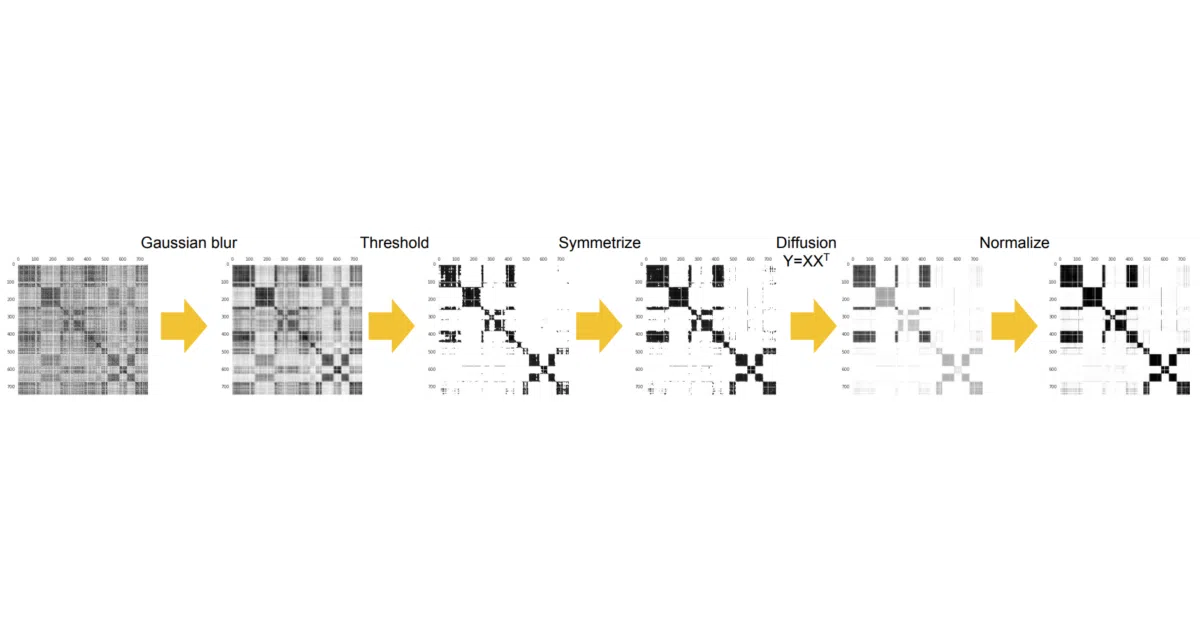
The refinement sequence applied to the affinity matrix before eigendecomposition is what made the 2018 paper work, and it’s fully exposed here: Gaussian blur, row-wise thresholding, and the quirky CropDiagonal trick that mimics a Laplacian while being more blur-tolerant. There’s also auto-tuning of the p_percentile threshold, constrained clustering driven by speaker-turn scores, and a MultiStageClusterer whose streaming_predict revises earlier labels as each new embedding arrives — corrections included.
Key highlights
- Four Laplacian variants (affinity, unnormalized, graph cut, random walk) plus pluggable affinity functions and K-Means distances (cosine by default, any scipy distance works)
- Constrained spectral clustering via affinity integration or constraint propagation from speaker-turn scores
- Streaming multi-stage clustering with a Hungarian-based
Deflickerto stop labels flapping between frames - Fallback clusterers for degenerate cases (too few embeddings, single-cluster decisions)
max_spectral_sizecaps the Laplacian for speed by pre-clustering hierarchically — at some quality cost
Caveats
- The author is explicit: this is a demonstration, not a reproduction — not the original C++ code, not a Google product, and some features may be missing or incomplete
- Speaker turn detection itself is not implemented; the multi-stage code covers only fallback, main, pre-clusterer, and dynamic compression
- The API changed when the newer algorithms landed; anyone on the old interface is pointed back to version 0.1.0
Verdict
If you’re building diarization or any embedding-clustering pipeline and want to try the exact techniques from Google’s papers without reading C++, this is the reference. If you just need generic clustering, scikit-learn already has you covered.
Frequently asked
- What is wq2012/SpectralCluster?
- A faithful-ish Python port of the spectral clustering algorithms behind Google's diarization papers — refinements, constraints, streaming and all.
- Is SpectralCluster open source?
- Yes — wq2012/SpectralCluster is open source, released under the Apache-2.0 license.
- What language is SpectralCluster written in?
- wq2012/SpectralCluster is primarily written in Python.
- How popular is SpectralCluster?
- wq2012/SpectralCluster has 558 stars on GitHub.
- Where can I find SpectralCluster?
- wq2012/SpectralCluster is on GitHub at https://github.com/wq2012/SpectralCluster.