veasion/AiPPT
PowerPoint's JSON doppelgänger: AI writes it, browser renders it
A JavaScript toolkit that turns AI-generated outlines into real PPT files—and back again—without leaving the browser.
Not currently ranked — collecting fresh signals.
star history
What it does
AiPPT is a browser-based pipeline for generating and manipulating PowerPoint presentations. Feed it a topic, a file, or a URL and it spits out a PPT. It also runs in reverse: upload an existing deck and get a JSON representation you can edit in the browser, then re-export to PPTX. The project is pitched as “commercial-grade” and offers a hosted API, but the core engine is open source.
The interesting bit
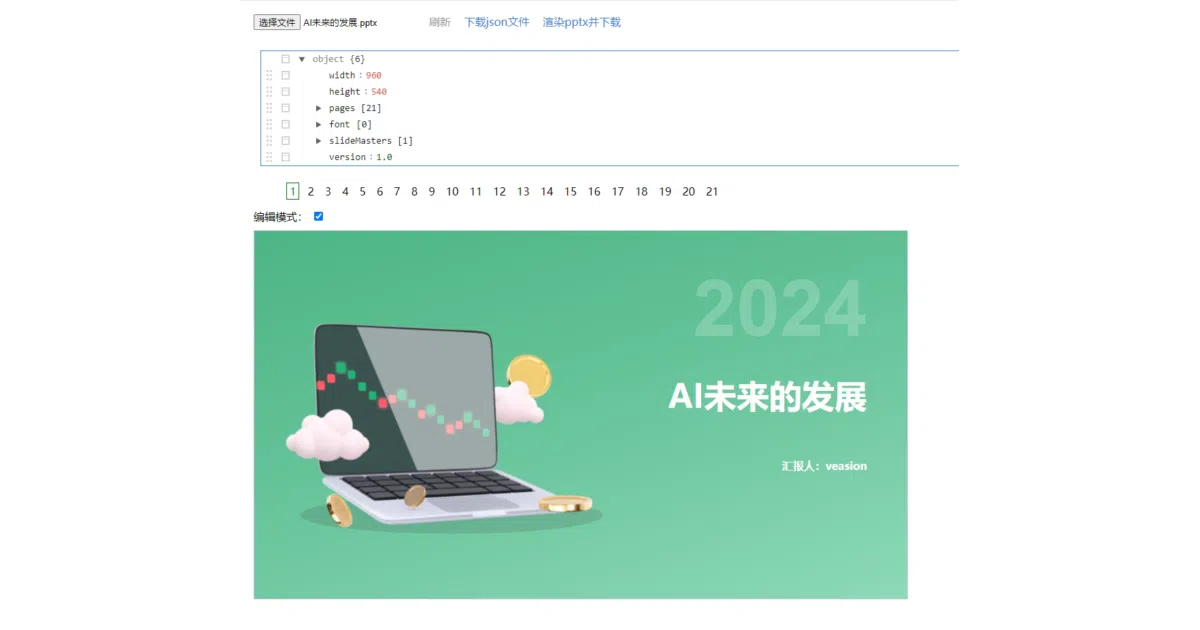
The bidirectional JSON bridge is the quiet workhorse here. Most AI slide tools treat PPT as a write-only format; this one parses native charts, animations, and even 3D effects into a structured intermediate format, lets you mess with it, then bakes it back into a real Office-compatible file. That’s the kind of boring-but-hard problem that usually lives in proprietary software.
Key highlights
- Generates PPT from topics, documents, or URLs via AI
- Parses existing PPTs to JSON with support for charts, animations, and 3D effects
- Browser-based editor for JSON-derived slides with re-export to PPTX
- Custom template support and “intelligent animation” addition
- Live demos at GitHub Pages; commercial API and private deployment available via docmee.cn
Caveats
- README is thin on implementation details: no mention of which LLM backends are used, how the JSON schema is structured, or whether the parser handles all PPTX edge cases
- The repo appears to be primarily a frontend/demo layer; the “commercial-grade” backend and API are closed-source services
- 1,889 stars but limited visible community activity or contribution guidelines
Verdict
Worth a look if you’re building a product that needs to ingest, edit, or emit real PowerPoint files in the browser—especially if you’ve been burned by template-based generators that can’t round-trip existing decks. Skip it if you need a fully open, self-hosted AI backend; the heavy lifting may be happening behind a paid API.
Frequently asked
- What is veasion/AiPPT?
- A JavaScript toolkit that turns AI-generated outlines into real PPT files—and back again—without leaving the browser.
- Is AiPPT open source?
- Yes — veasion/AiPPT is open source, released under the GPL-3.0 license.
- What language is AiPPT written in?
- veasion/AiPPT is primarily written in JavaScript.
- How popular is AiPPT?
- veasion/AiPPT has 1.9k stars on GitHub.
- Where can I find AiPPT?
- veasion/AiPPT is on GitHub at https://github.com/veasion/AiPPT.