tencent-ailab/IP-Adapter
Show, Don't Tell: Making Stable Diffusion Obey Reference Images
IP-Adapter exists because describing a reference photo in text is inefficient; it bolts a 22M-parameter sidecar onto Stable Diffusion so the model can simply look at the image instead.
Not currently ranked — collecting fresh signals.
star history
What it does
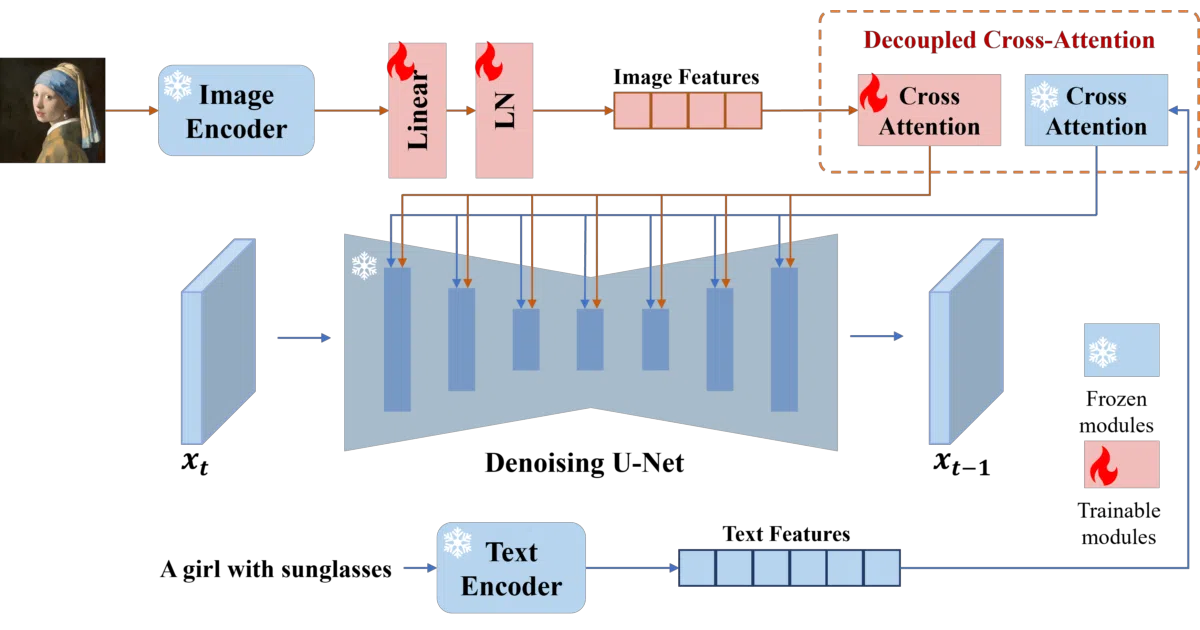
IP-Adapter is a lightweight adapter that adds image-prompt capability to pretrained text-to-image diffusion models such as Stable Diffusion 1.5 and SDXL. Instead of replacing the base model, it attaches a 22M-parameter module that processes a reference image and feeds its features into the existing pipeline alongside—or in place of—text embeddings. The result is image variation, style transfer, inpainting, and multimodal generation driven by both pictures and words.
The interesting bit
The adapter generalizes across custom models fine-tuned from the same base checkpoint and works with existing control tools like ControlNet and T2I-Adapter. That means you can lock down composition with one pipeline and set mood or identity with another, without either system retraining the other. The project also ships training code and weight-conversion utilities, so the same recipe can be retargeted to custom datasets.
Key highlights
- Only 22M parameters, yet the authors claim comparable or better performance than fully fine-tuned image-prompt models.
- Supports multimodal prompts: blend image and text guidance using a tunable
scaleparameter. - Ecosystem footprint is already wide, with integrations in HuggingFace Diffusers, AUTOMATIC1111 WebUI, ComfyUI, InvokeAI, and AnimateDiff.
- Several specialized variants exist, including fine-grained feature transfer (Plus) and face-identity preservation (FaceID), though some are marked experimental.
- The SDXL release switched from OpenCLIP ViT-bigG to the smaller ViT-H to cut inference memory, paired with a two-stage training strategy that pre-trains at 512×512 before multi-scale fine-tuning.
Caveats
- CLIP’s default image processor center-crops inputs, so non-square reference images lose peripheral content by default; the README suggests resizing to 224×224 as a workaround.
- Several FaceID and Plus variants are explicitly tagged as “experimental” in the release history.
- Architectural details are sparse in the README beyond a single figure; the actual mechanics are left to the linked arXiv paper.
Verdict
A solid choice if you want to add visual style or identity guidance to Stable Diffusion without training a new base model from scratch. Skip it if you are looking for a polished end-user application; this is a research artifact with notebooks, community plugins, and a disclaimer about misuse.
Frequently asked
- What is tencent-ailab/IP-Adapter?
- IP-Adapter exists because describing a reference photo in text is inefficient; it bolts a 22M-parameter sidecar onto Stable Diffusion so the model can simply look at the image instead.
- Is IP-Adapter open source?
- Yes — tencent-ailab/IP-Adapter is open source, released under the Apache-2.0 license.
- What language is IP-Adapter written in?
- tencent-ailab/IP-Adapter is primarily written in Jupyter Notebook.
- How popular is IP-Adapter?
- tencent-ailab/IP-Adapter has 6.6k stars on GitHub.
- Where can I find IP-Adapter?
- tencent-ailab/IP-Adapter is on GitHub at https://github.com/tencent-ailab/IP-Adapter.