supertone-inc/supertonic
A 99M-Parameter TTS Engine That Runs on Your E-Reader
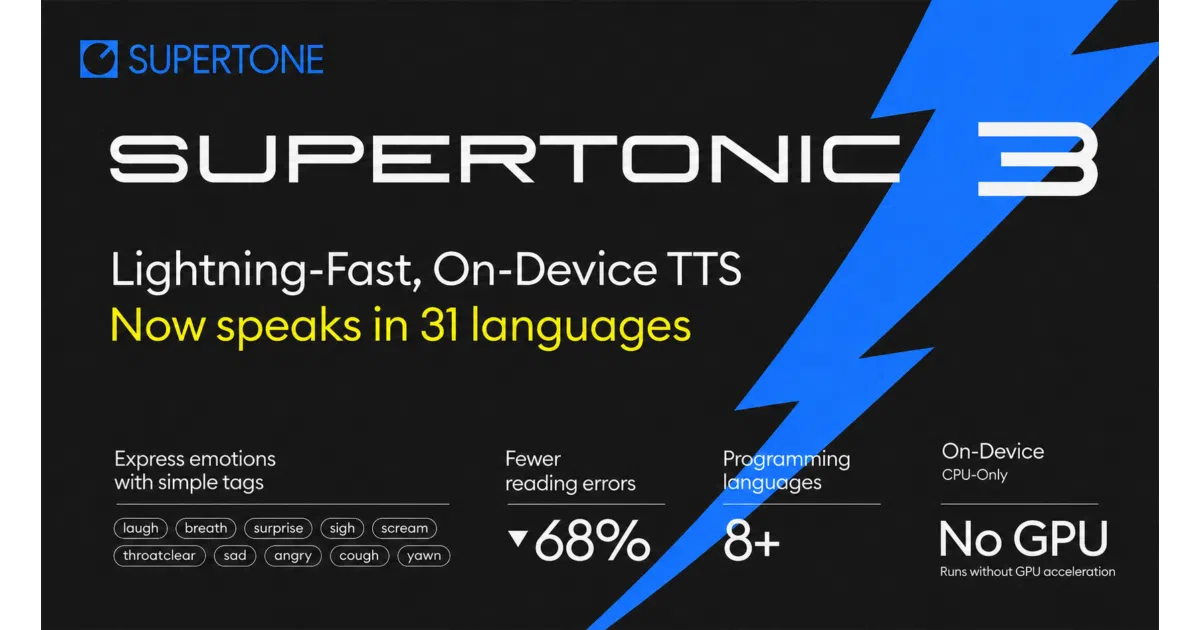
Supertonic packs a 31-language, open-weight TTS model into 99 million parameters so it can run offline on everything from a Raspberry Pi to a browser tab.
Velocity · 7d
+50
★ / day
Trend
↗accelerating
star history
What it does
Supertonic generates 44.1kHz speech from text using a compact, open-weight ONNX model. It covers 31 languages and ships with SDK examples for Python, Node.js, Rust, Swift, Go, Java, C++, C#, Flutter, and browser WebGPU. Everything stays local: no cloud tokens, no network latency, and no external API bills.
The interesting bit
The model squeezes its competition not by brute force but by staying tiny—99 million parameters versus the 0.7B–2B parameter class of other open TTS systems. Despite the diet, benchmark results on the Minimax-MLS-test set show it landing in the same WER/CER neighborhood as much larger rivals like VoxCPM2 and Qwen3-TTS. It also accepts lang="na" when you have no idea what language the input is in, which is the kind of laziness good engineering encourages.
Key highlights
- 31-language support with a language-agnostic
namode for mixed or unknown input. - 10 inline expression tags (
<laugh>,<breath>,<sigh>, etc.) baked into synthesis without prompt engineering. - Edge-first deployment path: runs CPU-only on Raspberry Pi, e-readers, iOS, and desktop browsers via WebGPU.
- Open-weight checkpoint with direct 44.1kHz 16-bit WAV output—no upsampler required.
- Python SDK can spawn an OpenAI-compatible local HTTP server for drop-in replacement in existing audio pipelines.
Caveats
- Per-language accuracy varies; the published benchmark table shows Supertonic 3 trailing larger models on some languages like Finnish and French.
- The main repository hosts model assets and inference examples rather than a single unified library; the Python SDK lives in a separate repo.
- Several non-Python runtimes need manually installed native dependencies (ONNX Runtime C libraries, JDK, .NET 9) before the examples will build.
Verdict
Ideal for developers who need private, offline speech synthesis in resource-constrained or mobile environments. If you require top-tier accuracy for every single language or a fully managed cloud API, larger alternatives still have the edge.
Frequently asked
- What is supertone-inc/supertonic?
- Supertonic packs a 31-language, open-weight TTS model into 99 million parameters so it can run offline on everything from a Raspberry Pi to a browser tab.
- Is supertonic open source?
- Yes — supertone-inc/supertonic is open source, released under the MIT license.
- What language is supertonic written in?
- supertone-inc/supertonic is primarily written in Swift.
- How popular is supertonic?
- supertone-inc/supertonic has 13.5k stars on GitHub and is currently accelerating.
- Where can I find supertonic?
- supertone-inc/supertonic is on GitHub at https://github.com/supertone-inc/supertonic.