snipeship/ccflare
A proxy that lets Claude and GPT share a house without fighting
ccflare is a multi-provider LLM proxy that load-balances across accounts, keeps full observability, and never translates your payloads.
Not currently ranked — collecting fresh signals.
star history
What it does
ccflare sits between your code and the Anthropic/OpenAI APIs. You point SDKs at prefixed routes—/v1/anthropic/* or /v1/openai/*—and it forwards requests natively, strips the prefix once, and retries on rate limits using a pool of accounts. There’s also a compatibility layer (/v1/ccflare/*) where model names like anthropic/claude-sonnet-4 or openai/gpt-5.4 pick the provider family for you.
The interesting bit
Most proxies translate schemas; ccflare deliberately doesn’t. Anthropic payloads stay Anthropic, OpenAI stays OpenAI. The value is in the plumbing: per-account rate-limit tracking, automatic failover, a live request stream, and a dashboard that shows history and analytics without you building it yourself. It also handles OAuth for Claude Code and Codex accounts through a TUI, not just static API keys.
Key highlights
- Native passthrough—no payload translation, no schema mangling
- Account-level failover and load balancing with configurable strategies
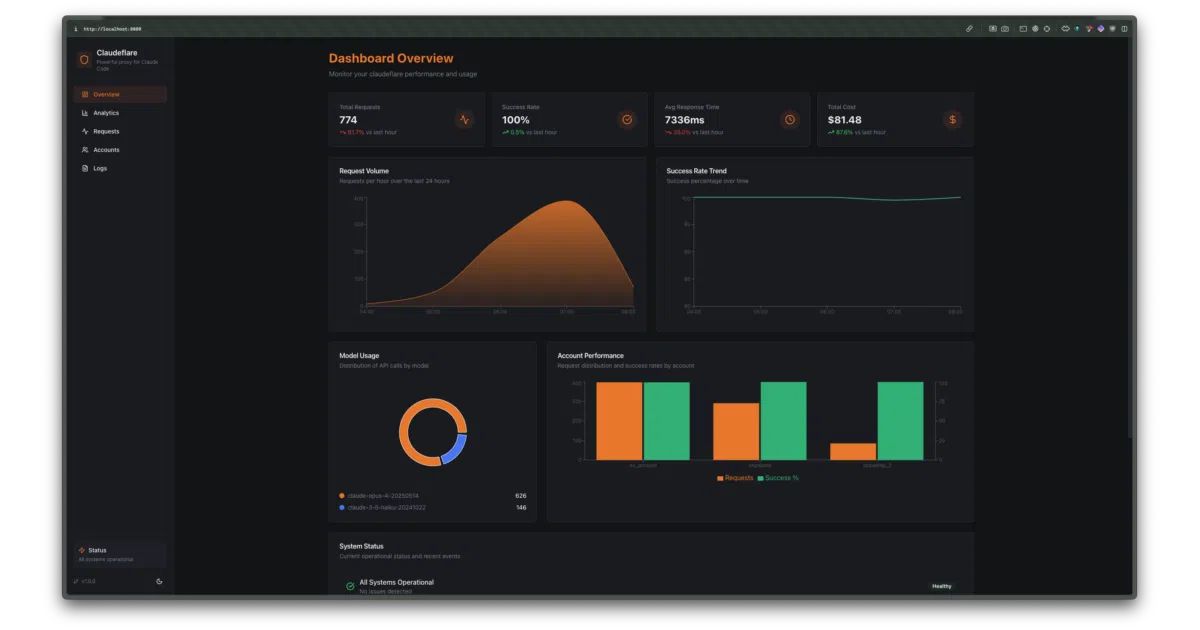
- Built-in dashboard, TUI, request history, analytics, and health endpoints
- OAuth support for Claude Code and Codex CLI accounts
- Management API for accounts, config, retention, and live log streaming
Caveats
- Requires Bun ≥ 1.2.8; no Node.js runtime mentioned
- README doesn’t specify how rate-limit state is shared (memory? SQLite?)
- Compatibility route provider selection logic (
prefers codex, then openai) is present but the exact fallback rules are terse
Verdict
Worth a look if you’re juggling multiple API keys, hitting rate limits, or tired of building internal dashboards for LLM usage. Skip it if you only have one account and one provider; the overhead won’t pay off.
Frequently asked
- What is snipeship/ccflare?
- ccflare is a multi-provider LLM proxy that load-balances across accounts, keeps full observability, and never translates your payloads.
- Is ccflare open source?
- Yes — snipeship/ccflare is open source, released under the MIT license.
- What language is ccflare written in?
- snipeship/ccflare is primarily written in TypeScript.
- How popular is ccflare?
- snipeship/ccflare has 1.1k stars on GitHub.
- Where can I find ccflare?
- snipeship/ccflare is on GitHub at https://github.com/snipeship/ccflare.