sigsep/open-unmix-pytorch
Separating pop music the hard way: one LSTM per instrument
It gives researchers and audio engineers a reproducible, pre-trained PyTorch baseline for splitting pop music into four stems.
Not currently ranked — collecting fresh signals.
star history
What it does
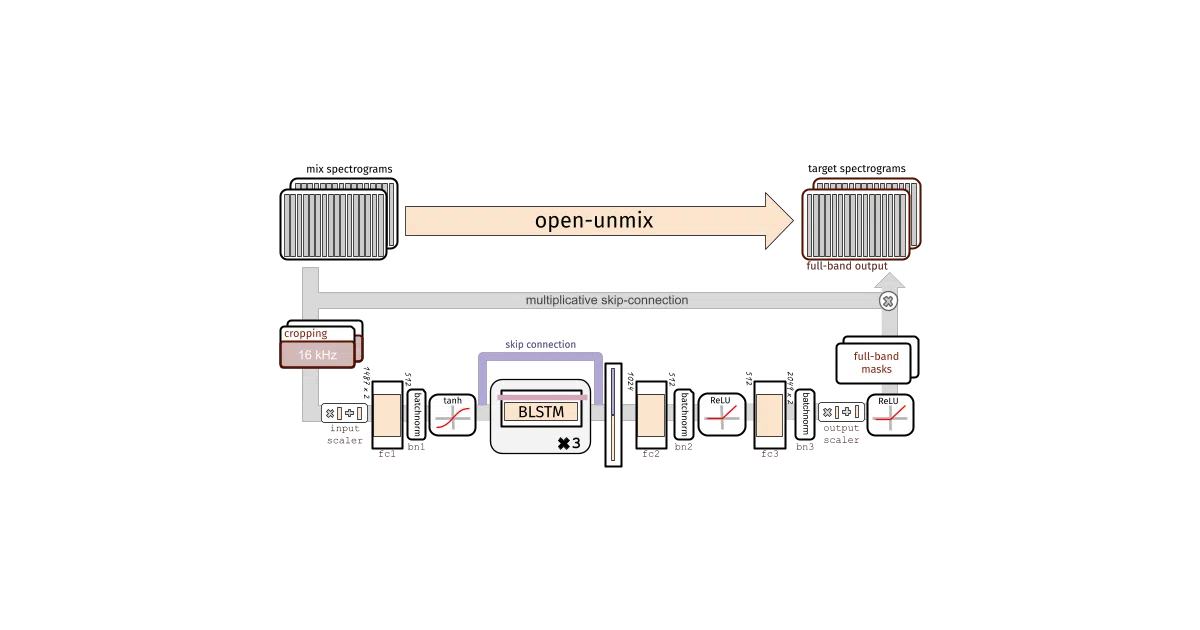
Open-Unmix is a music source separation system that takes a mixed pop track and splits it into four stems: vocals, drums, bass, and everything else. It ships as a PyTorch implementation with several pre-trained models, including a default umxl model trained on extra private data and older variants tied to the MUSDB18 dataset. Under the hood, it learns to predict magnitude spectrograms by applying a mask in the frequency domain, then wraps the separated outputs in a differentiable multichannel Wiener filter before converting back to waveforms.
The interesting bit
Instead of one giant network handling all instruments, Open-Unmix trains a separate three-layer bidirectional LSTM for each target source. While training multiple LSTMs is undeniably more work, it grants per-stem flexibility and keeps the architecture modular. The inference-time Separator then stitches these individual models together and applies a parameter-free Wiener filter to clean up the results.
Key highlights
- Ships with ready-to-use pre-trained models (
umxl,umxhq,umx, and a Sony-provided speech enhancement modelumxse). - Each source model is a standalone bidirectional LSTM that operates on standardized magnitude spectrograms with learned frequency compression.
- The
Separatorcombines outputs via a differentiable generalized Wiener filter, replacing the originalnorbertdependency. - Updated to support PyTorch 2.0 as of April 2024, though the maintainers note that regression tests were relaxed and outputs may differ slightly from earlier versions.
- Can be loaded via
torch.hubwithout installing the package, and supports both time-domain and spectrogram-domain inputs.
Caveats
- The default
umxlmodel weights are licensed for non-commercial use only (CC BY-NC-SA 4.0). - Because the core LSTMs are bidirectional, the system requires future audio context and cannot run in real time or online; a uni-directional variant would need separate training.
- The project is explicitly a reference implementation and inference toolkit—training scripts are not included in the PyPI package and live in separate documentation.
Verdict
Researchers benchmarking against SiSEC 2018 or audio engineers who need a quick, reproducible stem separator should grab this. If you need real-time streaming separation or a single end-to-end model to fine-tune, look elsewhere.
Frequently asked
- What is sigsep/open-unmix-pytorch?
- It gives researchers and audio engineers a reproducible, pre-trained PyTorch baseline for splitting pop music into four stems.
- Is open-unmix-pytorch open source?
- Yes — sigsep/open-unmix-pytorch is open source, released under the MIT license.
- What language is open-unmix-pytorch written in?
- sigsep/open-unmix-pytorch is primarily written in Python.
- How popular is open-unmix-pytorch?
- sigsep/open-unmix-pytorch has 1.5k stars on GitHub.
- Where can I find open-unmix-pytorch?
- sigsep/open-unmix-pytorch is on GitHub at https://github.com/sigsep/open-unmix-pytorch.