open-mmlab/PIA
Your fine-tuned Stable Diffusion models can finally move
PIA bolts motion modules onto existing text-to-image checkpoints so your personalized images can move without turning into strangers.
Not currently ranked — collecting fresh signals.
star history
What it does
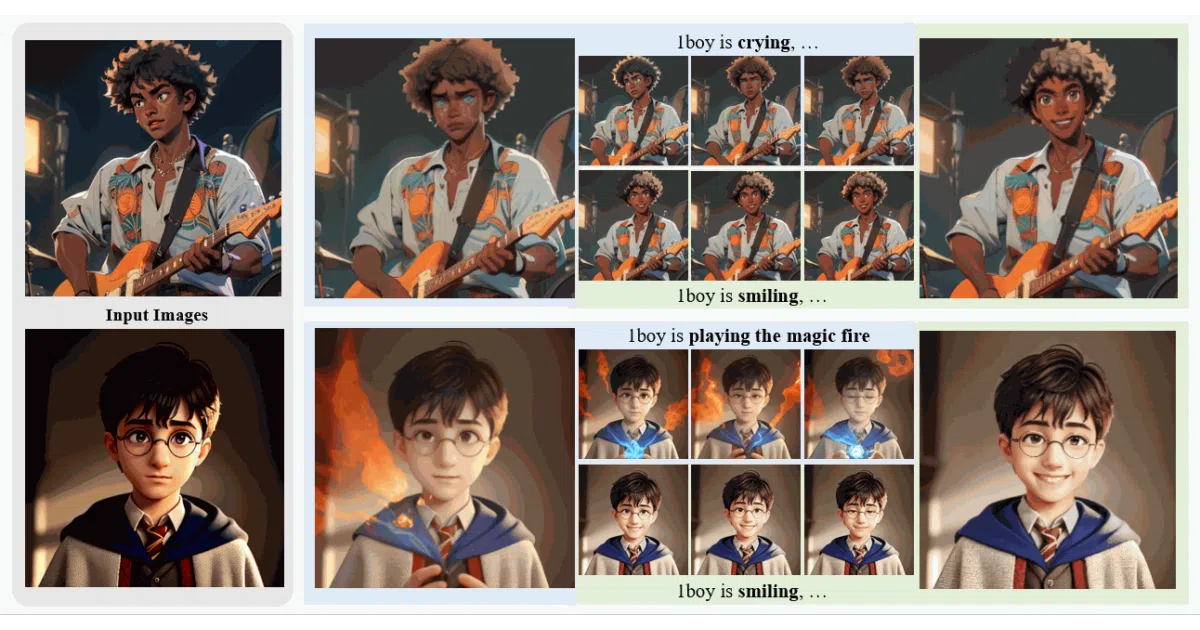
PIA takes a single image and a text prompt, then generates a short video animation. It builds on Stable Diffusion v1-5 through plug-and-play modules, and works with existing DreamBooth or LoRA personalized models out of the box. You can adjust motion intensity, generate loops, or apply style transfers without retraining the underlying subject model.
The interesting bit
Rather than training a monolithic video model from scratch, PIA treats motion as a modular upgrade to frozen text-to-image weights. The training pipeline borrows heavily from AnimateDiff, but the focus is on keeping generated motion aligned to both the prompt and the specific identity locked in your input image.
Key highlights
- Compatible with off-the-shelf personalized checkpoints without retraining them
- Three discrete motion magnitudes—small, moderate, and large—controlled by a single parameter
- 1024×1024 generation fits in 16 GB of VRAM when using PyTorch 2.0 memory-efficient attention
- Supports looping videos and style-transferred outputs from the same base image
- Demos available on HuggingFace Spaces, Replicate, Colab, and OpenXLab
Caveats
- The training script borrows heavily from AnimateDiff, so data preparation and configuration assumptions follow that lineage closely
- You will need to wrangle separate downloads for base Stable Diffusion weights, the PIA checkpoint, and any personalized models
Verdict
A solid choice if you already maintain custom Stable Diffusion checkpoints and want to bring them to life as short clips. Less appealing if you want a single turnkey model or are running on tight GPU memory budgets.
Frequently asked
- What is open-mmlab/PIA?
- PIA bolts motion modules onto existing text-to-image checkpoints so your personalized images can move without turning into strangers.
- Is PIA open source?
- Yes — open-mmlab/PIA is open source, released under the Apache-2.0 license.
- What language is PIA written in?
- open-mmlab/PIA is primarily written in Python.
- How popular is PIA?
- open-mmlab/PIA has 972 stars on GitHub.
- Where can I find PIA?
- open-mmlab/PIA is on GitHub at https://github.com/open-mmlab/PIA.