microsoft/muzic
Microsoft Research’s AI music lab, distilled into one repo
It bundles a sprawling portfolio of symbolic and generative music research from Microsoft Research Asia into runnable, paper-accompanying code.
Not currently ranked — collecting fresh signals.
star history
What it does
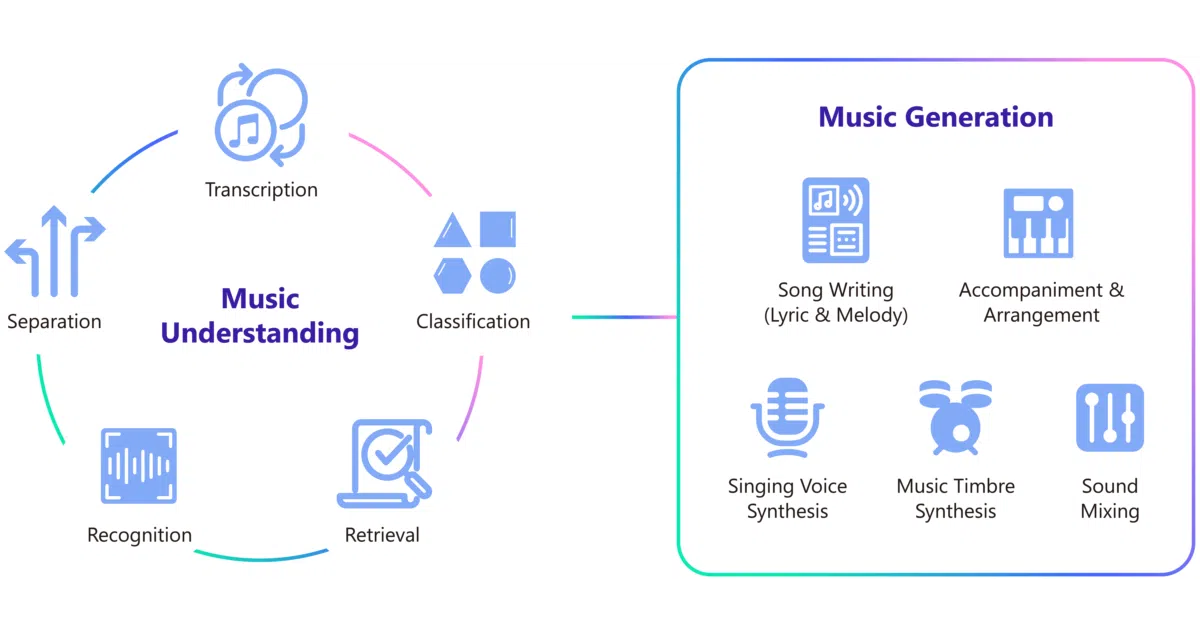
Muzic is an umbrella repository, not a single application. It houses the official implementations of a wide range of distinct research projects spanning symbolic music understanding, lyric transcription, melody generation, multi-track accompaniment, and singing voice synthesis. Each model lives in its own folder with its own README, so the repo behaves more like a curated research archive than a unified framework.
The interesting bit
The breadth is the point. While most open-source music-AI tools focus on one trick, Muzic attempts to own the entire stack—from analyzing scores to generating structure-aware pop accompaniment—right down to MusicAgent, an LLM-based agent for versatile music processing.
Key highlights
- Covers analysis (
MusicBERT,CLaMP) and synthesis (GETMusic,HiFiSinger,MuseCoco). - Includes unusual specializations like rap lyric generation (
DeepRapper) and music-form-aware melody generation (MeloForm). CLaMPwon the Best Student Paper Award at ISMIR 2023 for cross-modal symbolic music retrieval.- Recent additions include
MuseCocofor text-to-symbolic-music generation andMusicAgent, an LLM-powered agent for versatile music processing. - All contributions fall under Microsoft’s standard Contributor License Agreement.
Caveats
- The documented target environment is dated: Linux only, tested on Ubuntu 16.04 with CUDA 10 and Python 3.6.12.
- Each project is isolated in its own folder with its own README and dependencies, so there is no unified framework or shared API.
- The repository is explicitly framed as a research project, so expect paper-accompanying implementations rather than a polished end-user product.
Verdict
Researchers and reproducibility engineers working on symbolic music or cross-modal audio-language models will find extensive reference implementations. Product developers looking for a single, modern, maintained music-generation API should look elsewhere.
Frequently asked
- What is microsoft/muzic?
- It bundles a sprawling portfolio of symbolic and generative music research from Microsoft Research Asia into runnable, paper-accompanying code.
- Is muzic open source?
- Yes — microsoft/muzic is open source, released under the MIT license.
- What language is muzic written in?
- microsoft/muzic is primarily written in Python.
- How popular is muzic?
- microsoft/muzic has 5k stars on GitHub.
- Where can I find muzic?
- microsoft/muzic is on GitHub at https://github.com/microsoft/muzic.