mankidev/antialgorithm
A skill that makes your agent worse at its first idea, on purpose
antialgorithm forces coding agents to name their most average pick and then walk away from it before doing creative work.
Too new to rank. Velocity needs a few days of history.
not enough history yet
star history
What it does
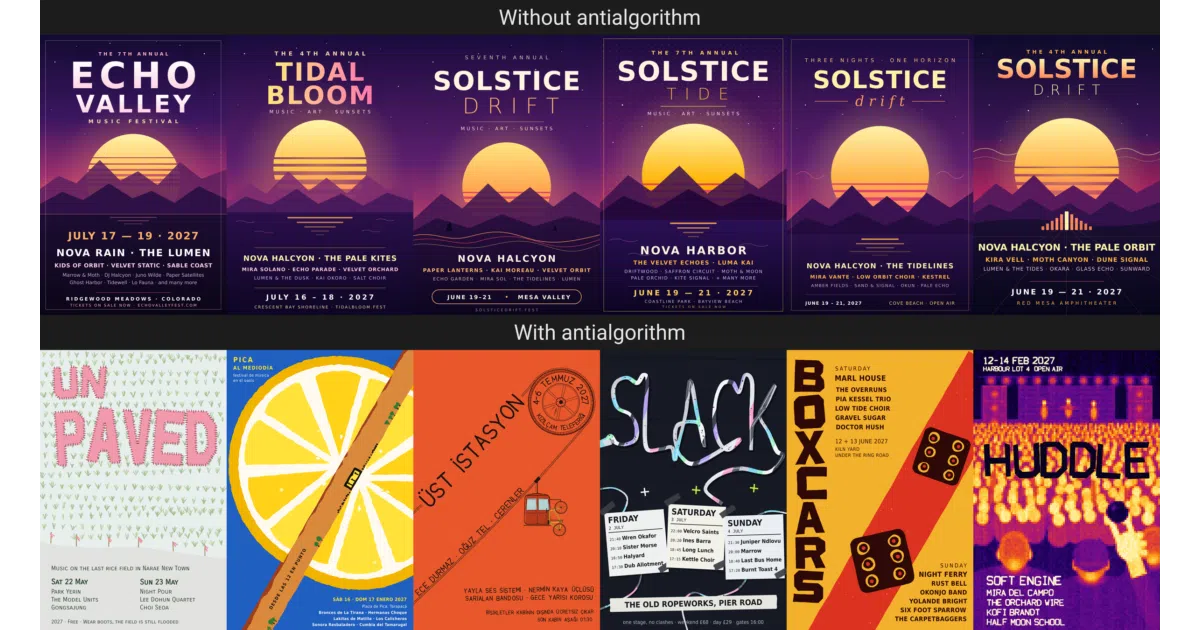
It’s an agent skill (Claude Code, Codex, Cursor, OpenCode, and others) for the creative half of agent work: names, slogans, story and game ideas, posters, UI. The core trick is simple — the model must first state its most obvious, statistically-average choice, then deliberately move away from it using a reason pulled from the actual project. The README shows the effect: six poster runs without the skill all converge, while runs with it scatter.
The interesting bit
The boring part is where the value is. seed.py rolls a random starting point (making method, colors, voice, constraint, pressure) from system randomness, so two people with the same prompt land in different places — and it logs seeds to a history file so your own sessions don’t repeat. moves.py keeps a short log of the “move” behind each off-default answer, so the model doesn’t recycle the one trick that worked last time.
Key highlights
seed.pyrolls visual, text, or idea seeds;--keep "axis=value"pins one axis (say, the subject) and rerolls only the lookmoves.pyprevents the model from reusing a move just because it worked beforerough.pyshakes straight lines and even spacing in SVGs so hand-made styles stop looking plotted — only for print/paint/stamp lookscheck.pyrenders an SVG at full and icon size and flags text that overflows, hides under shapes, or is too small- Visual rules in
visuals.mdload only for visual work, so naming tasks stay lightweight
Caveats
- The showcase comparison isn’t apples-to-apples: the top row is one full batch of six runs, the bottom row is picked from about a dozen runs made while the skill was being written — the authors say so themselves
check.py’s size limits are tuned for posters; app screens need--min-text 0.6- Needs Python 3, and
check.pyadds numpy, Pillow, and an SVG renderer as dependencies
Verdict
Worth adding if you use agents for naming, posters, or UI mockups and are tired of everything looking like the same festival poster. If your agent work is strictly code, there’s nothing here for you.
Frequently asked
- What is mankidev/antialgorithm?
- antialgorithm forces coding agents to name their most average pick and then walk away from it before doing creative work.
- Is antialgorithm open source?
- Yes — mankidev/antialgorithm is open source, released under the MIT license.
- What language is antialgorithm written in?
- mankidev/antialgorithm is primarily written in Python.
- How popular is antialgorithm?
- mankidev/antialgorithm has 608 stars on GitHub.
- Where can I find antialgorithm?
- mankidev/antialgorithm is on GitHub at https://github.com/mankidev/antialgorithm.