lucidrains/imagen-pytorch
Rebuilding Google’s Imagen: T5, cascading noise, and no CLIP
A PyTorch port of Google’s Imagen that generates images from frozen T5 text embeddings instead of CLIP, using a cascading diffusion stack.
Not currently ranked — collecting fresh signals.
star history
What it does
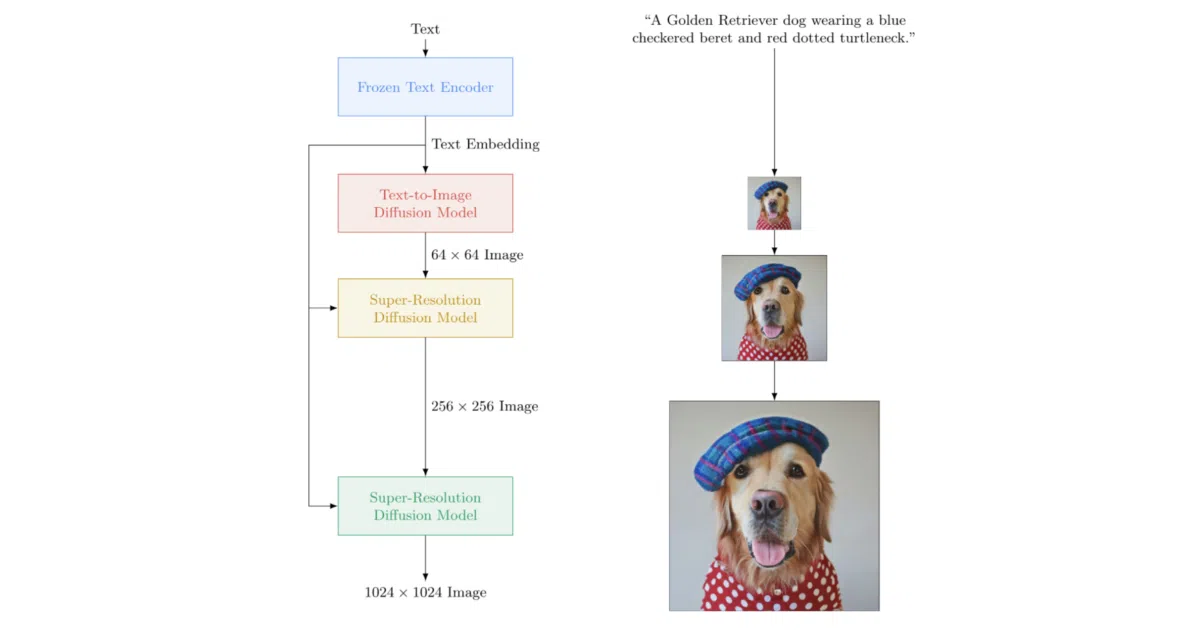
Implements Google’s Imagen in PyTorch as a cascading DDPM that turns text embeddings from a frozen T5 model into images. The package centers on an ImagenTrainer class that manages exponential moving averages, gradient accumulation, and checkpointing across a pipeline of U-nets. It handles text-conditional generation, unconditional synthesis, and super-resolution-only training without a base model.
The interesting bit
The README argues this stack is “actually much simpler than DALL-E2” because it needs neither CLIP nor a dedicated prior network; the heavy lifting is done by T5’s attention outputs and dynamic thresholding during classifier-free guidance. That design choice—trading a multimodal encoder for a frozen language model—is the core architectural bet.
Key highlights
- Generates images conditioned on frozen T5 text embeddings rather than a learned image-text joint space.
- Stacks multiple U-nets for base generation and super-resolution, with explicit noise-level conditioning between stages.
ImagenTrainerautomates EMA updates, splits oversized batches for GPU memory limits, and handles save/load state management.- Supports unconditional training and placeholder “null U-net” workflows for super-resolution-only pipelines.
- Developed in the open with the LAION community; contributors are already experimenting with text-to-video extensions.
Caveats
- The shoutouts section reads like a live bug ledger: color shifts, checkerboard artifacts, and sampling order bugs have been patched recently, which suggests the implementation is still hardening.
- The README explicitly solicits help with “the replication,” implying this is a work-in-progress training framework rather than a drop-in pretrained model.
Verdict
Worth a look if you are building or researching diffusion pipelines and want a PyTorch-native Imagen reference. If you need a polished, ready-to-generate model out of the box, this is still a construction site.
Frequently asked
- What is lucidrains/imagen-pytorch?
- A PyTorch port of Google’s Imagen that generates images from frozen T5 text embeddings instead of CLIP, using a cascading diffusion stack.
- Is imagen-pytorch open source?
- Yes — lucidrains/imagen-pytorch is open source, released under the MIT license.
- What language is imagen-pytorch written in?
- lucidrains/imagen-pytorch is primarily written in Python.
- How popular is imagen-pytorch?
- lucidrains/imagen-pytorch has 8.4k stars on GitHub.
- Where can I find imagen-pytorch?
- lucidrains/imagen-pytorch is on GitHub at https://github.com/lucidrains/imagen-pytorch.