linwhitehat/ET-BERT
BERT for packets: pre-training on encrypted traffic bursts
ET-BERT treats encrypted traffic bursts like text corpora so transformers can classify flows without ever seeing a plaintext payload.
Not currently ranked — collecting fresh signals.
star history
What it does
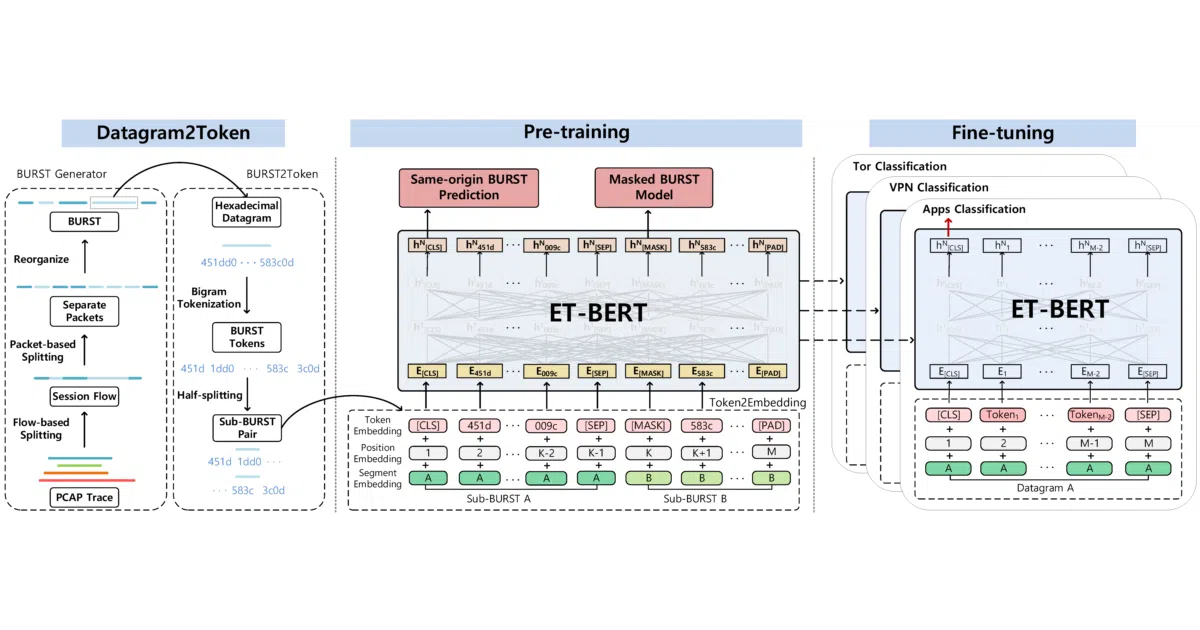
ET-BERT is a BERT-style transformer pre-trained on large-scale unlabelled encrypted traffic, then fine-tuned to classify specific traffic types. It learns contextual relationships between datagrams and transport bursts from raw packet features rather than decrypted payloads. The repository includes a downloadable pre-trained model and data pipelines built around a CSTNET TLS 1.3 dataset.
The interesting bit
The premise is that encrypted packet sequences carry enough structural signal—burst boundaries, timing, datagram order—to support masked pre-training tricks usually reserved for natural language. The authors call this “contextualized datagram representation,” which is academic speak for tokenizing packet captures and feeding them to a transformer.
Key highlights
- Pre-trained on an encrypted traffic burst corpus using multi-layer attention, then fine-tuned on small labeled datasets for specific scenarios.
- Ships with an anonymous real-world TLS 1.3 dataset (CSTNET) and a downloadable pre-trained checkpoint.
- Built on top of the
UER-pyframework, reusing its transformer and training machinery. - Designed to be applied across different encrypted traffic scenarios without scenario-specific re-architecture.
- Uses WordPiece tokenization with a custom vocabulary (
encryptd_vocab.txt) for traffic representation.
Caveats
- The codebase expects you to edit hardcoded paths inside source files before running anything.
- Full reproduction requires a specific hardware and software stack: Tesla V100S, CUDA 11.4,
tshark,SplitCap, NVIDIAapex, and TensorFlow for model conversion. - Only anonymous data is released from the original CSTNET dataset; using your own pcaps requires navigating the
data_processscripts.
Verdict
A useful research artifact if you study encrypted traffic analysis or need a baseline for TLS 1.3 flow classification without decryption. For production use, the path-editing and dependency stack suggest waiting for a more packaged implementation.
Frequently asked
- What is linwhitehat/ET-BERT?
- ET-BERT treats encrypted traffic bursts like text corpora so transformers can classify flows without ever seeing a plaintext payload.
- Is ET-BERT open source?
- Yes — linwhitehat/ET-BERT is open source, released under the MIT license.
- What language is ET-BERT written in?
- linwhitehat/ET-BERT is primarily written in Python.
- How popular is ET-BERT?
- linwhitehat/ET-BERT has 670 stars on GitHub.
- Where can I find ET-BERT?
- linwhitehat/ET-BERT is on GitHub at https://github.com/linwhitehat/ET-BERT.