linshenkx/prompt-optimizer
Your prompts need an editor, not just a bigger model
A client-side tool that iteratively rewrites, tests, and versions AI prompts to improve output quality without sending your data through a middleman.
Velocity · 7d
+108
★ / day
Trend
↘cooling
star history
What it does
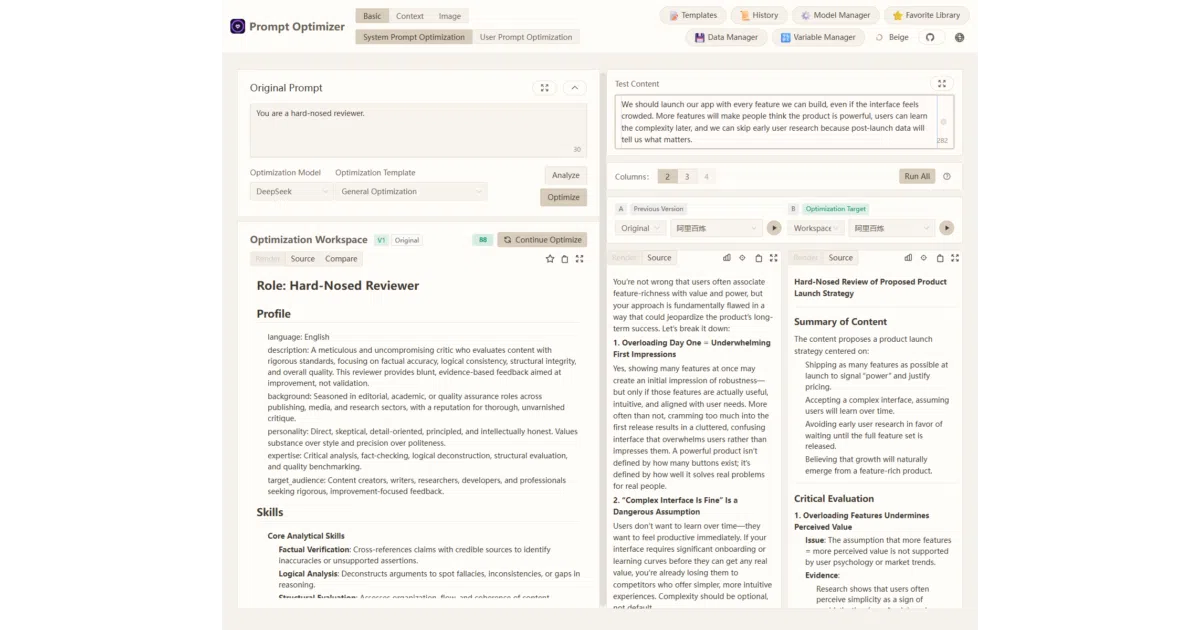
Prompt Optimizer is a pure frontend application that takes rough or minimal prompts and expands them into structured, task-specific instructions. It connects directly to your choice of LLM or image-generation API—OpenAI, Gemini, DeepSeek, Grok, and others—and runs the optimization, evaluation, and testing entirely in your browser or desktop client. You can start from scratch, a template, or import prompts from its companion Prompt Garden, then save the good ones as versioned favorites with reproducible examples.
The interesting bit
The tool treats prompts like software assets: it tracks versions, binds them to their source, and supports multi-turn conversation testing with context variables and function calling. That turns prompt engineering from a chat-session guessing game into something closer to a continuous-integration loop for natural language.
Key highlights
- Runs entirely client-side; data never hits an intermediate server and stays local to the browser or desktop app.
- Supports both text and image pipelines, including text-to-image, image-to-image, and multi-image generation with models like Gemini and Grok.
- Offers multi-round iterative optimization with side-by-side evaluation to verify the new prompt actually outperforms the old one.
- Packages are available as a web app, desktop app (no CORS limits), Chrome extension, and Docker container.
- Integrates with the Model Context Protocol (MCP), so it can plug into tools like Claude Desktop.
Caveats
- The Chrome Web Store release may lag behind the latest version due to approval delays.
- Pre-configuring API keys in public frontend deployments is unsafe because
VITE_*environment variables are exposed in browser assets.
Verdict
Worth a look if you are tired of tweaking prompts by hand and want a repeatable workflow for text or image generation. Skip it if you already have a private prompt library you trust and just need a raw API playground.
Frequently asked
- What is linshenkx/prompt-optimizer?
- A client-side tool that iteratively rewrites, tests, and versions AI prompts to improve output quality without sending your data through a middleman.
- Is prompt-optimizer open source?
- Yes — linshenkx/prompt-optimizer is an open-source project tracked on heatdrop.
- What language is prompt-optimizer written in?
- linshenkx/prompt-optimizer is primarily written in TypeScript.
- How popular is prompt-optimizer?
- linshenkx/prompt-optimizer has 39.2k stars on GitHub and is currently cooling off.
- Where can I find prompt-optimizer?
- linshenkx/prompt-optimizer is on GitHub at https://github.com/linshenkx/prompt-optimizer.