julrog/nn_vis
A VR-ready tool that turns neural nets into 3D sculptures you can read
Master thesis project renders trained models as bundled, importance-colored 3D graphs to reveal architecture and generalization at a glance.
Not currently ranked — collecting fresh signals.
star history
What it does
Takes a trained neural network, estimates parameter importance via batch-normalization fine-tuning, then renders it as a 3D scene with edge bundling, ray tracing, and transparency. The result is a decluttered, explorable model where color and geometry encode what actually matters for each output class. A standalone OpenGL viewer handles the rendering; VR mode lets you walk inside the network.
The interesting bit
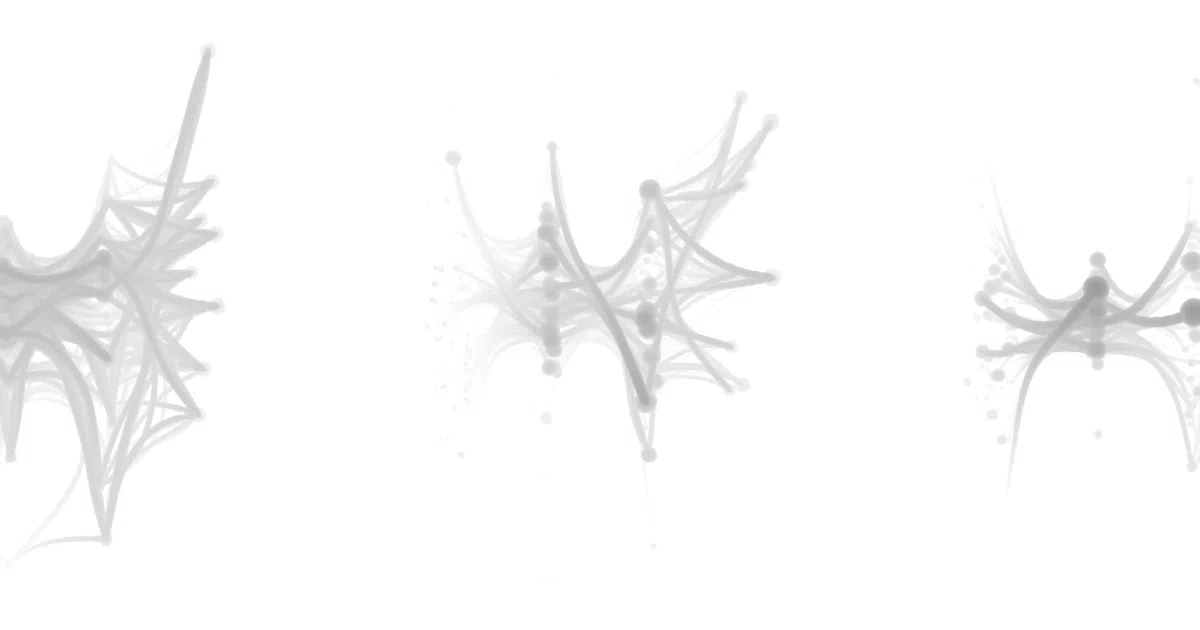
The visualization is opinionated in a useful way: it uses established edge-bundling techniques from graph drawing to pull related pathways together, so generalization literally looks like a tighter bundle. The README shows a striking side-by-side where an untrained network sprawls outward, basic training pulls it in, and L1 regularization tightens it further—same architecture, visibly different geometry.
Key highlights
- Importance estimation is validated by pruning: removing low-importance weights barely hurts accuracy, removing high-importance ones does.
- Class-specific importance coloring lets you see which sub-networks serve which predictions.
- One-time processing pipeline (3–4 minutes for a 784→81→49→10 MNIST net) feeds a real-time renderer with tweakable shader parameters.
- Ships with Docker, demo data, and example scripts for MNIST and beyond.
- VR support exists; controls are keyboard-driven (H to rotate, K to screenshot, 0-9 for camera slots).
Caveats
- Processing is not real-time; each model must be baked before exploration.
- Tested stack is narrow: Windows 10, Python 3.9, NVIDIA RTX 3080. Your mileage on other setups is unclear.
- The README trails off mid-sentence in the “Other Visualizations” section, suggesting the docs may be partially unfinished.
Verdict
Worth a look if you research neural network interpretability or need to explain model behavior to humans who prefer spatial intuition over tensorboard curves. Skip it if you need live, in-training visualization or production-grade cross-platform stability.
Frequently asked
- What is julrog/nn_vis?
- Master thesis project renders trained models as bundled, importance-colored 3D graphs to reveal architecture and generalization at a glance.
- Is nn_vis open source?
- Yes — julrog/nn_vis is open source, released under the MIT license.
- What language is nn_vis written in?
- julrog/nn_vis is primarily written in Python.
- How popular is nn_vis?
- julrog/nn_vis has 1.2k stars on GitHub.
- Where can I find nn_vis?
- julrog/nn_vis is on GitHub at https://github.com/julrog/nn_vis.