jd-opensource/JoyAI-Video-Edit
Streaming Video Edits That Never Peek at the Future
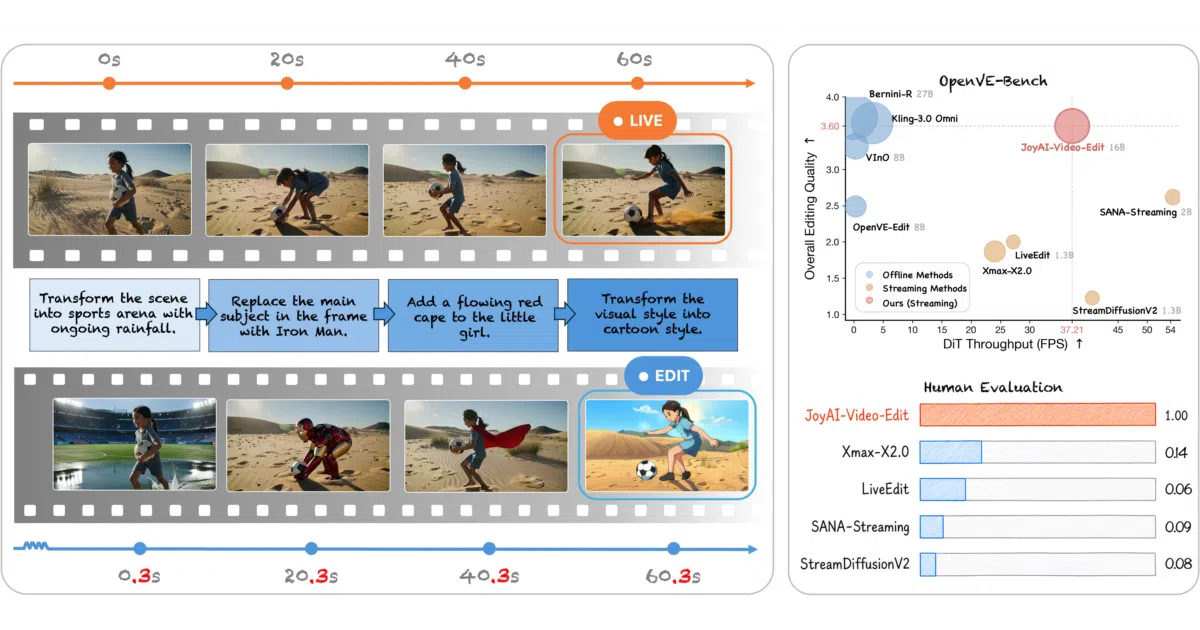
JoyAI-Video-Edit applies natural-language instructions to live or uploaded video streams frame by frame, without buffering the whole clip or revisiting future frames.
Collecting fresh signals — velocity needs a few days of history.
collecting data…
star history
What it does
JoyAI-Video-Edit is a causal, instruction-guided video editing system built around a 16-billion-parameter multimodal diffusion transformer. It ingests frames from a live camera or uploaded video as they arrive and applies natural-language edits—style transfers, object swaps, background replacement, or reference-image guidance—without waiting for the full sequence or rolling back to earlier frames. The published deployment benchmark claims 30 FPS throughput at 720 × 1248, and a Hugging Face demo runs at 24 FPS on a single RTX PRO 6000.
The interesting bit
The architecture treats streaming video as an autoregressive diffusion problem: an MLLM encodes the instruction, a causal video VAE compresses the stream, and bounded KV-state inference keeps memory from ballooning as the clip grows. That “no future frames” constraint is what separates it from offline batch editors that can revise earlier shots after seeing the ending.
Key highlights
- Causal editing: processes each frame once, in order, with no lookahead or fixed clip length.
- Heavyweight backbone: 16B-parameter MMDiT plus distillation and long-horizon optimization to sustain 720p throughput.
- Broad control: supports subject edits, local object add/remove, style transfer, background changes, and reference-image-guided (RV2V) conditioning.
- Live demo available: an 840 × 480 streaming demo runs on a single RTX PRO 6000 (Blackwell) GPU.
- Apache 2.0 license; model weights and deployment code are released, though training pipelines are not.
Caveats
- Consumer GPU support is still on the roadmap; current targets are workstation-grade cards like the RTX PRO 6000.
- Full training and data-generation pipelines remain unreleased, so the project is currently inference-only.
- External runtime dependencies (MiMo-VL and ONNX detector files) are required but not bundled in the main repository.
Verdict
Video researchers and product teams building interactive streaming tools should take a close look. If you are waiting for a plug-and-play consumer GPU release or need to train your own variant from scratch, this is still a preview.
Frequently asked
- What is jd-opensource/JoyAI-Video-Edit?
- JoyAI-Video-Edit applies natural-language instructions to live or uploaded video streams frame by frame, without buffering the whole clip or revisiting future frames.
- Is JoyAI-Video-Edit open source?
- Yes — jd-opensource/JoyAI-Video-Edit is open source, released under the Apache-2.0 license.
- What language is JoyAI-Video-Edit written in?
- jd-opensource/JoyAI-Video-Edit is primarily written in Python.
- How popular is JoyAI-Video-Edit?
- jd-opensource/JoyAI-Video-Edit has 1.9k stars on GitHub.
- Where can I find JoyAI-Video-Edit?
- jd-opensource/JoyAI-Video-Edit is on GitHub at https://github.com/jd-opensource/JoyAI-Video-Edit.