hijohnnylin/neuronpedia
Mechanistic Interpretability, Packaged as a Self-Hosted Platform
It bundles SAE analysis, steering, circuit tracing, and automated interpretation into one web interface to replace a pile of disjoint scripts.
Not currently ranked — collecting fresh signals.
star history
What it does
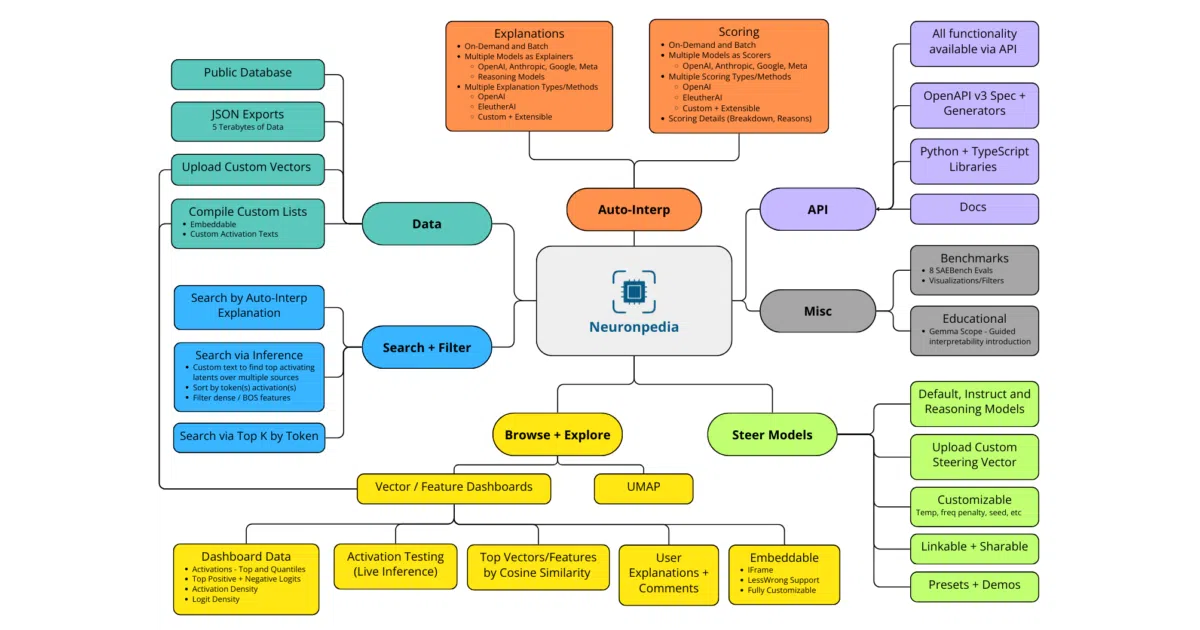
Neuronpedia is a full-stack platform for mechanistic interpretability research. It provides a web interface and API for exploring sparse autoencoders, testing activations, steering model outputs, tracing circuits, and scoring automated interpretations. The project is structured as a monorepo of standalone services—including a webapp, inference server, graph server, and autointerp worker—that are designed to run together.
The interesting bit
Instead of offering yet another Python library, Neuronpedia ships as an integrated product: a web frontend, Python inference backends, and pre-loaded model configurations for GPT-2, Gemma 2, and DeepSeek R1 distill. The README highlights an “AI agent development” configuration, suggesting the maintainers see it as a backend for custom interpretability apps, not just a standalone GUI.
Key highlights
- Monorepo architecture with decoupled services (webapp, API, inference, graph server, autointerp).
- Supports local hosting, though local inference is limited to one model at a time due to compute constraints.
- Pre-configured inference setups for several popular models and SAE sets, including GPT-2 small and Gemma-2-2b-it.
- Feature set covers the interpretability workflow end-to-end: UMAP embeddings, cosine similarity search, probes, dashboards, and data export.
- Includes an OpenAPI schema for the inference server, making the backend callable by custom clients.
Caveats
- A local instance starts with an empty database; you must import sources, activations, and explanations before the UI is useful.
- Local inference is restricted to a single server at a time, and the first model load is slow.
- Search explanations require an OpenAI API key, so not all features run fully offline.
Verdict
This is for interpretability researchers and engineers who want a shared, visual interface for SAE and circuit work—not for developers looking for a lightweight, drop-in library. If you don’t need a full web stack, it’s likely overkill.
Frequently asked
- What is hijohnnylin/neuronpedia?
- It bundles SAE analysis, steering, circuit tracing, and automated interpretation into one web interface to replace a pile of disjoint scripts.
- Is neuronpedia open source?
- Yes — hijohnnylin/neuronpedia is open source, released under the Apache-2.0 license.
- What language is neuronpedia written in?
- hijohnnylin/neuronpedia is primarily written in TypeScript.
- How popular is neuronpedia?
- hijohnnylin/neuronpedia has 1.2k stars on GitHub.
- Where can I find neuronpedia?
- hijohnnylin/neuronpedia is on GitHub at https://github.com/hijohnnylin/neuronpedia.