hardikpandya/stop-slop
Stripping the robot voice out of generated text
A bundle of prompt-level rules and reference files that trains models to catch and cut their own telltale rhetorical habits.
★18.3k stars LLMOps · Eval
Velocity · 7d
+26
★ / day
Trend
↘cooling
star history
What it does
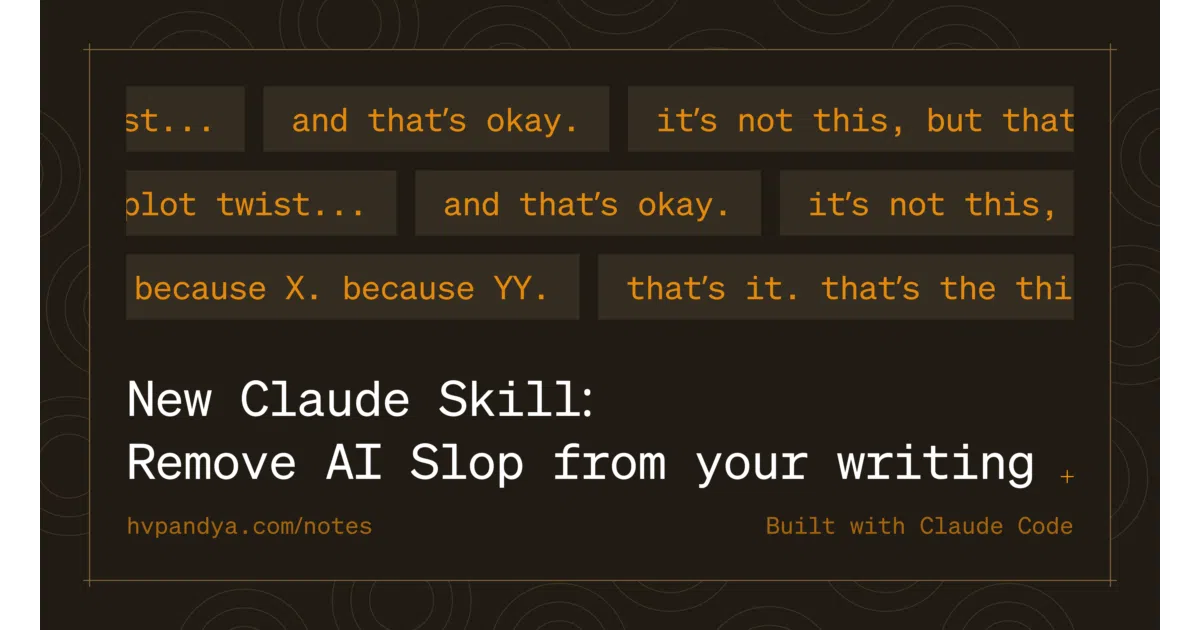
stop-slop is a skill file—a bundle of instructions, banned phrase lists, and structural rules designed to make LLM output sound less like LLM output. You feed it into Claude or another model as a system prompt or project skill, and it acts like an opinionated copy editor that strips out throat-clearing openers, adverbs, em dashes, and passive voice. The included scoring rubric (1-10 across five dimensions, with a failing grade below 35/50) flags synthetic-sounding prose for revision.
The interesting bit
Most “humanize” tools are post-processing filters or paraphrasers; this is prompt-level hygiene. It treats AI slop as a predictable grammar with its own clichés—binary contrasts, false agency, dramatic fragmentation—and simply bans them by category rather than trying to outsmart detectors. The scoring rubric is the practical glue: it gives the model a concrete threshold to fail, which is more useful than vague instructions to “write naturally.”
Key highlights
- Ships as a
SKILL.mdcore file plus three reference docs (phrases.md,structures.md,examples.md) that load on demand. - Bans specific mechanical tics: no Wh- sentence starters, no em dashes, no staccato fragmentation, no adverbs, no passive voice.
- Catches rhetorical habits like “false agency” and “narrator-from-a-distance” voice.
- Includes a 5-dimension scoring rubric (Directness, Rhythm, Trust, Authenticity, Density) with a hard cutoff at 35/50.
- Works with Claude Code, Claude Projects, custom instructions, or raw API system prompts.
Verdict
Grab this if you publish AI-assisted prose and are tired of manually scrubbing the same robotic tics. Skip it if you want your model to keep its em dashes and adverbs, or if you need a neutral, hands-off writing assistant.
Frequently asked
- What is hardikpandya/stop-slop?
- A bundle of prompt-level rules and reference files that trains models to catch and cut their own telltale rhetorical habits.
- Is stop-slop open source?
- Yes — hardikpandya/stop-slop is open source, released under the MIT license.
- How popular is stop-slop?
- hardikpandya/stop-slop has 18.3k stars on GitHub and is currently cooling off.
- Where can I find stop-slop?
- hardikpandya/stop-slop is on GitHub at https://github.com/hardikpandya/stop-slop.