google/deepvariant
Teaching neural networks to spot typos in DNA
It turns aligned DNA reads into pileup images and lets a CNN call germline variants, eliminating the complex filtering typical of traditional pipelines.
Not currently ranked — collecting fresh signals.
star history
What it does
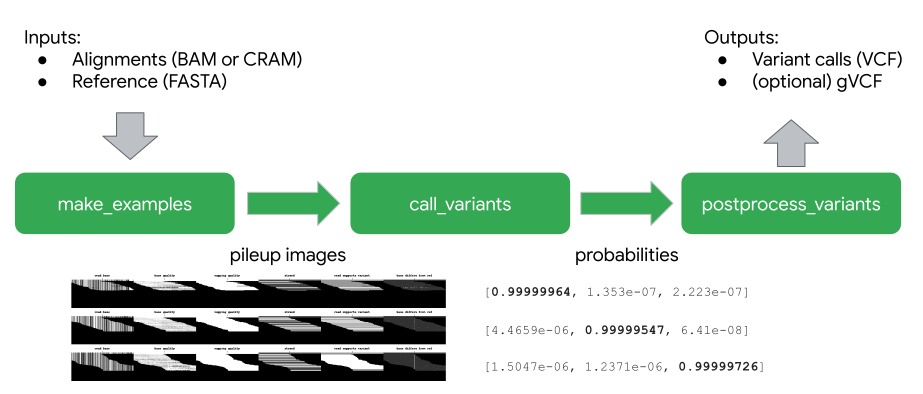
DeepVariant is a germline variant caller for diploid organisms. It ingests aligned sequencing reads in BAM or CRAM format, encodes each candidate site as a pileup image tensor, and runs it through a convolutional neural network. The output is a standard VCF or gVCF file. The tool supports a wide range of sequencing technologies—Illumina, PacBio HiFi, Oxford Nanopore, Complete Genomics, Roche SBX, and RNA-seq—and includes DeepTrio for joint calling on parent-child trios or duos.
The interesting bit The core insight is treating variant calling as computer vision rather than statistical inference: each genomic position becomes an image that the model inspects for patterns. Under the hood it relies on Nucleus, a Google-built library that glues genomics file formats to TensorFlow. Deployment is Docker-first, with optional GPU and TPU acceleration, and Google quotes roughly $2.84 to $11.80 to call a 30x human whole genome on cloud instances depending on preemptible pricing.
Key highlights
- Broad sequencer support: NGS (Illumina/Element), PacBio HiFi, Oxford Nanopore R10.4.1, Complete Genomics, Roche SBX, and both Illumina and PacBio RNA-seq.
DeepTrioextension for trio/duo joint calling, usingGLnexusto merge output VCFs.- All bundled models are trained exclusively on human data; other species require retraining or caution.
- Strictly diploid—only hom-alt, het, and hom-ref genotypes are supported.
- Docker-native with GPU/TPU support; an experimental pipeline can overlap CPU preprocessing with GPU inference.
Caveats
- Every model ships trained on human data, so non-human variant calling is effectively bring-your-own-model.
- Hard-coded diploid ploidy means polyploid or aneuploid organisms are out of scope.
- Unix-like only; Windows is explicitly unsupported.
Verdict
Human genomics pipelines that need germline calling from diverse sequencers should consider this a default option. If you are studying polyploid crops, non-model organisms without retraining budget, or somatic tumor evolution, this is not your tool—point somatic work to the separate DeepSomatic repo instead.
Frequently asked
- What is google/deepvariant?
- It turns aligned DNA reads into pileup images and lets a CNN call germline variants, eliminating the complex filtering typical of traditional pipelines.
- Is deepvariant open source?
- Yes — google/deepvariant is open source, released under the BSD-3-Clause license.
- What language is deepvariant written in?
- google/deepvariant is primarily written in Python.
- How popular is deepvariant?
- google/deepvariant has 3.8k stars on GitHub.
- Where can I find deepvariant?
- google/deepvariant is on GitHub at https://github.com/google/deepvariant.