explosion/spacy-streamlit
spaCy dashboards without the Streamlit boilerplate
Pre-built visualizers for dependency parses, NER, and similarity that drop into any Streamlit app with a single function call.
Not currently ranked — collecting fresh signals.
star history
What it does
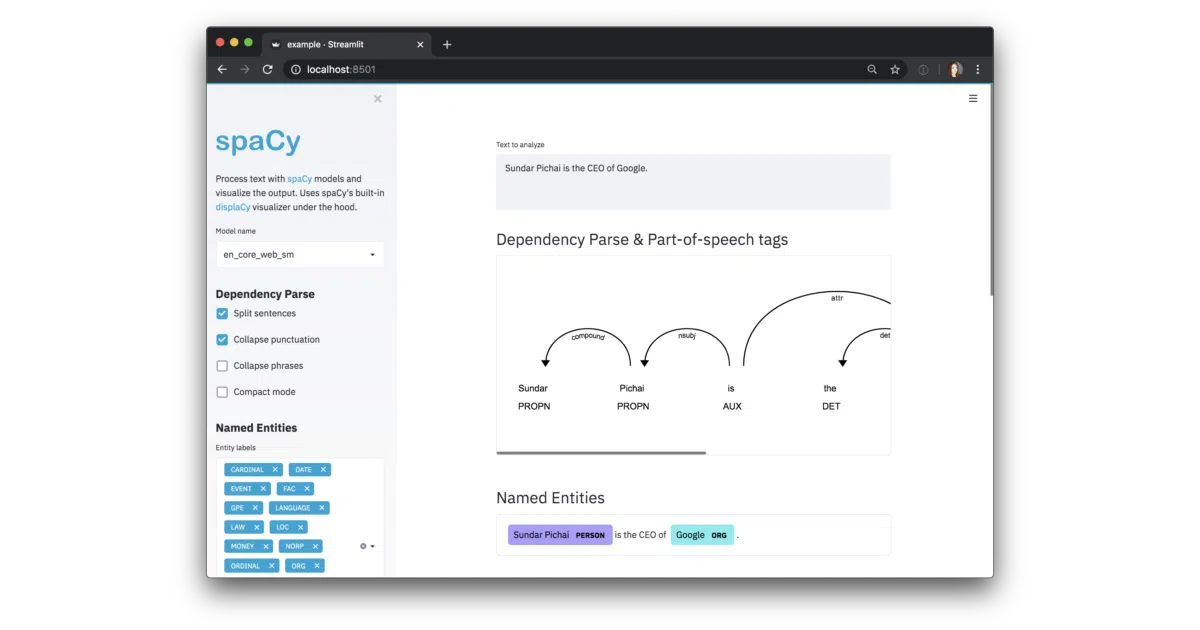
spacy-streamlit wraps spaCy’s displacy visualizers and other NLP outputs into ready-made Streamlit components. You get dropdown model selectors, dependency parse trees, named entity highlights, text classification scores, token attribute tables, and word-vector similarity comparisons—either as a complete bundled UI or à la carte.
The interesting bit
The library is essentially a thin but thoughtful adapter layer: it handles the tedious Streamlit state management (model loading, sidebar config, color theming) so you can call spacy_streamlit.visualize() and have a working demo in four lines of Python. The individual component functions like visualize_ner() or visualize_parser() let you embed just the visualizations you need into larger apps without inheriting the full kitchen sink.
Key highlights
- One-shot full visualizer via
visualize()with model dropdown, text input, and configurable components - Modular functions:
visualize_parser,visualize_ner,visualize_textcat,visualize_similarity,visualize_tokens - Supports multiple spaCy models with automatic sidebar selection and metadata display
- Experimental color theming via hex code injection
- Includes runnable examples for out-of-the-box use and custom integration patterns
Caveats
- The color theming is explicitly marked “experimental” and implemented as a UI “hack”
- Requires spaCy models to be downloaded separately; no model bundling
Verdict
Worth it if you demo spaCy models frequently or need to prototype NLP interfaces fast. Skip if you’re building production analytics dashboards—this is scaffolding, not architecture.
Frequently asked
- What is explosion/spacy-streamlit?
- Pre-built visualizers for dependency parses, NER, and similarity that drop into any Streamlit app with a single function call.
- Is spacy-streamlit open source?
- Yes — explosion/spacy-streamlit is open source, released under the MIT license.
- What language is spacy-streamlit written in?
- explosion/spacy-streamlit is primarily written in Python.
- How popular is spacy-streamlit?
- explosion/spacy-streamlit has 863 stars on GitHub.
- Where can I find spacy-streamlit?
- explosion/spacy-streamlit is on GitHub at https://github.com/explosion/spacy-streamlit.