devnen/Chatterbox-TTS-Server
Resemble’s Chatterbox, Bottled for Self-Hosters
Turns Resemble AI’s open-source Chatterbox TTS family into a self-hosted, OpenAI-compatible speech server with a web UI and broad GPU support.
Not currently ranked — collecting fresh signals.
star history
What it does
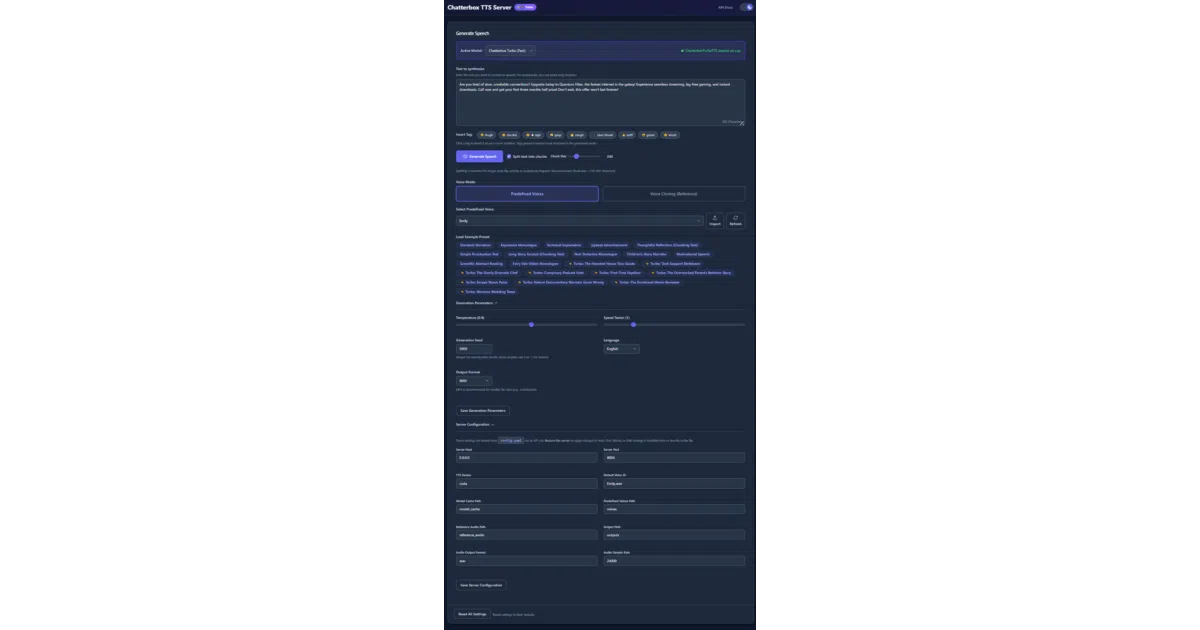
This project is essentially a deployment wrapper around Resemble AI’s open-source Chatterbox text-to-speech family. It exposes the Original, Multilingual, and Turbo models through a FastAPI backend with an OpenAI-compatible /v1/audio/speech endpoint and a built-in web UI, handling hardware abstraction for NVIDIA CUDA, AMD ROCm, Apple MPS, and CPU fallback. It also adds practical conveniences like intelligent text chunking for audiobook-scale inputs, voice cloning, built-in preset voices, and a generation seed for reproducible output.
The interesting bit
The server treats the three very different Chatterbox variants—high-quality English, 23-language multilingual, and the lightweight 350M-parameter Turbo with its [laugh] and [cough] paralinguistic tags—as hot-swappable engines you can flip between from a dropdown without restarting. That, plus an opt-in BF16 inference path and a voice-conditioning cache that skips re-encoding repeat references, suggests the authors are optimizing for the messy reality of self-hosted production rather than just demo-grade inference.
Key highlights
- OpenAI-compatible API endpoints (
/v1/audio/speech,/v1/audio/voices) plus a streaming/ttsendpoint with 20 ms chunk crossfades - Hot-swappable engine selector in the UI for Original, Multilingual, and Turbo models
- 23-language support via the Multilingual engine; Turbo adds native paralinguistic tags like
[chuckle] - Broad hardware support: NVIDIA (CUDA 12.1/12.8/13.0), AMD ROCm (including Strix Halo), Apple Silicon MPS, and CPU
- Windows Portable Mode: self-contained folder with embedded Python 3.10 that runs from a USB stick without a system install
Caveats
- Python 3.10 is strictly required; the README warns that 3.11+ may fail due to missing pre-built wheels for core dependencies
- Portable Mode is Windows-only; macOS and Linux users must manage their own Python 3.10 environment
- The project is explicitly based on the architecture of the authors’ earlier Dia-TTS-Server, so if you already run that stack, the structure will feel familiar
Verdict
Worth a look if you need a local, drop-in replacement for cloud TTS APIs with voice cloning and multilingual output. Skip it if you are looking for a novel model architecture—this is packaging and infrastructure around Resemble’s existing weights.
Frequently asked
- What is devnen/Chatterbox-TTS-Server?
- Turns Resemble AI’s open-source Chatterbox TTS family into a self-hosted, OpenAI-compatible speech server with a web UI and broad GPU support.
- Is Chatterbox-TTS-Server open source?
- Yes — devnen/Chatterbox-TTS-Server is open source, released under the MIT license.
- What language is Chatterbox-TTS-Server written in?
- devnen/Chatterbox-TTS-Server is primarily written in Python.
- How popular is Chatterbox-TTS-Server?
- devnen/Chatterbox-TTS-Server has 1.5k stars on GitHub.
- Where can I find Chatterbox-TTS-Server?
- devnen/Chatterbox-TTS-Server is on GitHub at https://github.com/devnen/Chatterbox-TTS-Server.