declare-lab/TangoFlux
Flow matching meets audio: 30 seconds of sound in 3 seconds
TangoFlux uses flow matching and iterative preference optimization to generate 44.1 kHz stereo audio in seconds rather than minutes.
Not currently ranked — collecting fresh signals.
star history
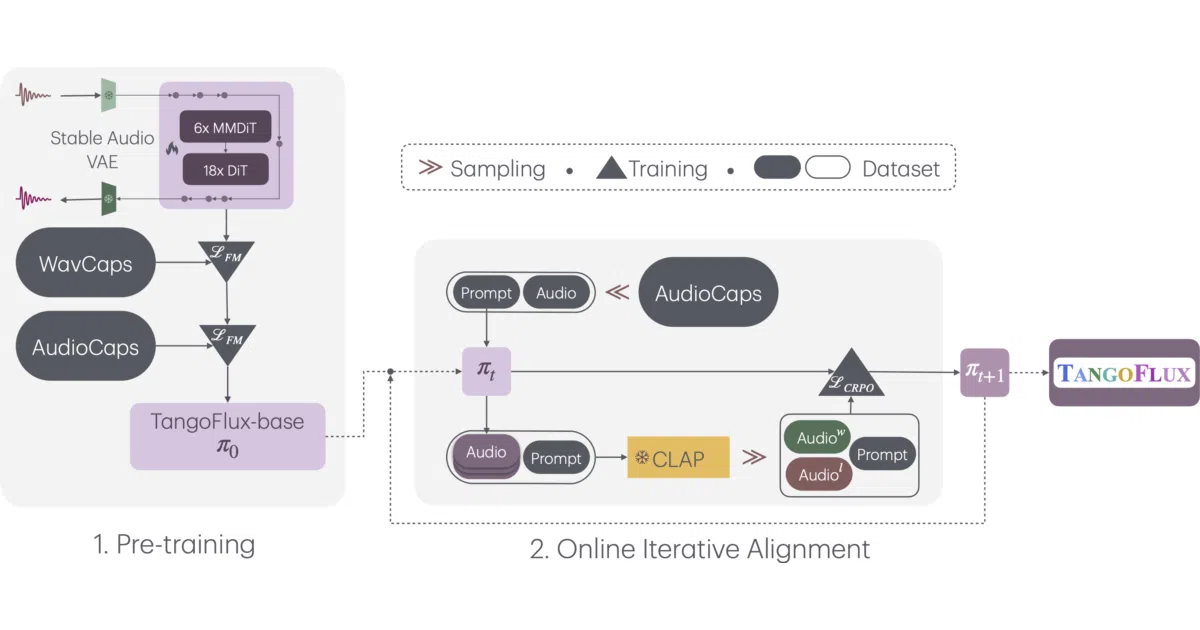
What it does TangoFlux is a 515-million-parameter text-to-audio model built on FluxTransformer blocks. It accepts a text prompt and a duration target, then generates up to 30 seconds of 44.1 kHz stereo audio by learning a rectified flow trajectory through a VAE latent space. The repository includes training scripts, a CRPO dataset generation toolkit, and pre-trained weights.
The interesting bit The model replaces conventional diffusion with flow matching, then sharpens results with CRPO—an iterative pipeline that synthesizes preference pairs and optimizes them with DPO loss designed specifically for flow matching. The README attributes the roughly three-second inference on a single A40 GPU to this architecture.
Key highlights
- Generates 30-second 44.1 kHz stereo audio in ~3 seconds on an A40, per the project’s own benchmarks
- Outperforms AudioLDM 2, Stable Audio Open, and Tango 2 on Fréchet Distance, KL divergence, and CLAP scores while using fewer parameters
- Three-stage training: pre-training, fine-tuning, and preference optimization via the CRPO dataset generation pipeline
- Accepted to ICLR 2026; backed by Stability AI and released under their Community License for research use only
- Integrations include a Hugging Face Space, Colab notebook, and a third-party ComfyUI node
Caveats
- The license stack is restrictive: Stability AI’s Community License limits use to non-commercial research, and WavCaps-derived data carries academic-only obligations
- Benchmarks compare inference times observed on the same A40 GPU; the README does not characterize performance on consumer hardware
Verdict Researchers and hobbyists who need fast text-to-audio generation will find the most value here. Commercial teams should look elsewhere unless they can negotiate a separate Stability AI license.
Frequently asked
- What is declare-lab/TangoFlux?
- TangoFlux uses flow matching and iterative preference optimization to generate 44.1 kHz stereo audio in seconds rather than minutes.
- Is TangoFlux open source?
- Yes — declare-lab/TangoFlux is an open-source project tracked on heatdrop.
- What language is TangoFlux written in?
- declare-lab/TangoFlux is primarily written in Jupyter Notebook.
- How popular is TangoFlux?
- declare-lab/TangoFlux has 884 stars on GitHub.
- Where can I find TangoFlux?
- declare-lab/TangoFlux is on GitHub at https://github.com/declare-lab/TangoFlux.