danielmiessler/Fabric
Treating AI prompts like composable CLI primitives
Fabric exists because AI has an integration problem, so it turns crowdsourced prompts into reusable terminal and API building blocks.
Velocity · 7d
+12
★ / day
Trend
↘cooling
star history
What it does
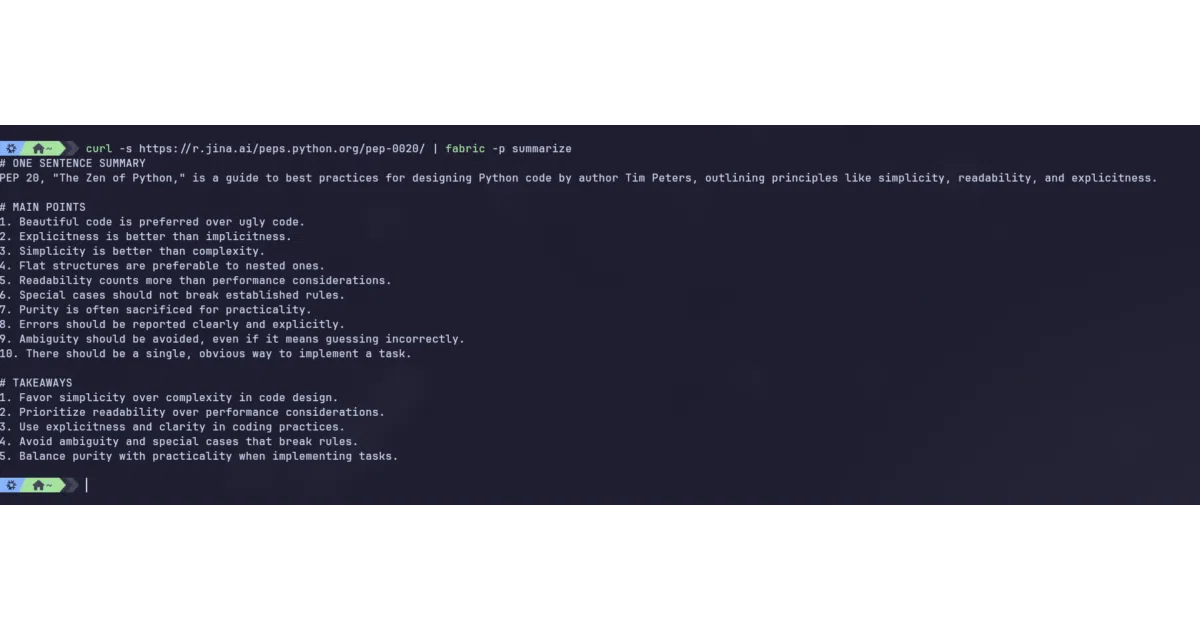
Fabric is a Go-based CLI and API that collects crowdsourced AI prompts—called patterns—and organizes them by real-world task. You pipe in content, pick a pattern, and the tool routes it to your chosen LLM backend, returning results to your terminal or application. It also exposes a REST server with Swagger documentation and an Ollama compatibility mode for local model use.
The interesting bit
Instead of building another chat wrapper, Fabric treats the prompt itself as the atomic unit of automation. The project breaks problems into small, composable patterns—such as the create_conceptmap visual knowledge mapper—and lets you swap backends from Claude Opus to a local Ollama instance without rewriting the prompt.
Key highlights
- Broad backend support: OpenAI, Anthropic, Azure (including Entra ID and AI Gateway), GitHub Models, Venice AI, Digital Ocean GenAI, Microsoft 365 Copilot, and Ollama compatibility mode
- Modular, crowdsourced patterns that can be customized or extended; the community library covers tasks from concept mapping to psychological analysis in the WELLNESS category
- Ships as a Go binary with ARM builds for Linux and Windows, plus a REST API with interactive Swagger docs
- Includes helper utilities like
code2contextandgenerate_changelogfor developer-specific workflows - Full internationalization for setup prompts across 10 languages and shell completions for Zsh, Bash, and Fish
Caveats
- Many community tutorials are outdated: the README explicitly warns that intro videos were recorded when Fabric was still Python-based, so current Go-based behavior and installation steps may differ.
Verdict
Developers who live in the terminal and want a reusable, backend-agnostic prompt library will get the most out of Fabric. If you just want an ad-hoc chat interface, it is probably overkill.
Frequently asked
- What is danielmiessler/Fabric?
- Fabric exists because AI has an integration problem, so it turns crowdsourced prompts into reusable terminal and API building blocks.
- Is Fabric open source?
- Yes — danielmiessler/Fabric is open source, released under the MIT license.
- What language is Fabric written in?
- danielmiessler/Fabric is primarily written in Go.
- How popular is Fabric?
- danielmiessler/Fabric has 44.4k stars on GitHub and is currently cooling off.
- Where can I find Fabric?
- danielmiessler/Fabric is on GitHub at https://github.com/danielmiessler/Fabric.