csinva/csinva.github.io
One researcher's compulsive note-taking habit, open-sourced
A Microsoft Researcher's decade of ML lecture slides, paper summaries, and cheat sheets, living in a Jekyll repo.
Velocity · 7d
+0.2
★ / day
Trend
→steady
star history
What it does This is the source for csinva.io, a personal site hosting Chandan Singh’s accumulated research and teaching materials from his PhD at Berkeley through his current role at Microsoft Research. The repo contains markdown-based slides (built with reveal-md), literature review overviews for active research areas, course notes spanning CS/stats/neuroscience, and occasional blog posts.
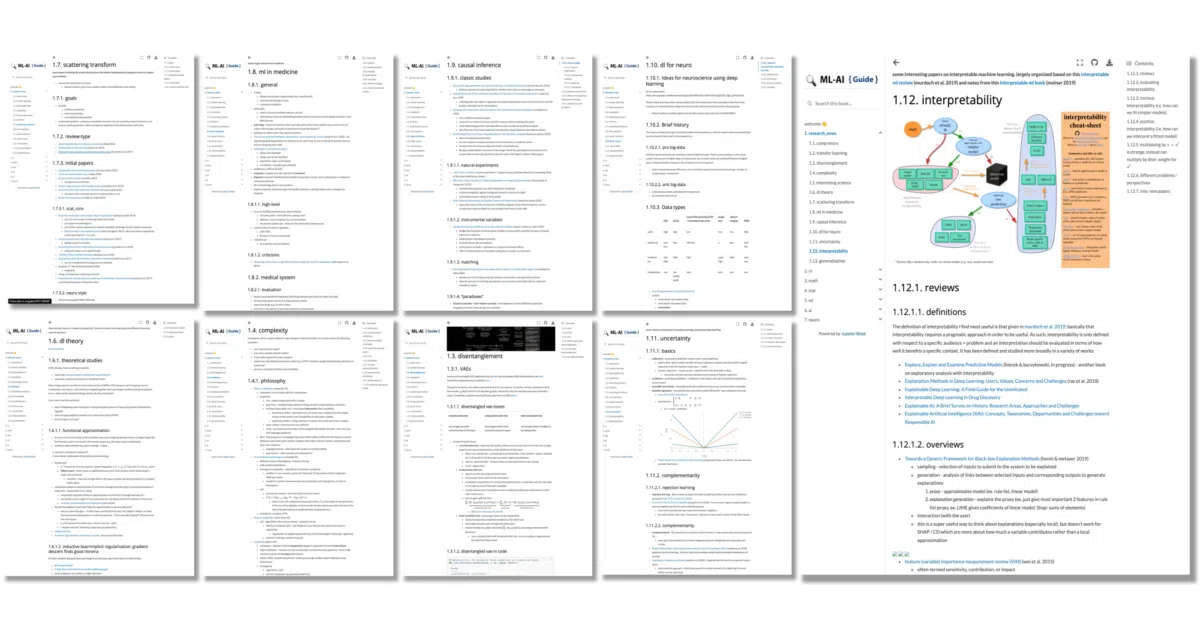
The interesting bit The “research_ovws” folder is the unusual part: living documents that summarize recent papers across eight specialized areas—interpretability, causal inference, transfer learning, uncertainty, DL theory, complexity, scattering transforms, and DL in neuroscience. These aren’t static bibliographies; they’re maintained summaries from someone actively working in the field.
Key highlights
- Berkeley CS 189 (ML) and CS 188 (AI) lecture slide sources, in editable markdown
- Cheat sheets including a visual interpretability reference (SVG)
- Research overviews that track active subfields, not just foundational papers
- Built openly with Jekyll on GitHub Pages; explicitly licensed for reuse
- Companion to the
imodelsinterpretable-ML package (covered separately in Singh’s BAIR blog post)
Caveats
- The notes are described as “rough” and “may serve as useful reference”—not polished textbooks
- Some content links to external Google Slides rather than repo-hosted sources
- Jekyll + reveal-md toolchain requires comfort with static-site generators to adapt
Verdict Worth bookmarking if you’re a grad student or researcher trying to enter interpretability, causal ML, or the intersection of deep learning and neuroscience. Less useful if you need interactive coursework or curated learning paths—this is one person’s working notes, not a designed curriculum.