city96/ComfyUI_ExtraModels
ComfyUI’s lost-and-found for oddball image models
It wires up a grab bag of non-standard diffusion models—DiT, PixArt, HunYuanDiT, Sana, and MiaoBi—into ComfyUI workflows.
Not currently ranked — collecting fresh signals.
star history
What it does
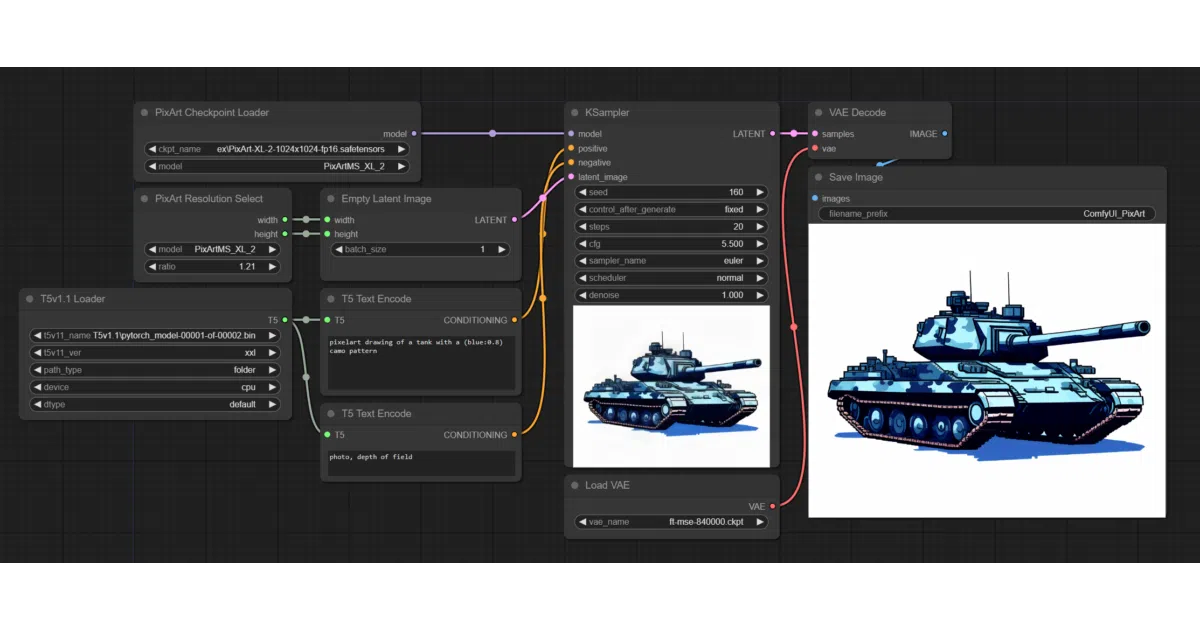
This is a collection of ComfyUI custom nodes that act as adapters for a handful of image generation models not supported by the base install. It provides loaders, text encoders, and latent utilities so you can drop models like PixArt, HunYuanDiT, and DiT into node graphs without writing your own wrappers. Think of it as glue code with a friendly face: it translates each model’s quirks—class labels for DiT, dual text encoders for HunYuanDiT, T5 prompts for PixArt—into ComfyUI’s native node vocabulary.
The interesting bit
The real engineering here is text-encoder logistics. T5 support includes a 4-bit quantization path to bring memory use down from roughly 22 GB to around 6 GB, and HunYuanDiT requires juggling both a CLIP and an mT5 encoder simultaneously. It is unglamorous glue code, but it saves you from hand-managing model configs.
Key highlights
- Supports DiT (class-label conditioning), PixArt (T5-based, including Sigma and LCM variants), HunYuanDiT, MiaoBi, and Sana.
- Handles non-standard text encoders and VAE pairings: T5 for PixArt, Gemma2 for Sana, dual encoders for HunYuanDiT.
- Includes memory-conscious options such as 4-bit T5 loading and CPU offloading for encoders.
- DiT and PixArt reuse standard SD 1.5 or SDXL VAEs, so you don’t need entirely new latent pipelines.
- Sana integration is currently unstable; the README recommends using the official developer fork until a rewrite lands.
Caveats
- Several models need manual weight downloads and specific file renaming; the README reads like a checklist of Hugging Face links and folder paths.
- PixArt’s attention implementation is only partially optimized without
xformers, and some sampler nodes impose batch-size or prompt-length restrictions. - HunYuanDiT support is marked WIP and requires two separate text encoders.
Verdict
Worth a look if you’re already living in ComfyUI and want to experiment with models outside the SD 1.5/SDXL/Llama ecosystem. If you prefer turnkey solutions or are allergic to manual file renaming, this will feel like a chore.
Frequently asked
- What is city96/ComfyUI_ExtraModels?
- It wires up a grab bag of non-standard diffusion models—DiT, PixArt, HunYuanDiT, Sana, and MiaoBi—into ComfyUI workflows.
- Is ComfyUI_ExtraModels open source?
- Yes — city96/ComfyUI_ExtraModels is open source, released under the Apache-2.0 license.
- What language is ComfyUI_ExtraModels written in?
- city96/ComfyUI_ExtraModels is primarily written in Python.
- How popular is ComfyUI_ExtraModels?
- city96/ComfyUI_ExtraModels has 536 stars on GitHub.
- Where can I find ComfyUI_ExtraModels?
- city96/ComfyUI_ExtraModels is on GitHub at https://github.com/city96/ComfyUI_ExtraModels.